
SEO · September 11, 2026
Do citations and directories still matter for local SEO

By Zac Spencer · Owner, Crave Media
The 300-directory pitch
If you've owned a local business for more than a year, someone has emailed you offering to submit it to 300 directories. Maybe 500. The pitch is always the same: citations are a local SEO ranking factor, you're missing hundreds of them, and for a monthly fee they'll fix it.
Local citations still matter for local SEO. That part of the pitch is true. The rest of it is selling you 2012.
A citation is any place your business name, address, and phone number appear online. Your Google Business Profile is one. So is your Yelp page, your listing on Apple Maps, and the chamber of commerce member page nobody has updated since the Obama administration. SEO people shorten name-address-phone to NAP, and the whole game comes down to two things: being listed in the places that count, and having the information match everywhere it appears.
Notice what's not in that sentence: volume. That's the part the 300-directory pitch gets wrong, and it's why this post exists.
Why citations still count
Google's problem with local businesses is trust. Anyone can type a business name and address into a website. Before Google puts you on the map for "plumber near me," it wants your details corroborated by sources it already trusts. When your name, address, and phone number read the same on Google, Apple, Yelp, and a couple of data aggregators, Google can be confident you're a real business at a real address. When they disagree, that confidence drops, and confidence is part of what gets you into the map pack.
So citations work less like votes and more like ID verification. A handful of matching, authoritative documents proves who you are. The 250th matching document proves nothing new, which is why the returns fall off a cliff after the first couple dozen listings.
There's also a newer reason to care, and it has nothing to do with Google. AI assistants now answer "who's a good roofer in Ogden" questions directly, and they lean on directory data to decide which businesses exist and are legitimate. Our sister site wrote up which directories feed AI search results if you want the full list. The short version: the same core listings that corroborate you for Google also make you visible to ChatGPT, and skipping them now costs you in two places instead of one.

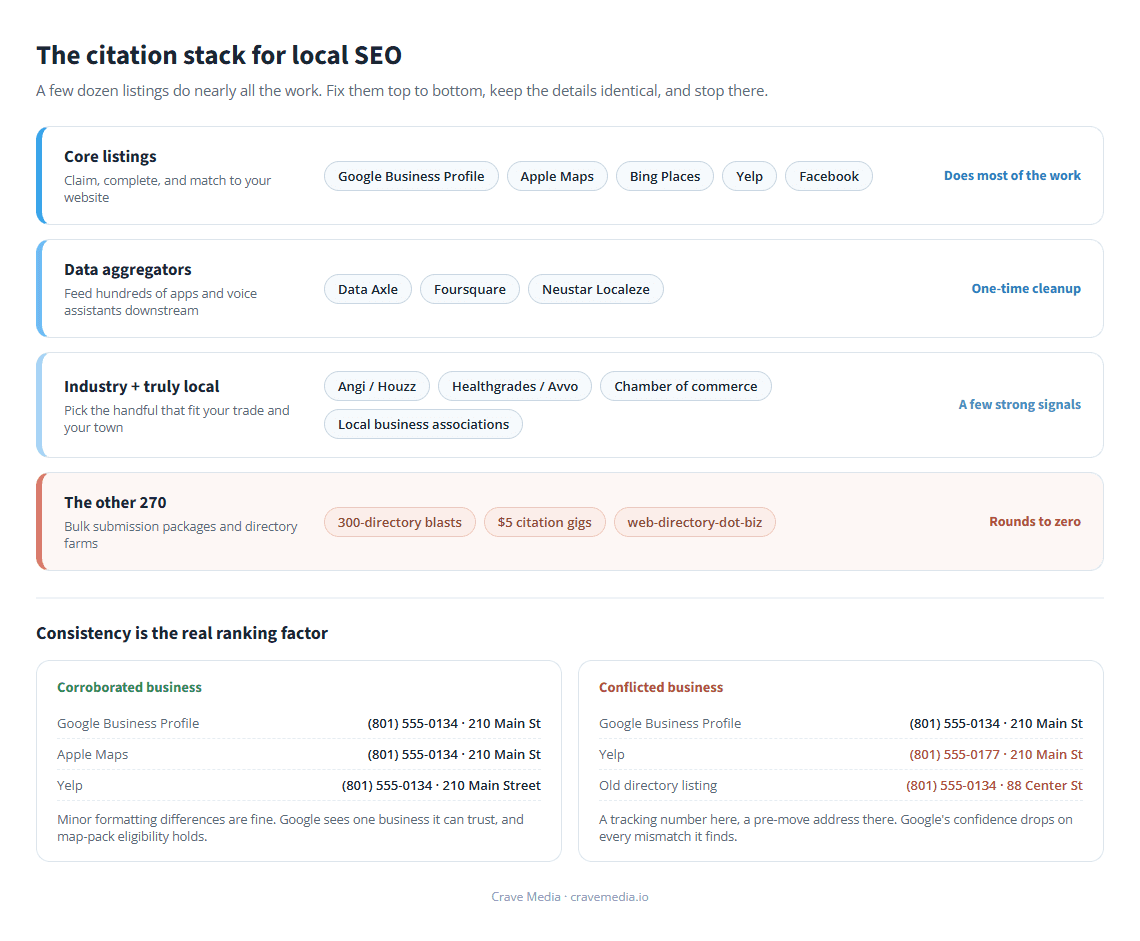
The citation stack: a small set of core listings and aggregators does nearly all the work. The bulk-submission tier below them is where the money gets wasted.
The listings worth having
Start with the four that carry real weight. Your Google Business Profile towers over everything else; if you fix only one listing this year, that's the one. Apple Maps is what every iPhone's built-in navigation and Siri use, and most small businesses have never claimed it. Bing Places feeds Microsoft's ecosystem and Copilot. Yelp matters more than most owners want it to, partly because other platforms and AI models ingest its data.
Behind those sit the data aggregators, companies like Data Axle and Foursquare that exist to supply business data to hundreds of other apps, sites, and voice assistants. Fix your record at the aggregator level and corrections trickle down to places you've never heard of. This is the closest thing to legitimate bulk citation work, and it's a one-time project, not a subscription.
Then there's the layer that depends on what you do and where you are. A remodeler wants Houzz and Angi. A dentist wants Healthgrades. A restaurant wants OpenTable and TripAdvisor. And local sources are quietly strong: your chamber of commerce, a Salt Lake City or Ogden business association, the local news site's business directory. One listing from a real local organization says more about you than fifty from generic directory farms, because it's the kind of source a national spammer can't easily buy.
Everything below that tier, the web-directory-dot-biz stuff that makes up the bulk of a 300-site submission package, rounds to zero. Google has publicly said to ignore link spam from those places, and at worst you've scattered copies of your NAP across sites you'll never be able to edit again.
Consistency is the actual job
Here's the failure mode we see most in audits: a business moved three years ago, and half its listings still show the old address. Or the owner started using a call-tracking number in some listings, so Google sees two different phone numbers and quietly loses confidence in both. That mismatch does more damage than any missing directory ever could.
The good news is Google isn't pedantic about formatting. "Suite 200" versus "#200," or "St" versus "Street," won't hurt you. What hurts is genuinely conflicting data: different phone numbers, an old address, a business name with "| Best Plumber in Utah" stuffed into it on one platform and not the others. Match the real-world details exactly and let the formatting fall where it falls.
One warning from the paid-ads side of our shop: if you use call tracking, keep tracking numbers out of your directory listings. Swap numbers on your website, never on your GBP or citations. Your listed number is part of your identity, and rotating it is self-inflicted NAP damage.
The subscription you can probably cancel
Our honest position: citation building is a project with an end. Claim and correct the core four, push clean data through the aggregators, add the industry and local listings that fit your business, and you're done building. After that it's maintenance, a check twice a year or after anything changes, your address, your phone number, your hours, your name.
If you're paying a monthly fee specifically for "citation building" and it's been running longer than six months, ask what was built last month. There are legitimate reasons for ongoing listing management, mostly for multi-location businesses or franchises where locations open and close. For a single-location plumber, that line item is usually inertia.
The other thing to be honest about: citations are a foundation, not a growth lever. Clean listings stop you from losing map-pack rankings you should have. They will not, by themselves, outrank a competitor with 300 Google reviews and a faster website. We've watched businesses obsess over directory counts while their GBP category was wrong, which is like alphabetizing the spice rack while the kitchen's on fire.
The one-afternoon audit
You can check most of this yourself before paying anyone. Search Google for your exact business name plus your phone number and read the first three pages. Anywhere your details appear wrong, note it. Then pull up your listing on Google, Apple Maps, Bing, and Yelp and compare them side by side against what's on your website's contact page. Fix what you control directly. For stubborn or unclaimable listings, the aggregators are usually the lever.
Budget about three hours. If what you find is a mess, or you'd rather someone else untangle it, citation cleanup is part of every local SEO campaign we run, and the audit that starts one is free. Request yours here and we'll tell you which listings are hurting you and which of the 300 directories you can safely keep ignoring.

About the author
Zac Spencer is an online marketing specialist and the owner of Crave Media, based in Salt Lake City, Utah. Since 2013 he has managed hundreds of Google Ads accounts across dozens of industries — with budgets from a few hundred dollars to $250K a month — and run SEO for local businesses, ecommerce shops, and international franchises.