
Local Service Ads · May 15, 2026
Are Google Local Service Ads worth it for home services

By Zac Spencer · Owner, Crave Media
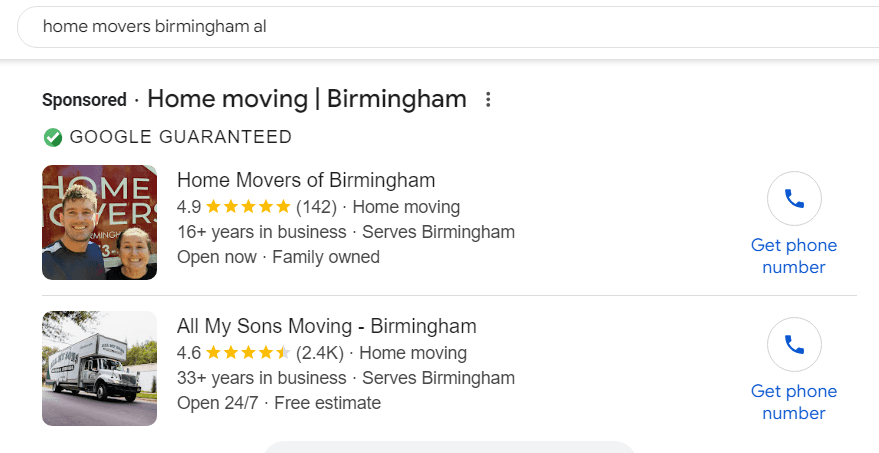
There's a section that sits above everything else on a Google search for home services. Above the regular ads, above the map, right at the top. It shows a few businesses with a green "Google Guaranteed" checkmark, a star rating, and a button to call or request a quote. That's Local Service Ads, and if you run a plumbing, HVAC, electrical, or cleaning business, it's worth understanding before you spend another dollar on marketing.
The pitch is simple. You only pay when a real customer contacts you. No paying for clicks that go nowhere. But "you only pay for leads" hides some details that decide whether this channel makes you money or quietly drains your budget. Let's get into it.
How Local Service Ads are different from regular Google Ads
Regular Google Ads charge you per click. Someone taps your ad, you pay, whether or not they ever call. Local Service Ads flip that. You pay per lead, a phone call or message from someone who found you through the ad. If nobody contacts you, you spend nothing.
The placement is also better. Local Service Ads sit at the very top of the page, above the normal paid ads and the map pack. For a lot of searches they're the first thing a customer sees, and on a phone they can fill most of the screen.
The catch is that you don't fully control which searches you show up for, and you can't write custom ad copy the way you can with regular ads. Google builds the listing from your profile. You give up some control in exchange for a simpler, higher-placed format.
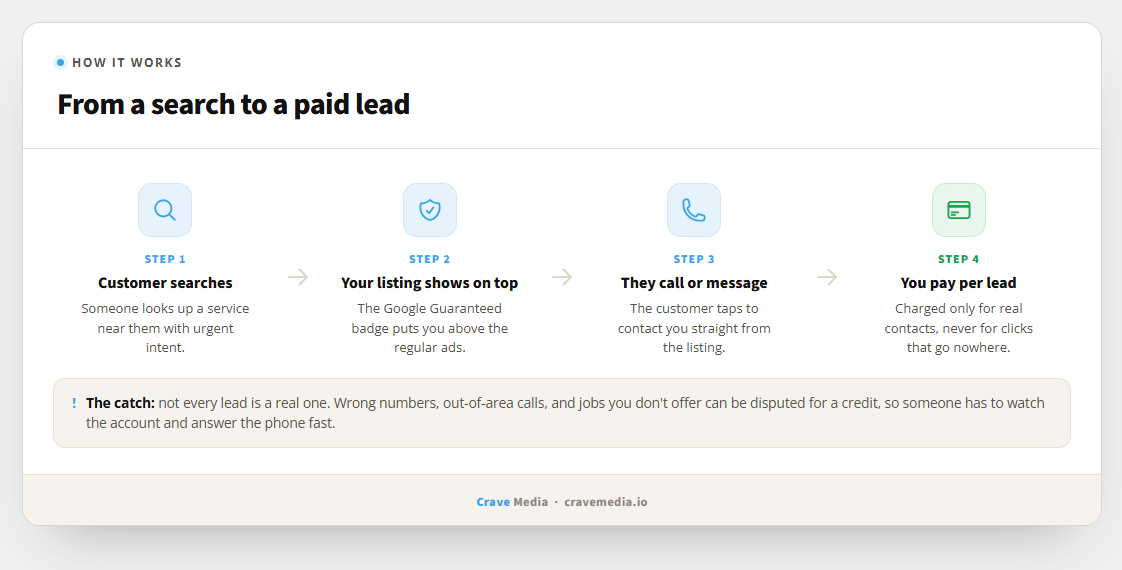
The whole path, from a customer's search to a lead you're charged for. The catch sits at the end: junk leads have to be disputed and the phone has to get answered.
The Google Guaranteed badge is the real draw
To run Local Service Ads, you go through Google's screening. They verify your license and insurance, run background checks on the business and sometimes the technicians, and confirm you are who you say you are. Pass, and you get the green Google Guaranteed checkmark on your listing.
That badge does a lot of quiet work. A homeowner about to let a stranger into their house to fix a furnace is nervous by default. The checkmark tells them Google vetted this company, and Google backs the work up to a coverage limit if something goes wrong. For a customer choosing between you and three other names they've never heard of, that little check tips the scale.
Getting verified takes some paperwork and a week or two of waiting. It's the most annoying part of setup, and it's also the part that makes the channel work, so it's worth pushing through.
What you pay per lead
You're charged per lead, and the cost per lead depends on your trade and your market. A lead for emergency plumbing costs more than a lead for house cleaning, because the job is worth more.
Not every lead is chargeable, which is the part people miss. If someone calls asking for a service you don't offer, or it's a wrong number, or they're outside your service area, you can dispute that lead and Google credits you. They don't catch everything automatically, so disputing junk leads is an ongoing task, not a set-it-and-forget-it thing. Skip it and you'll pay for calls you never should have.
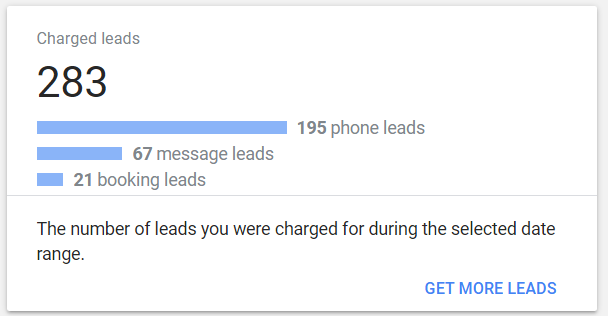
A real Local Service Ads account with hundreds of charged leads coming in. Managed well, this is one of the cleaner sources of new customers a home service business can get.
What decides where you rank
Among the businesses eligible to show, Google picks the order based on a few things. Your review score and review count weigh heavily, same as the map pack. How fast and how often you answer calls matters. Google tracks your responsiveness, and a business that lets calls ring out gets shown less. Your proximity to the searcher plays in too.
So the businesses winning at Local Service Ads are usually the ones with strong reviews who answer the phone fast. If calls go to voicemail during the day, fix that before you turn the ads on. You'll pay for leads you can't catch otherwise.
When it makes sense, and when it doesn't
Local Service Ads work best for businesses where a single job is worth real money and the customer is ready to hire now. Plumbing, HVAC, electrical, roofing, garage doors, cleaning. Anything with urgent demand and a decent ticket. If a typical job is worth a few hundred dollars or more, paying per lead pencils out as long as you close a reasonable share of them.
It's a worse fit if your margins are thin, your average job is small, or you can't answer the phone consistently. The math only works if you turn enough leads into paying customers. A business that closes one in ten calls is going to struggle no matter how cheap the leads look.
It also doesn't replace the rest of your marketing. Local Service Ads bring leads today, but the moment you pause them, they stop. Pair them with local SEO so you're also building rankings that keep producing for free, and you're not entirely dependent on a channel you rent.
Worth it, with a caveat
For most home service businesses in a market like Salt Lake City or Ogden, yes, Local Service Ads are worth running. The placement is the best on the page, the badge builds trust you can't buy any other way, and pay-per-lead keeps the risk lower than per-click ads.
The caveat is that "set it up and walk away" is how you waste money on it. Somebody needs to dispute the junk leads, keep response times tight, and watch which lead types actually convert so the budget goes to the right work.
That ongoing management is the part we handle for clients. If you want to know whether Local Service Ads would pay off for your business specifically, reach out for a free audit and we'll run the numbers with you before you spend anything.

About the author
Zac Spencer is an online marketing specialist and the owner of Crave Media, based in Salt Lake City, Utah. Since 2013 he has managed hundreds of Google Ads accounts across dozens of industries — with budgets from a few hundred dollars to $250K a month — and run SEO for local businesses, ecommerce shops, and international franchises.