
Websites · May 22, 2026
Why a slow website is costing you customers

By Zac Spencer · Owner, Crave Media
A slow website doesn't announce itself. Nobody calls to tell you they gave up waiting for your page to load and called a competitor instead. The lead just never happens, and you never know it was there. That's what makes site speed such an easy problem to ignore. The cost is invisible until you go looking for it.
But it's real, and it's bigger than most business owners think. A site that takes five or six seconds to load is bleeding customers every day, especially on phones. Let's talk about why that happens and what a fast site does for you.
People leave faster than you'd guess
Google has studied this for years, and the pattern is consistent. As a page's load time climbs from one second to three, the share of people who give up and leave jumps sharply. Push it to five or six seconds and you've lost a large chunk of your visitors before they've seen a word.
Think about your own habits. When you tap a link and stare at a blank white screen, how long do you wait? Two seconds? Three? Then you hit back and try the next result. Your customers do the exact same thing to you, and a slow website hands them a reason to leave before you've had a chance to win them over.
The frustrating part is that these are people who already found you. They searched, they clicked, they wanted what you offer. Losing a stranger who was never going to buy is one thing. Losing someone who was actively trying to give you money because your page hung for four seconds is a different kind of waste.
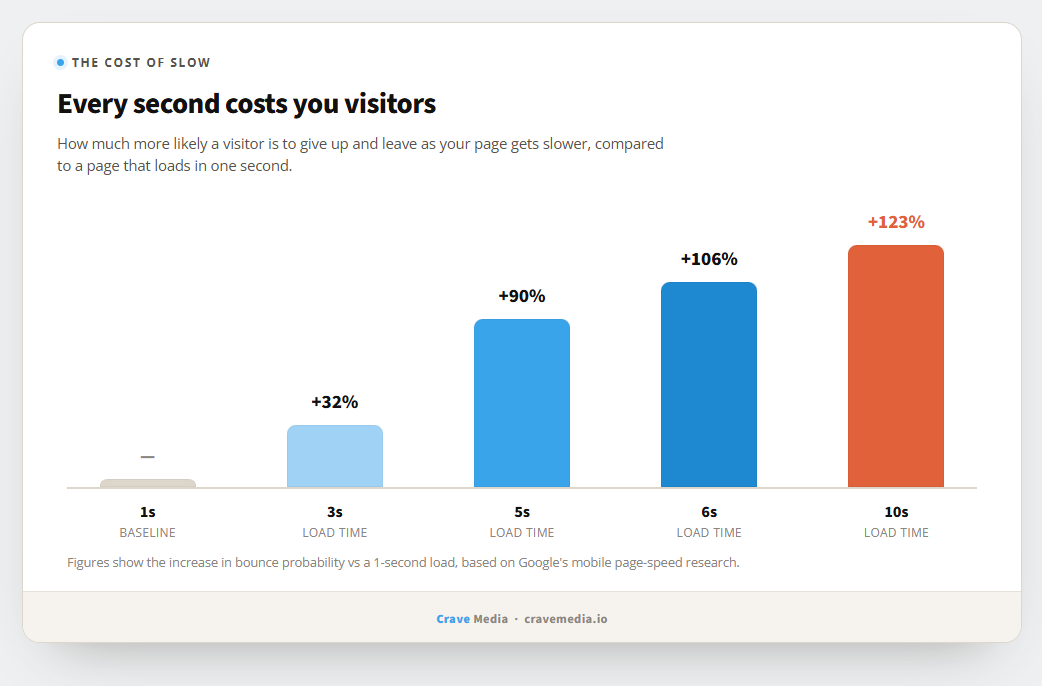
The drop-off isn't gentle. By the time a page takes five seconds, a visitor is roughly twice as likely to give up as they'd be at one second.
Speed and conversions are tied together
Site speed does more than keep people from bouncing. It shapes how everyone who stays behaves too.
A fast site feels trustworthy. Pages snap from one to the next, the contact form submits instantly, nothing stutters. That smoothness tells visitors, without saying it, that you run a competent operation. A sluggish, janky site plants the opposite seed of doubt right when someone's deciding whether to trust you with their home or their money.
It shows up in the numbers. When we rebuild a slow site as a fast one, the same traffic starts producing more calls and form fills, because fewer people drop off at each step between landing and contacting. You didn't get more visitors. You stopped losing the ones you already had.
Google is watching the clock too
Speed doesn't only affect the people on your site. It affects how many people Google sends there in the first place.
Page speed is one of Google's ranking signals. It measures real-world loading performance through what it calls Core Web Vitals: how fast the main content appears, how quickly the page responds when someone taps, and whether things jump around as it loads. Sites that score well get a nudge up. Sites that score badly get held back.
So a slow website costs you twice. It loses customers who do make it to your page, and it caps how high you can rank, which means fewer customers find the page at all. Speed work is some of the highest-leverage SEO you can do, because it helps both problems at once.
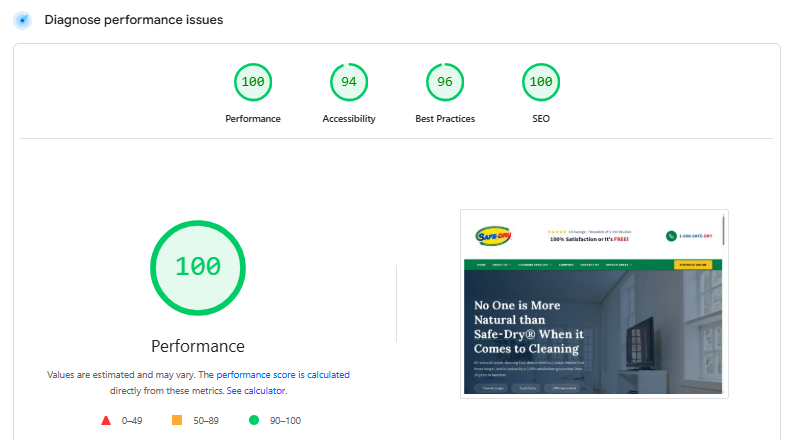
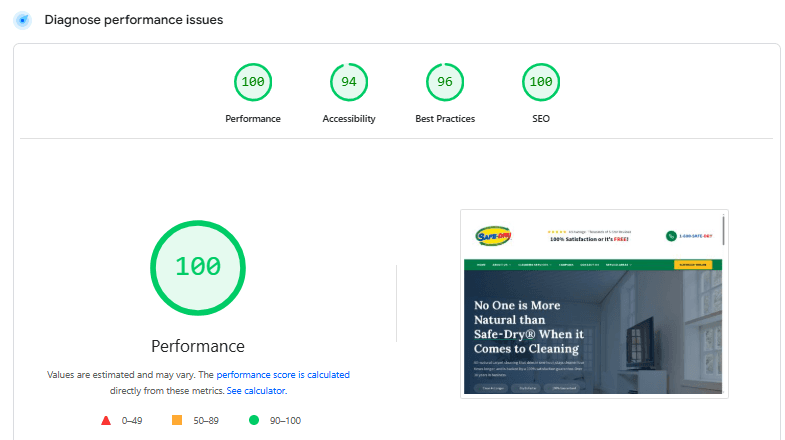
PageSpeed scores from a site we built. Green across the board isn't bragging. It's what lets the marketing behind it convert.
Why so many small business sites are slow
Most slow sites got that way for understandable reasons. A lot of them run on bloated page-builder templates that load a dozen scripts and fonts the business never uses. Stock photos get uploaded straight from the camera at full resolution, so a single hero image weighs several megabytes. Plugins pile up over the years, each one adding a little more weight.
None of it is the owner's fault. The tools that promise "build your own site in an afternoon" optimize for being easy to build, not fast to load. The speed cost shows up later, quietly, in the form of leads that never arrive.
The fix isn't always a full rebuild, but it's usually more than swapping a photo. Oversized images need compressing, unused scripts need removing, and the whole thing needs to be built on a foundation made for speed rather than patched on top of a slow one.
What a fast site is built on
When we build a website for a client, speed isn't a feature we add at the end. It's baked into how the thing is constructed.
We build on modern frameworks that ship lean code instead of dragging around a heavy template. Images get sized and compressed properly and load only when they're needed. The site serves from fast hosting close to your customers. The result loads in about a second on a phone, which is the difference between a visitor who sticks around and one who's already gone.
That speed makes everything else you spend on marketing work harder. Your Google Ads send people to a page that loads before they lose patience. Your SEO traffic finds a site that converts. Your Local Service Ads leads land somewhere that looks as professional as the badge that sent them.
A fast website doesn't get you customers by itself. It stops you from losing the ones your other marketing already earned. If yours feels slow, that's leads slipping away you can't see. Get a free audit and we'll show you exactly how it's performing and what's dragging it down.

About the author
Zac Spencer is an online marketing specialist and the owner of Crave Media, based in Salt Lake City, Utah. Since 2013 he has managed hundreds of Google Ads accounts across dozens of industries — with budgets from a few hundred dollars to $250K a month — and run SEO for local businesses, ecommerce shops, and international franchises.