
Websites · July 24, 2026
Do you need a new website or just a redesign

By Zac Spencer · Owner, Crave Media
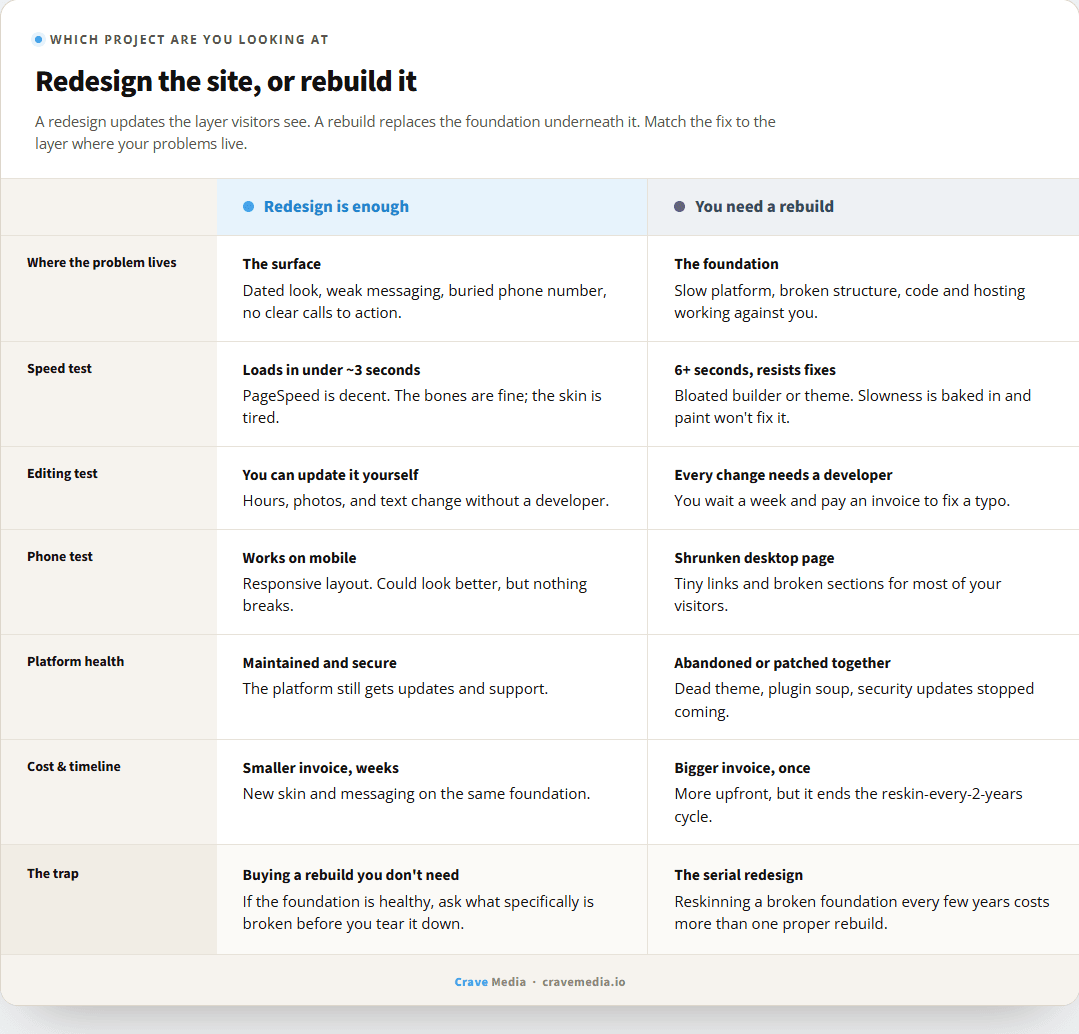
Every few years, a business owner looks at their website and winces. Maybe a customer mentioned it looks dated. Maybe you saw a competitor's new site and felt a pang. Either way, you're now staring at a question with a real price tag attached: does this need a website redesign, or does the whole thing need to be torn down and rebuilt?
The two projects sound similar. They are not. A redesign keeps the foundation and updates what sits on top of it. A rebuild replaces the foundation itself. Getting this call wrong in either direction costs you, because a redesign on a rotten foundation is money down the drain, and a full rebuild of a site that only needed a facelift is paying for a kitchen remodel when you wanted new cabinet doors.
After enough of these projects, the pattern gets predictable. The answer is usually sitting in plain sight once you know what to look for.
What a redesign can fix
A redesign works with what you have. Same platform, same underlying structure, new skin and better thinking. It's the right call more often than web companies like to admit, because rebuilds are the bigger invoice.
A redesign handles the visible problems. Dated design that makes a good business look like it stopped trying in 2018. A homepage that talks about "quality and integrity" but never says what you do or where you do it. Buttons nobody clicks because they say "Submit" instead of "Get a free quote." Photos that came with the template. A layout that buries your phone number and hides your reviews.
Those problems are cosmetic in the literal sense: they live in the layer visitors see. And they matter. We wrote about what a high-converting local business website looks like, and most of that anatomy, from the headline to the proof to the calls to action, can be fixed in a redesign without touching the foundation.
If your site loads reasonably fast, works on a phone, and runs on a platform that's still maintained, a redesign probably gets you where you want to go for a fraction of the cost.
When only a rebuild will do
Some sites can't be saved by new paint, and the tell is almost always underneath the surface.
Speed is the big one. If your pages take six seconds to load and the last "optimization" round barely moved the number, the slowness is usually baked into the foundation: a bloated page builder stacked on a decade of plugins, or hosting that was cheap for a reason. You can't design your way out of that. We covered what a slow website costs you in customers, and that cost doesn't care how nice the new buttons look.
The editability test is nearly as reliable. If changing your hours or adding a photo means calling a developer and waiting for an invoice, the platform is working against you and every future marketing effort inherits that friction.
A few more signs point the same direction. The site isn't responsive, so phone visitors get a shrunken desktop page with tiny links (more than half your traffic, treated worst). The platform or theme is abandoned, so security updates stopped coming. Or the site's structure is such a mess that Google can't make sense of it, with no real page per service and one long homepage trying to rank for everything.
Any one of these might be tolerable alone. Stack two or three and you're renovating a condemned building.
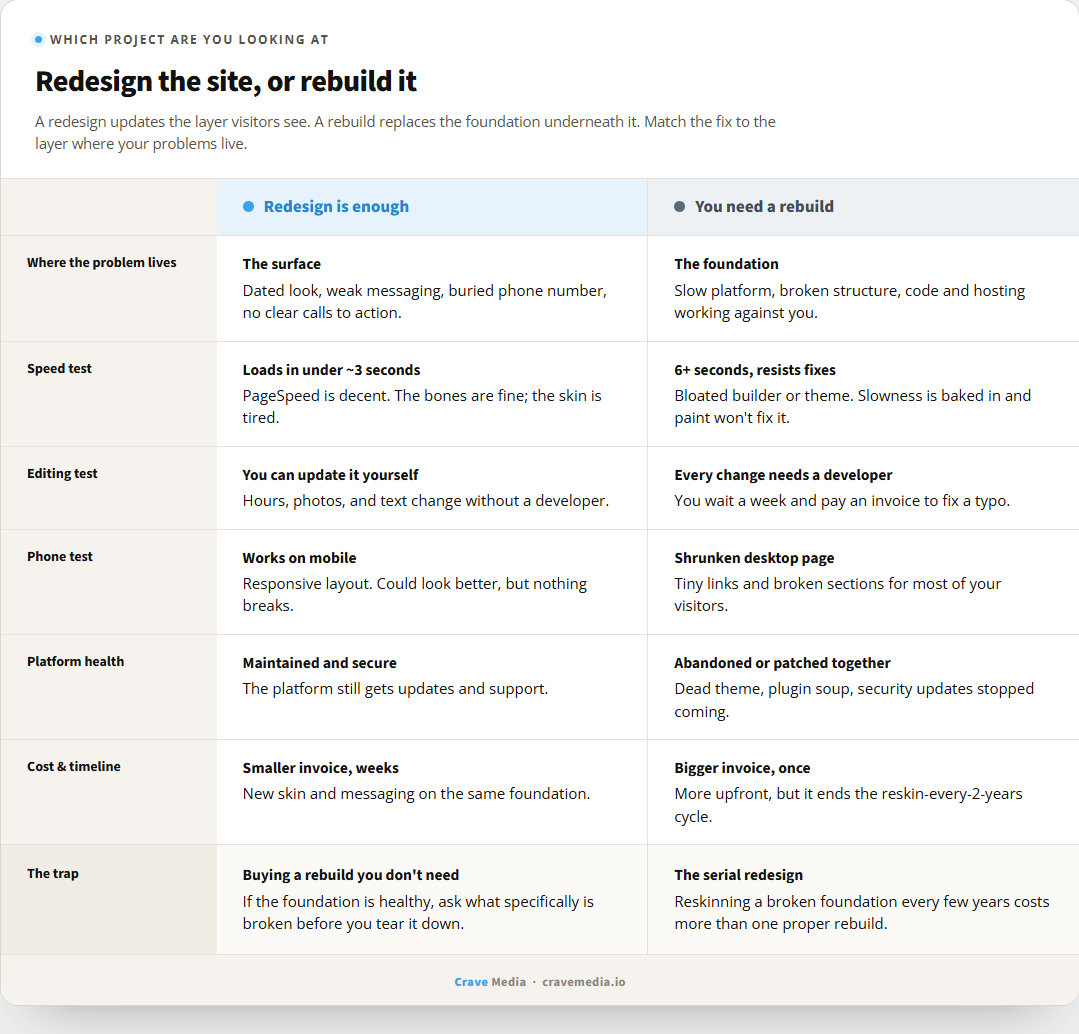
Redesign problems live in the layer visitors see. Rebuild problems live in the foundation. The fix has to match the layer the problem lives in.
The trap between the two
The most expensive path is the serial redesign: paying to reskin a broken foundation every two or three years because each refresh feels cheaper than a rebuild. Picking the wrong project once stings less than picking it three times in a row.
The math catches up fast. Two redesigns plus the ongoing developer-dependence tax plus the leads a slow site quietly drops often add up to more than one proper rebuild would have cost, and at the end of it you still own the same broken foundation. In our experience, owners who've been through this cycle twice are the quickest to see it, because they've watched the "affordable" option get expensive.
The reverse trap exists too, though it's rarer. A web company quotes a full rebuild for a site that needed a messaging pass and a speed cleanup, because rebuilds are what they sell. If your site is structurally healthy and someone leads with "burn it down," ask them to point at the specific foundation problem first.
How to check your own site in an afternoon
You can get most of the way to the answer without hiring anyone.
Run your site through Google's PageSpeed Insights and check the load time on your own phone, on cellular, not office Wi-Fi. We walked through how fast a site should load and how to test it if you want the full method. Under three seconds and the foundation is probably fine. Six or more and no amount of design will fix what visitors feel.
Then try to edit something yourself. Change a word on your homepage. If you can't figure out how, or you literally don't have a login that allows it, note that.
Last, look at the site on your phone and tap through it like a customer would. Can you find what the business does, where it works, and how to call, all within about ten seconds? Is any of it broken or comically small?
Fast, editable, works on phones, but looks tired and doesn't convert: redesign. Slow, locked down, or falling apart on mobile: stop putting new paint on it.
What this looks like when we do it
When a business brings us their site, the audit comes before any recommendation. Sometimes we come back with "keep the platform, fix the messaging and the top three pages." Sometimes the honest answer is that the foundation is the problem, and we explain exactly why, in the terms above, so you're not taking our word for it.
When a rebuild is the right call, our site building service starts from what converts: speed, clear service pages, and calls to action that match how local customers buy. A new foundation is only worth it if the thing built on top of it produces leads.
If you're staring at your own site trying to make this call, send it over for a free audit. We'll tell you which project you're looking at, and if the answer is the cheaper one, we'll tell you that too.

About the author
Zac Spencer is an online marketing specialist and the owner of Crave Media, based in Salt Lake City, Utah. Since 2013 he has managed hundreds of Google Ads accounts across dozens of industries — with budgets from a few hundred dollars to $250K a month — and run SEO for local businesses, ecommerce shops, and international franchises.