
SEO · June 2, 2026
How to set up a Google Business Profile that ranks

By Zac Spencer · Owner, Crave Media
Your Google Business Profile is the single biggest lever a local business has on Google, and most are running it at half power. It's free, it takes an afternoon to set up right, and it decides whether you land in that little map with three businesses when someone searches for what you do. Google Business Profile optimization is the work of filling it out completely, keeping it active, and giving Google enough reason to trust you over the shop down the street.
We've managed local search for Utah businesses for a decade, and the same pattern shows up over and over. A business pours money into ads while its free profile sits half-finished, filed under the wrong category, and last touched in 2021. Cleaning that up is usually the highest-return hour of work on the table. So let's go through how to set a profile up so it ranks, and how to keep it there.
Why the profile decides whether you show up
When someone searches "electrician near me," Google shows a map with three businesses pinned to it before the regular blue links even start. That box is the map pack, and it gets the bulk of the calls. Your Google Business Profile is what feeds it. No profile, or a weak one, and you're not in the running for those three spots.
Google decides who lands there based on how close you are to the searcher, how relevant your business looks for what they typed, and how trusted you appear. You can't do much about distance. The profile is where you control the other two. If you want the deeper version of how local ranking works, we wrote a full guide to ranking in the Salt Lake City map pack, but the profile is where it all starts.
Start with the right category
Your primary category is the strongest relevance signal on the whole profile, and people get it wrong all the time. Pick the most specific one that fits. "Electrician" is fine, but if you mostly do panel upgrades and EV chargers, there may be a tighter category that puts you in front of exactly the right searches. "Carpet cleaning service" beats the generic "cleaning service" every time.
Then add secondary categories for the other things you do, but don't pad the list with categories that only sort of apply. A roofer who adds "general contractor" because it sounds bigger ends up competing in a category they can't win and muddying what Google thinks they do. Primary category should match your bread and butter. Secondaries should be real services, not aspirations.
Fill in every field Google gives you
Google rewards complete profiles, partly because a finished profile signals an active, real business. Most owners fill in the name and phone and stop. Go further than that.
Get your hours right, including holiday and special hours, because a profile showing "open" when you're closed frustrates customers and a profile that's always vague tells Google you're not paying attention. Set your service area or address depending on whether customers come to you. Write a real business description that explains what you do and where, working your main services in like a human would, not a keyword list. Add your opening date, your booking or quote link, and the attributes Google offers for your industry. Each field you complete is one more thing Google can match a search against.
Add your services and products
The services section is quietly one of the most useful parts of the profile. Every service you list is a relevance signal, a chance to match a search Google might not otherwise connect to you. A plumber who lists water heater repair, drain cleaning, repiping, and sump pump installation as separate services gives Google far more to work with than one who just says "plumbing."
If your work is visual, use the products section too. A landscaper or a remodeler showing real project photos with short descriptions gives both Google and the customer a reason to stop scrolling. It's free shelf space, and most competitors leave it empty.
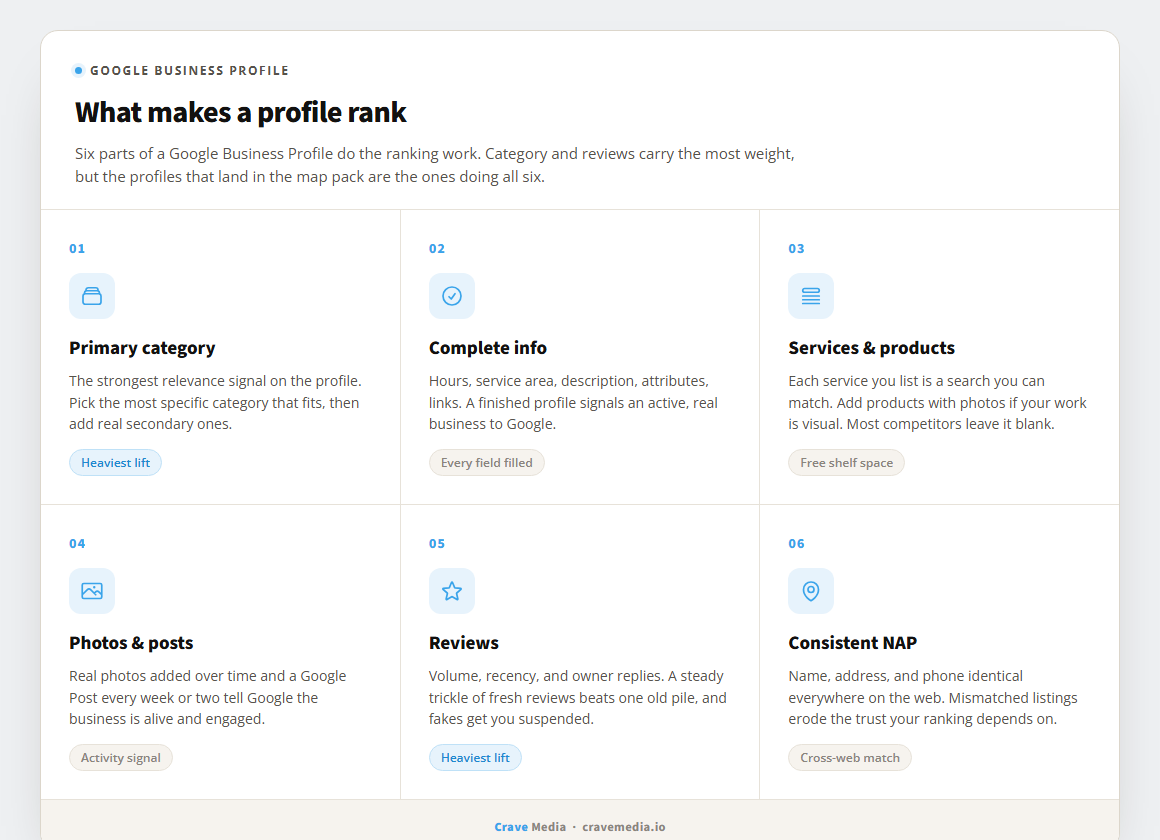
The levers that move a profile into the map pack. Category and reviews do the heaviest lifting, but the profiles that rank are the ones doing all six.
Photos and posts keep it looking active
Profiles that look alive rank better than ones frozen in time. Add real photos of your trucks, your team, and your finished work, and add new ones now and then instead of dumping a batch once and forgetting it. Stock photos and logos do nothing here. Customers can tell, and so can Google.
Google Posts are the other half. They're short updates, like a promotion, a recent job, or a seasonal reminder, that show up on your profile. Posting every week or two is a small, steady signal that the business is running and engaged. It takes ten minutes and almost nobody bothers, which is exactly why it's worth doing.
Reviews are your prominence engine
If we had to name the one thing that separates the businesses in the map pack from the ones just below it, it's reviews. Not only the star rating. The number of reviews, how fresh they are, and whether the owner replies.
A business with 140 reviews and a 4.8 average reads as a safer bet than one with 11 perfect reviews, and Google treats it that way. The move is to ask every happy customer, every time, and make it effortless by texting them the direct link. Aim for a steady trickle rather than begging 30 people at once in March, because a constant flow of recent reviews signals an active business far better than one old pile. Reply to them too, the good and the bad, because that's a signal on its own.
Never buy reviews or have friends post fake ones. Google is good at catching it, and a suspension erases months of progress in a day.
Keep your name, address, and phone consistent
Google cross-references your profile against the rest of the web. When your name, address, and phone number match exactly everywhere they appear, from your website to Yelp to old directory listings, Google trusts the data. When your address shows up three slightly different ways across the internet, that trust erodes and your ranking suffers.
Pick one exact format and use it everywhere. This unglamorous cleanup, fixing inconsistent listings across the directories Google checks, is one of the highest-impact things we do when we take on a new local client, and it's the part most people skip because it's tedious.
Mistakes that get you buried or suspended
A few common moves do real damage. Stuffing keywords into your business name, like "Joe's Plumbing Salt Lake City Best Emergency Plumber," is against Google's rules and can get you suspended even though plenty of businesses still try it. Using a fake address or a virtual office to appear in a city you're not really in is another one Google has gotten aggressive about. Running duplicate listings for the same location splits your reviews and confuses ranking. And letting your info go stale, with old hours or a disconnected number, quietly tells Google the business may be gone.
None of these are worth the risk. The profiles that rank and stay ranked are the honest, complete, well-maintained ones.
How long until it ranks
Now the honest part most agencies skip. If your profile was a mess and you clean it up, you can see movement in the map pack within a few weeks. But durable ranking gains usually take three to six months, and the more competitive your city, the longer it runs.
The payoff is that it holds. Ads stop the day you stop paying for them. A profile you've built up keeps bringing in calls without a per-click cost. One of our clients went from barely registering to 3.41 million search impressions and 64,800 clicks over six months, mostly off the back of local search done right. That kind of visibility builds slowly, then sticks.
What we'd do for you
When we take on local SEO for a Utah business, the first month is mostly profile cleanup and groundwork. We audit your Google Business Profile, fix what's wrong or missing, pick the categories that match how people search for you, and make your name, address, and phone consistent across the web. From there it's the steady work of reviews, photos, posts, and the service and location content that backs the profile up.
If you run a business in Salt Lake City or Ogden and you're not in that map pack, those are calls going straight to your competitors. Get a free audit and we'll show you exactly where your profile stands and what it would take to climb.

About the author
Zac Spencer is an online marketing specialist and the owner of Crave Media, based in Salt Lake City, Utah. Since 2013 he has managed hundreds of Google Ads accounts across dozens of industries — with budgets from a few hundred dollars to $250K a month — and run SEO for local businesses, ecommerce shops, and international franchises.