
SEO · June 9, 2026
How to get more Google reviews without breaking the rules

By Zac Spencer · Owner, Crave Media
Ask any local business owner what they want more of and reviews are near the top of the list, right behind calls. They know a wall of recent five-star reviews wins the click, and they know the competitor with 200 reviews is eating their lunch. What trips people up is how to get more Google reviews without crossing a line that gets the whole profile penalized. The shortcuts that fill a review count fast are usually the ones Google bans.
The good news is that the safe way is also the way that actually works long-term. You don't need a clever trick. You need a habit, a short link, and the discipline to skip the moves that feel efficient but blow up in your face. We've run local search for Utah businesses for years, and the review playbook below is the same one we set up for every client.
Why Google reviews move your ranking
Google ranks local businesses on three things: how close you are to the searcher, how relevant you look, and how prominent you are. Reviews are the heart of that last one. They're the clearest public signal that real people use your business and trust it.
It's not only the star rating, either. Google weighs how many reviews you have, how recent they are, and whether you respond to them. A shop with 150 reviews and a 4.7 average that picked up six reviews last month looks alive and trusted. One with 14 reviews, even perfect ones, and nothing since 2023 looks like a business that might not answer the phone. Reviews feed both the ranking and the decision a customer makes once they find you, which is why they're worth getting right. They're also one of the bigger levers in local SEO that you fully control.
Just ask, every single time
The least exciting reason most businesses don't have many reviews: nobody asks. The work gets done, the customer is happy, everyone moves on, and the review that would have happened never does. People don't leave reviews on their own unless they're angry. The happy ones need a nudge.
So build the ask into the job. The tech mentions it before leaving. The office follows up with a message. Whatever fits how you work, the point is that it happens on every job, not when someone remembers in a slow week. A business that asks ten customers a week ends up with 500 review opportunities a year. Most of those people won't follow through, but enough will that you'll pull away from competitors who never ask at all.
The one rule: ask everyone, not just the people you think will say something nice. Cherry-picking who gets the request is a problem, and we'll get to why in a minute.
Make it one tap
The gap between a customer wanting to leave a review and actually doing it is friction. Every extra step loses people. "Search for us on Google and scroll down to reviews" loses almost everyone. A direct link that opens the review box loses almost no one.
Google gives every business a short review link in the Business Profile dashboard. Drop that link into a text message you send right after the job, and the customer taps once and types. Texting beats email by a wide margin here because people open texts and the link is right there on the phone they'd write the review from anyway.
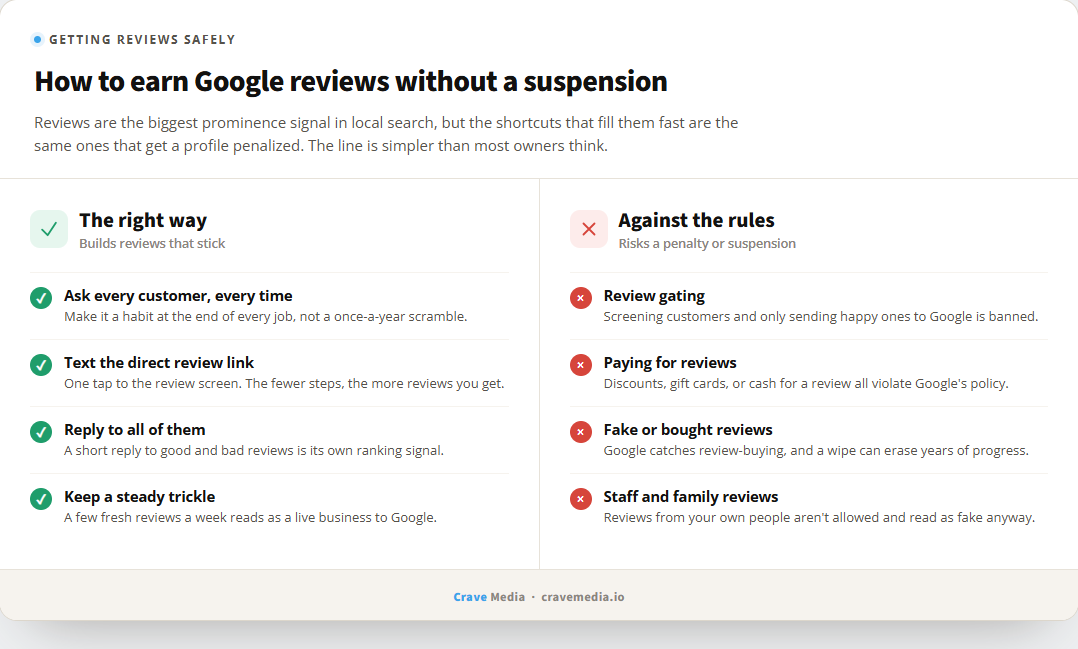
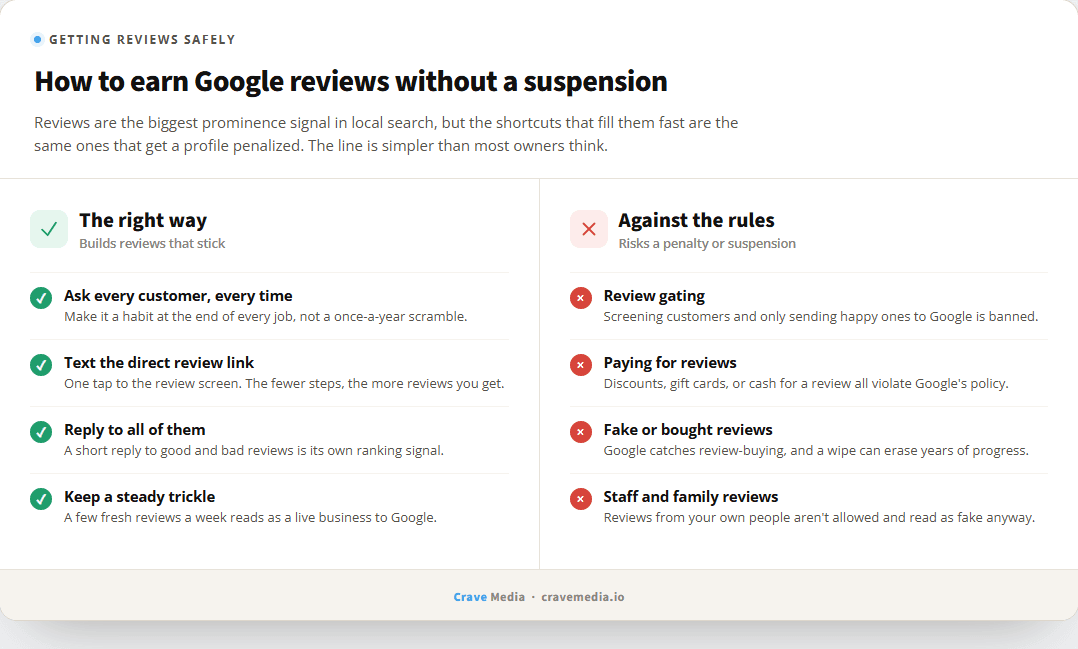
The whole game in one picture: the habits on the left build reviews that hold up, and the shortcuts on the right are what get a profile penalized.
Time the ask while it's fresh
When you ask matters almost as much as whether you ask. The window is right after you've delivered something the customer is happy about. The AC is blowing cold again, the clean carpet looks new, the leak is fixed. That's when the goodwill is highest and the experience is sharp in their memory.
Wait three weeks and two things happen: they've forgotten the details that make a review specific and useful, and the warm feeling has faded into "yeah, that got handled." Send the request within a few hours of finishing, while they're still a little relieved and grateful. A review written in that moment is also more detailed, which helps you more than a generic "good service" left a month later.
Reply to every review
Responding to reviews is half of the system and the half almost everyone skips. Google has said replies are a signal, and it makes sense, because a business that answers its reviews is clearly paying attention.
Thank the people who leave good ones. Keep it short and human, not copy-pasted. For the bad ones, reply calmly, acknowledge the issue, and offer to make it right offline. You're not really writing to the upset customer at that point. You're writing to the next 50 people who will read that exchange while deciding whether to call you. A measured reply to a harsh review often does more for you than the review does against you.
The moves that get you suspended
Now the part that matters most for getting more reviews without breaking the rules, because some of the most tempting tactics are against Google's policy and can wipe your reviews or suspend your profile.
Review gating is the big one. That's screening customers first, asking only the happy ones for a public review, and steering the unhappy ones somewhere private. It feels smart. It's also explicitly banned, and Google has gotten better at detecting it. Ask everyone or ask no one.
Paying for reviews is out, and "paying" includes discounts, gift cards, entry into a giveaway, or any reward tied to leaving one. Offering a coupon for a review violates the policy even if the review is honest. Buying reviews outright or having friends and staff post fake ones is the fastest way to get burned. Google catches review-buying, and a sweep can erase years of legitimate reviews along with the fake ones. The risk is never worth it.
None of the safe practices are slow, either. Asking every customer and texting the link will grow your reviews faster than any gimmick, and the reviews won't vanish in the next policy enforcement.
What to do about a bad review
Bad reviews feel like emergencies. Most aren't. A profile with all five stars and nothing else actually reads as suspicious to shoppers, who've learned that perfect ratings are often fake. A 4.7 with a couple of honest three-star reviews and thoughtful replies looks real.
Reply, stay professional, and fix what you can. If a review violates Google's policies, because it's spam, a competitor, or has nothing to do with a real visit, you can flag it for removal, though Google is slow and inconsistent about taking them down. The most reliable fix for one bad review is a steady stream of good ones burying it. That comes back to having a system that's always running.
How we'd set up your review engine
When we take on local search for a client, building a review habit is one of the first things we do, because it pays off faster than almost anything else. We get your direct review link in front of customers at the right moment, set up the text-message ask so it goes out automatically after a job, and put a simple process around replying so reviews don't pile up unanswered. Paired with a complete profile, it's how a business climbs into the map pack and stays there. We covered the rest of that profile work in our guide to setting up a Google Business Profile that ranks.
One client we did this for went from barely showing up locally to 3.41 million search impressions and 64,800 clicks over six months, with reviews doing a lot of the heavy lifting on trust. If you're in Salt Lake City or Ogden and your review count is stuck while competitors pull ahead, get a free audit and we'll show you where you stand and exactly how to fix it.

About the author
Zac Spencer is an online marketing specialist and the owner of Crave Media, based in Salt Lake City, Utah. Since 2013 he has managed hundreds of Google Ads accounts across dozens of industries — with budgets from a few hundred dollars to $250K a month — and run SEO for local businesses, ecommerce shops, and international franchises.