
Local Service Ads · July 17, 2026
Local Service Ads vs Google Ads: which gets cheaper leads

By Zac Spencer · Owner, Crave Media
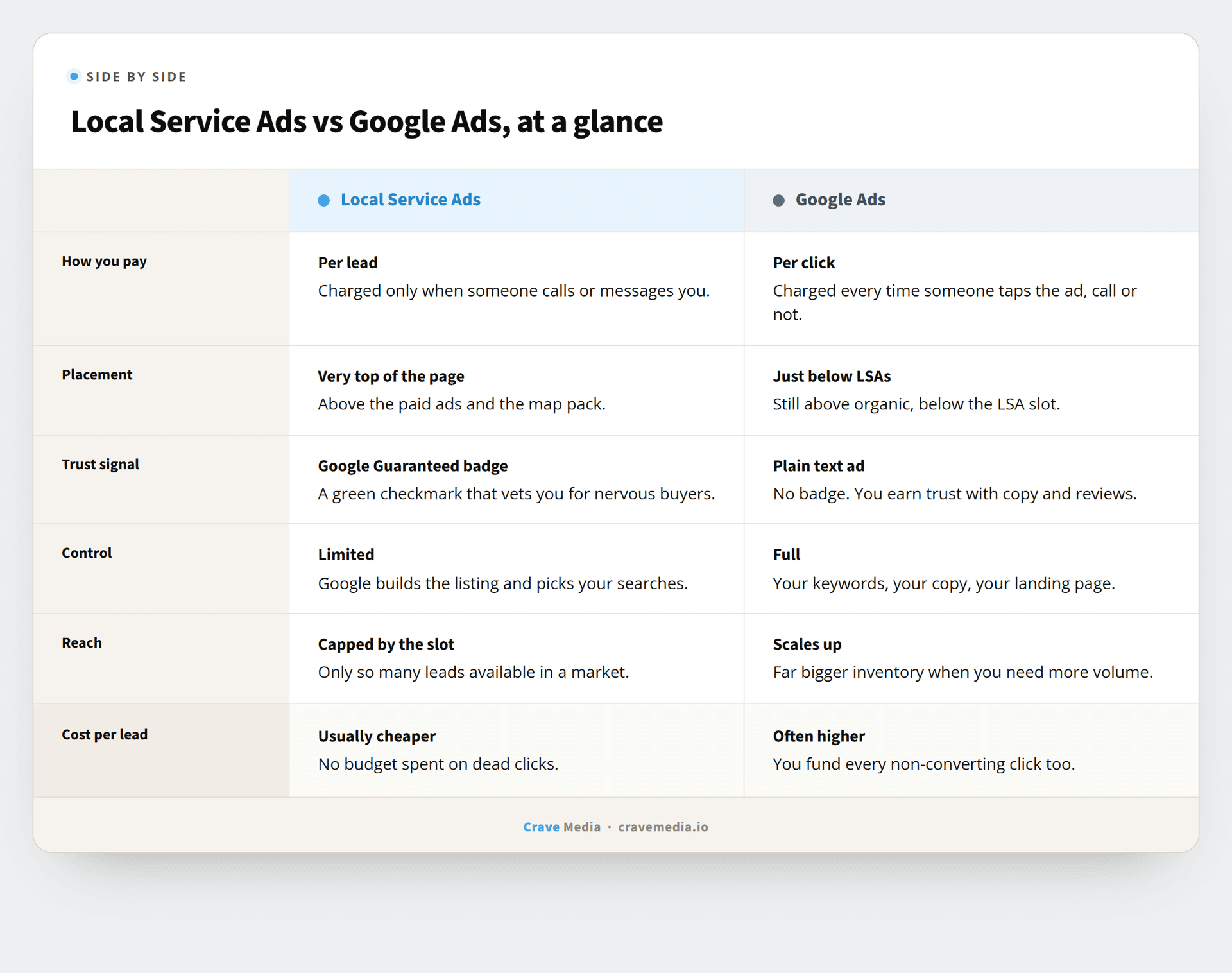
Two spots at the top of a Google search can both send you customers, and they charge you in completely different ways. One takes your money every time somebody clicks, whether they call or not. The other only bills you when a real person actually reaches out. So when a home service owner asks which one brings in cheaper leads, the answer isn't a coin flip, it comes down to how each channel counts a "lead" in the first place.
Get this wrong and you either overpay for clicks that never turn into work, or you leave the cheapest leads on the page untouched. The Local Service Ads vs Google Ads question is worth ten minutes of your attention before you set a budget, because for most home service businesses one of these should clearly come first.
How each one charges you
Regular Google Ads run on pay-per-click. Somebody types "AC repair near me," sees your ad, taps it, and you get charged the moment they land on your site. Whether they call, fill out a form, or bounce in three seconds and forget you exist, you paid for that click. Your cost per lead is whatever you spent divided by the clicks that actually became customers, and that ratio is where the money is won or lost.
Local Service Ads flip the model. You pay per lead, meaning a phone call or a message from someone who found you through the ad. No contact, no charge. A hundred people can see your listing and scroll past, and you owe nothing until one of them actually calls. That single difference is why so many home service owners find their cost per lead drops when they turn LSAs on.
There's a placement gap too. Local Service Ads sit at the very top of the page, above the regular paid ads and above the map pack, with a green Google Guaranteed checkmark next to your name. Google Ads sit just below them. Both beat the organic results, but the LSA slot is the first thing a nervous homeowner sees, and the badge does trust-building that a plain text ad can't touch. We got into how that badge works in our piece on the Google Guaranteed badge and how to earn it.
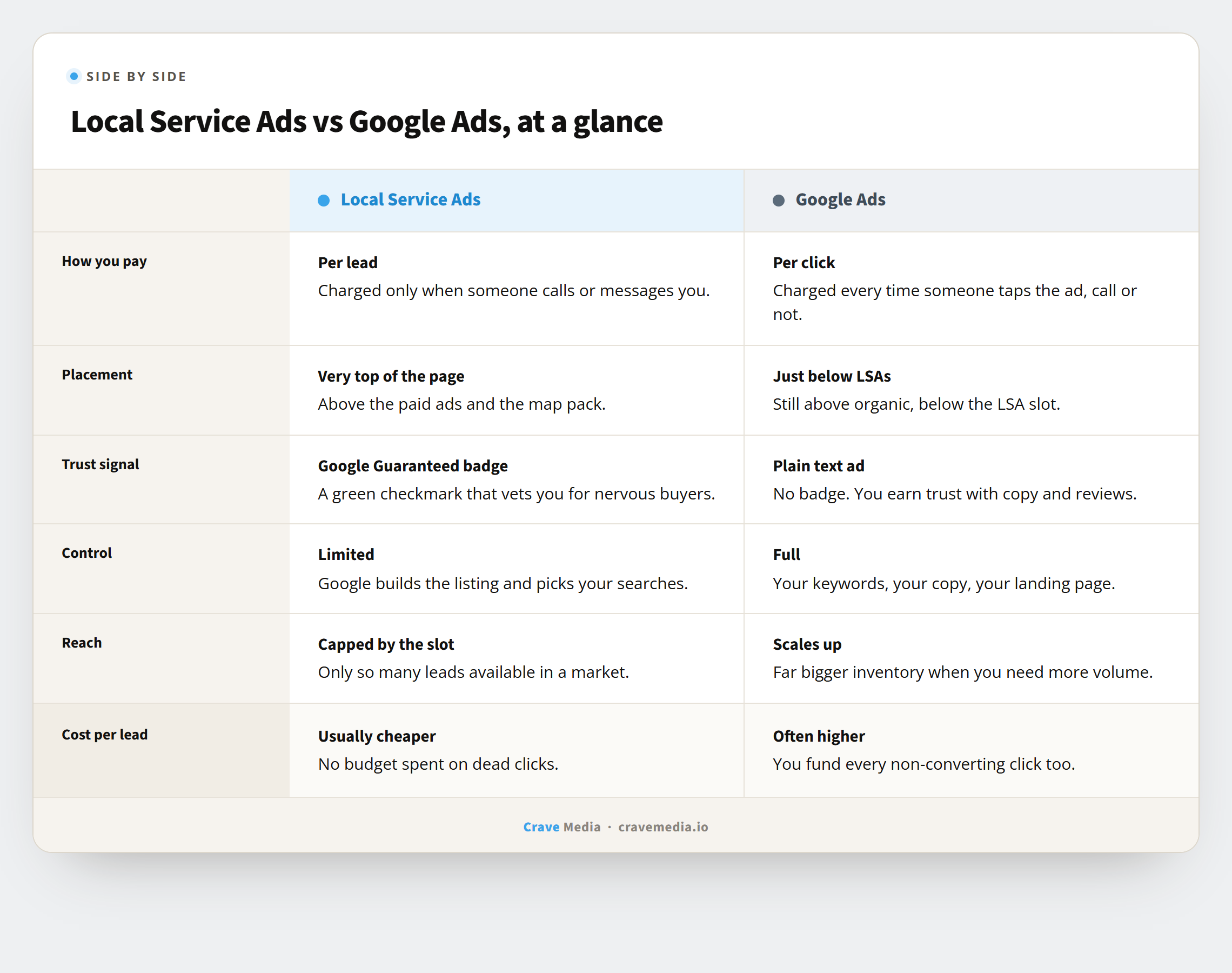
Local Service Ads vs Google Ads, row by row. The pay-per-lead model usually wins on raw cost per lead, but control and reach are where Google Ads earn their place.
Which one actually gets cheaper leads
For most home service trades, Local Service Ads win the cost-per-lead contest, and it's not especially close.
The reason is baked into the pricing. With pay-per-click, you fund every dead click: the tire-kickers, the wrong numbers, the people comparison-shopping who were never going to hire you. A chunk of your budget always goes to clicks that produce nothing, so your real cost per lead is a good bit higher than the price of a single click suggests. With pay-per-lead, that waste mostly disappears, because you're only opening your wallet when a live person contacts you.
One of our home service clients running Local Service Ads pulled in 283 leads in a stretch where their per-click campaigns brought in 176, and the LSA leads landed at a lower cost each. Same market, same business, two different meters running. Framed honestly as one client's result and not a promise of yours, it's the pattern we see over and over: for plumbing, HVAC, electrical, roofing, garage doors, and cleaning, the pay-per-lead slot tends to be the cheaper door.
But "cheaper per lead" isn't the whole story, and this is where owners get burned. Cheap leads you can't handle aren't cheap. Google tracks how fast you answer, and an LSA lead you send to voicemail is money lit on fire, since you may still get charged for the call. The businesses winning cheap leads on LSAs are the ones answering the phone fast and disputing the junk leads that slip through. Set it up and walk away and the cost advantage evaporates.
Where Google Ads still earn their keep
If Local Service Ads are cheaper, why would anyone run Google Ads at all? Because cost per lead is only one number, and a few real limits keep LSAs from being the whole answer.
Volume is the big one. Local Service Ads only serve so many searches in a given market, and once you've captured the leads available in that slot, there's no dial to turn for more. Google Ads have a far bigger inventory. When you want to grow past what the LSA slot can feed you, per-click campaigns are how you reach the rest of the demand.
Control is the other. With LSAs, Google builds the listing and decides which searches you appear for. You can't write the ad, and you can't aim it at a specific high-value service. Google Ads let you choose your exact keywords, write copy that speaks to the job you most want, and point traffic at a landing page you control. If you make most of your margin on full system replacements, you can bid hard on that and steer the click where you want it. That precision is worth paying per click for, as long as your campaigns are actually converting instead of leaking budget.
Then there's eligibility. Local Service Ads are gated to certain trades and require passing Google's license, insurance, and background screening. If your category isn't covered, or you're a service that just doesn't fit the pay-per-lead format, Google Ads are your top-of-page option. They also handle the searches LSAs ignore, like research-stage queries where someone isn't ready to call yet but is worth reaching.
Run the math on your own numbers
Averages are a starting point, not an answer. Your real cost per lead depends on your trade, your close rate, and how fast you answer the phone, so the only comparison that matters is the one you run on your own account.
The honest way to compare is cost per job, not cost per lead. A channel with slightly pricier leads that close at twice the rate is the cheaper channel where it counts. Track how many leads each source sends, how many turn into booked work, and what you paid to get there. We walked through how to find that number in our breakdown of what a good cost per lead looks like for a local business, and it applies cleanly here: the source that produces the lowest cost per booked job wins, even if its per-lead price looks higher on paper.
For a lot of home service businesses, that math lands on running both. Local Service Ads for the cheap, high-intent leads at the top of the page, and Google Ads to scale past what the LSA slot can supply and to target the specific jobs worth the most to you. They're not rivals so much as two tools for different parts of the same funnel.
Where to start
If you run a home service business in a market like Salt Lake City or Ogden and you're eligible, start with Local Service Ads. The leads are usually cheaper, the placement is the best on the page, and the pay-per-lead model keeps your risk lower while you learn what a lead is worth to you. Get the badge, answer every call fast, and dispute the junk.
Add Google Ads once the LSA slot is maxed out or when you need control the pay-per-lead format won't give you: more volume, specific high-margin services, or searches LSAs don't cover. Most growing home service businesses end up with both, weighted toward whichever produces the lowest cost per booked job in their market.
Not sure which mix fits your numbers? That's exactly what we sort out for free. Reach out for an audit and we'll look at your trade, your market, and your close rate, then tell you honestly where your first dollar should go and which channel is likely to bring you the cheaper work.

About the author
Zac Spencer is an online marketing specialist and the owner of Crave Media, based in Salt Lake City, Utah. Since 2013 he has managed hundreds of Google Ads accounts across dozens of industries — with budgets from a few hundred dollars to $250K a month — and run SEO for local businesses, ecommerce shops, and international franchises.