
Google Ads · June 30, 2026
Why your Google Ads aren't converting and how to fix it

By Zac Spencer · Owner, Crave Media
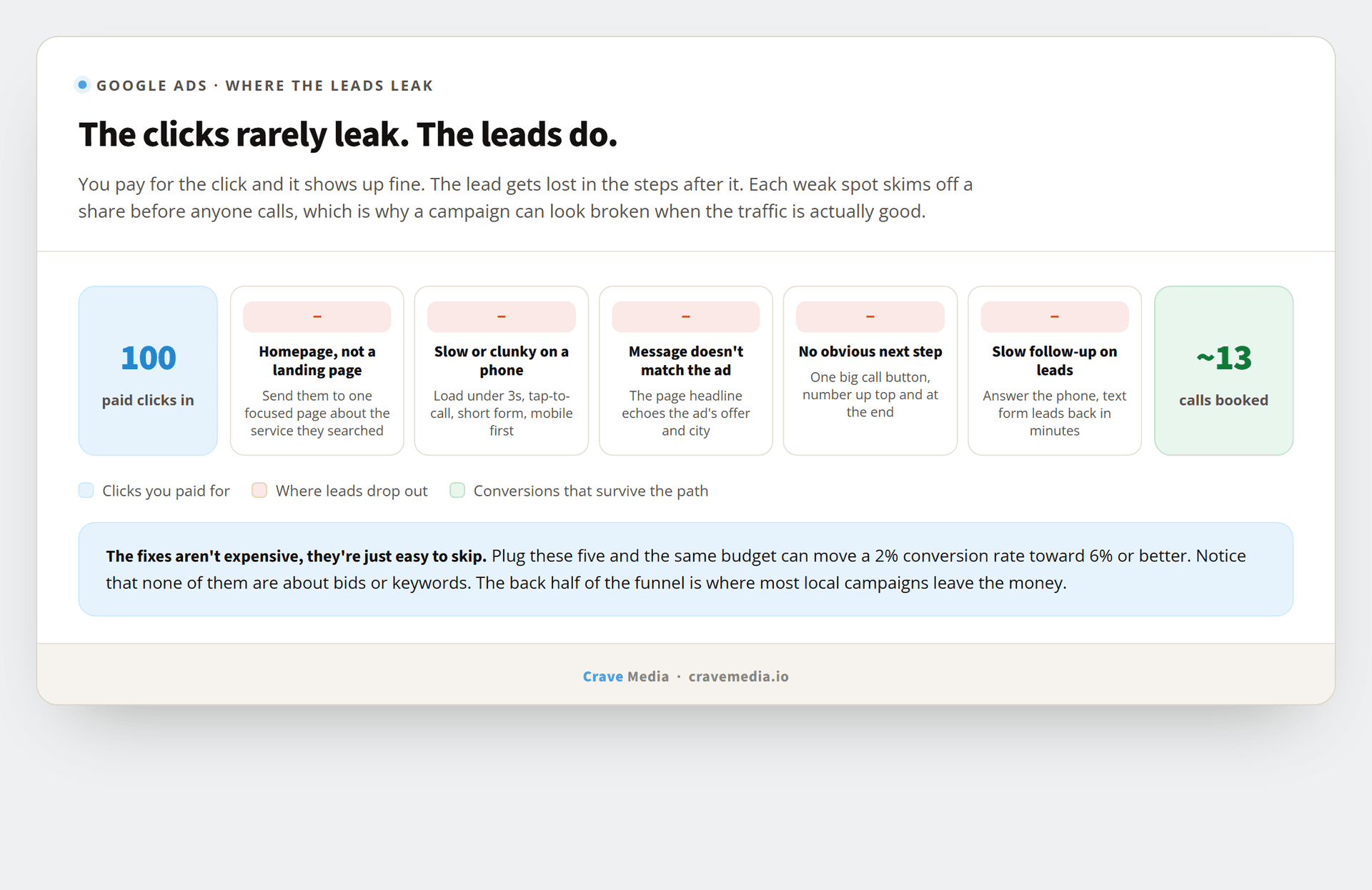
You're spending real money on Google Ads. The clicks are coming in. The phone isn't ringing. That's a miserable place to be, because every day the meter runs whether or not anyone calls.
The first instinct is to blame the clicks. Maybe the keywords are wrong, maybe Google's sending junk traffic, maybe the whole channel is a scam. Sometimes that's part of it. But when Google Ads aren't converting for a local business, the leak is almost never where people look first. The click usually does its job. The lead gets lost in the few seconds after it, on the page you sent them to and the steps you asked them to take. Let's walk through where the money goes and how to get it back.
The click is fine. Look at what happens next.
Picture the path a customer takes. They search, they see your ad, they click. Then they land on a page, they decide in a second or two whether you're worth their time, and either they call or they bounce. Every one of those steps after the click is a place you can lose them, and most local campaigns are bleeding from the same handful of spots.
So before you touch your keywords or your bids, look at the back half of the funnel. That's where a 2% conversion rate becomes a 6% one, and where the same ad budget suddenly produces three times the leads. The fixes aren't expensive. They're just easy to skip.
You're sending paid traffic to your homepage
This is the most common mistake, and it's an expensive one. You pay for a click on "emergency plumber Salt Lake City," and the click lands on your homepage, where the visitor now has to figure out, on their own, whether you do emergency work, whether you serve their area, and what they're supposed to do next.
Your homepage is built for everyone. It talks about your history, your services, your team, your service area, the works. A paid visitor doesn't want all that. They searched for one specific thing, and they want a page about that one thing, with the answer and a phone number right there.
A dedicated landing page that matches the ad does the opposite of a homepage. It's about the one service they searched for. It says you do it, you do it near them, here's the proof, here's the number. No menu to get lost in, no other services pulling their attention. When the page picks up the exact conversation the ad started, the visitor doesn't have to do any work, and far more of them call. Pointing ad traffic at the homepage instead of a focused landing page is one of the quietest ways to waste a budget.
The page is slow or a mess on a phone
Most of your paid clicks happen on a phone. Someone's standing in a flooded kitchen, they tap your ad, and your page takes six seconds to load. They're gone before they ever saw your number. Google's own data has long pointed to bounce rates climbing sharply with every extra second of load time, and on mobile, patience is even thinner.
Speed is half of it. The other half is whether the page is usable with a thumb. Tiny tap targets, a phone number that isn't clickable, a form with eight fields, a popup that covers the screen and won't close. Each one quietly sheds a percentage of the people you paid to get there. We've written before about how a slow website is costing you customers, and it hits paid traffic hardest, because with ads you're literally paying for every visitor who gives up.
The fix is unglamorous: get the page loading in under three seconds, make the phone number a tap-to-call link, cut the form down to name, number, and what they need, and make sure all of it works on the small screen first.
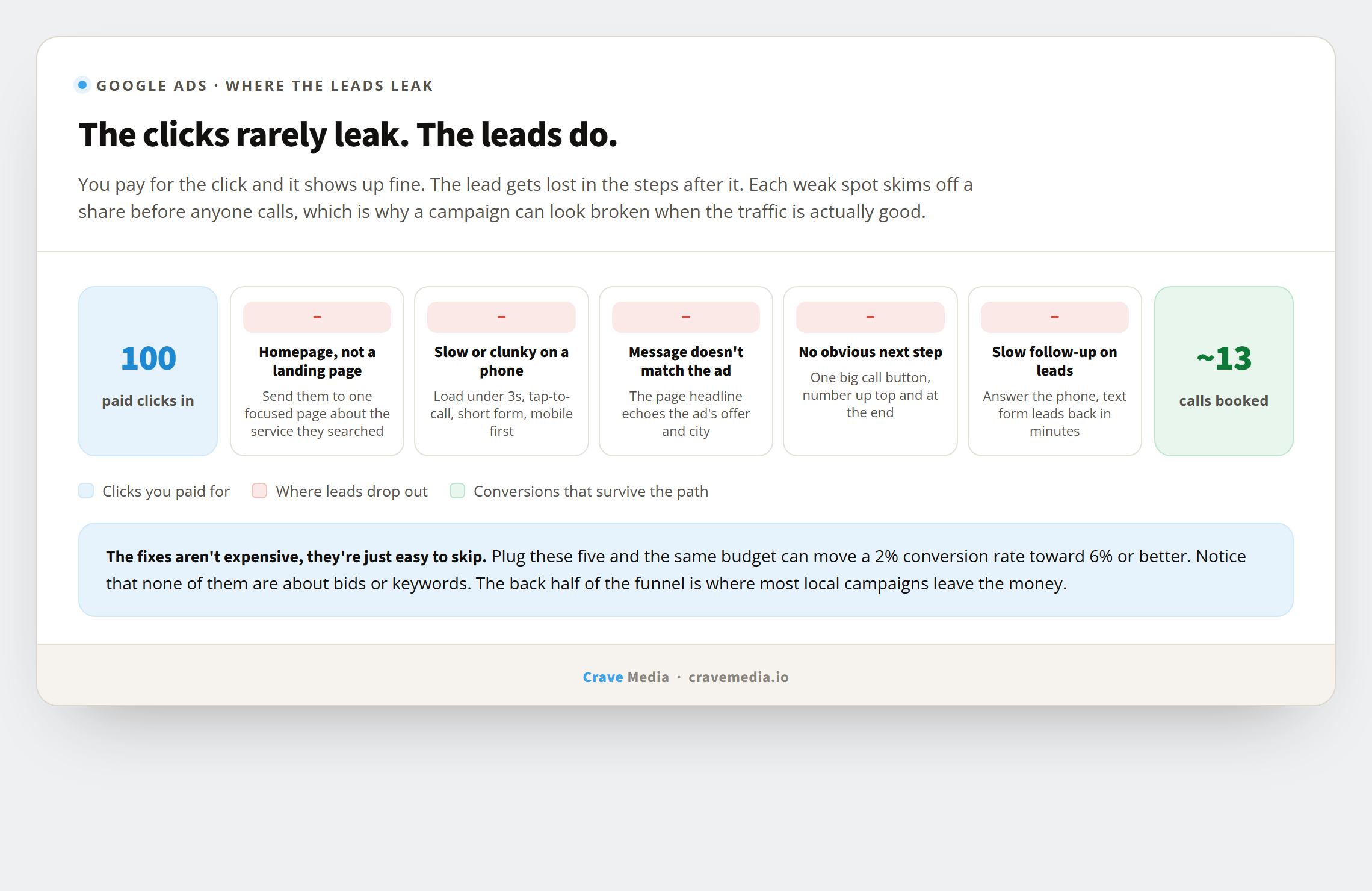
The clicks rarely leak. The leads leak in the steps after the click, and each weak spot quietly skims off a share of the budget before anyone calls.
The ad and the page are telling different stories
Say your ad promises "$59 drain cleaning." The visitor clicks, lands on a page about your full plumbing services, and there's no mention of the $59 anywhere. That mismatch costs you the conversion, because the first thing the visitor does is wonder if they clicked the wrong thing.
This is called message match, and it matters more in paid search than almost anywhere else. The ad sets an expectation; the page has to deliver on it in the first line. Whatever the ad said, the headline of the page should echo it. Same offer, same service, same city. When the two line up, the visitor relaxes and keeps reading. When they don't, you've paid for a click that bounces in two seconds.
There's no obvious thing to do next
Some pages bring the visitor right to the edge and then leave them standing there. No clear button. A phone number buried in the footer. A "contact us" link that opens a generic form. The visitor was ready, and the page made them hunt.
Tell people exactly what to do and make it the easiest thing on the page. A big tap-to-call button. The number repeated at the top and again where they finish reading. One short form, if you use a form at all. For most home services, calling is the conversion, so the whole page should funnel toward the phone. A confused visitor doesn't call. They hit the back button and click your competitor's ad.
You might be converting and just can't see it
This is the one that catches a lot of business owners. They say their Google Ads aren't converting, but what they really mean is they can't see any conversions. Those aren't the same problem.
If you're not tracking calls, you're flying blind. A huge share of local conversions are phone calls, and a click that turns into a call looks, in a basic Google Ads account, exactly like a click that bounced. Without call tracking, you can't tell which keywords drive real conversations and which ones drain the budget, so you end up optimizing toward clicks instead of customers.
Set up conversion tracking properly before you conclude the campaign is broken. That means call tracking, form tracking, and tying it back to the keyword and ad that drove it. Plenty of campaigns that look dead on the surface are quietly producing leads nobody's counting. You can't fix what you can't measure, and you definitely can't tell a winning campaign from a losing one. This is also where the decision between Google Ads and SEO gets clearer, because once you can see real cost per lead, you can compare channels honestly instead of guessing.
You're getting leads and dropping them
The conversion doesn't end when the phone rings. If the call goes to voicemail at 5:15, or the form fill sits in an inbox until tomorrow, you paid for a lead and then let it cool. Speed to lead is brutal in home services. The customer who filled out your form filled out three others, and the first business to call back usually wins the job.
So the back end matters as much as the page. Someone answering the phone during business hours, a system that texts a form lead back within minutes, a missed-call auto-text so the after-hours callers don't vanish. Without that, you can have a perfect landing page and still feel like the ads don't work, because the leads are real but they're slipping out the bottom.
What the numbers look like when it's working
When the whole path is tight, the same budget does a lot more. One business we worked with pulled in 3.41 million search impressions and about 64,800 clicks over six months, and on the paid side, 1,740 conversions at a 13.46% conversion rate. That conversion rate is the part to notice. It didn't come from a bigger budget. It came from the clicks landing on pages built to convert and the leads getting answered fast.
That's one client's result, not a promise of yours. Your numbers depend on your market, your offer, and your follow-up. But the pattern holds: the businesses getting the most out of Google Ads aren't the ones spending the most. They're the ones who fixed the leaks. If you want a sense of how big the budget even needs to be, we broke down how much a local business should spend on Google Ads, and most of the waste hides in exactly the spots above.
If you'd rather have someone find the leaks for you, that's what our Google Ads management does. A free audit will usually surface two or three of these in the first look.
Start with the page, not the bids
When the ads aren't converting, resist the urge to crank the bids or rip up the keywords first. Send paid traffic to a focused landing page, make it fast and easy on a phone, match the message to the ad, point people clearly at the call, and make sure you're tracking and answering every lead. Do that, and most campaigns that looked broken turn out to have been working the whole time. The clicks were never the problem.

About the author
Zac Spencer is an online marketing specialist and the owner of Crave Media, based in Salt Lake City, Utah. Since 2013 he has managed hundreds of Google Ads accounts across dozens of industries — with budgets from a few hundred dollars to $250K a month — and run SEO for local businesses, ecommerce shops, and international franchises.