
Google Ads · June 5, 2026
How much should a local business spend on Google Ads

By Zac Spencer · Owner, Crave Media
Ask ten marketers how much you should spend on Google Ads and you'll get ten different numbers, most of them pulled from thin air. The truth is there's no magic figure that fits every local business. A plumber in Salt Lake City and a dentist in Ogden can run the same campaign type and need completely different budgets, because they're chasing different customers at different prices.
So instead of guessing at a Google Ads budget, the better move is to work backward from what you want: a certain number of new customers a month. Once you frame it that way, the number stops being a shot in the dark and turns into math you can check.
Start with customers, not dollars
Most owners start with the wrong question. They ask "what's a normal monthly budget for a business like mine," when they should be asking "how many new customers do I need, and what is one worth to me."
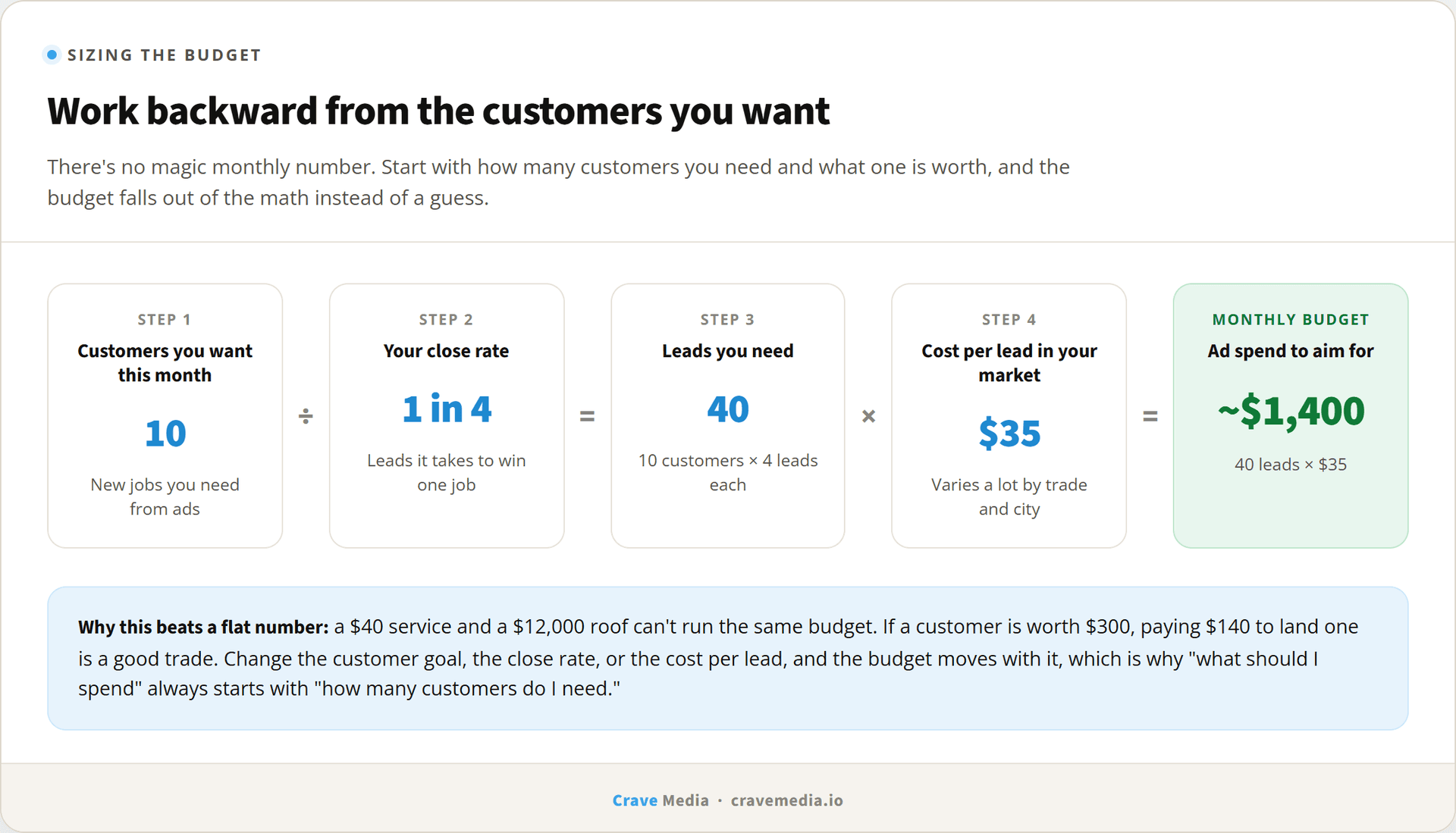
Work it back in four steps. Decide how many new jobs or clients you want from ads this month. Look at how many leads it takes you to close one, so if you close one in four, ten customers means forty leads. Multiply those leads by what a lead costs in your trade. That number, roughly, is your monthly ad spend.
The piece that changes everything is what a customer is worth to you. If a new client is worth $300, spending $150 to land one is a great trade. If you're a roofer and a job is worth $12,000, you can afford to spend far more per lead than a business selling a $40 service. Your budget should scale to the value of what you sell, not to some industry average you read in a forum.
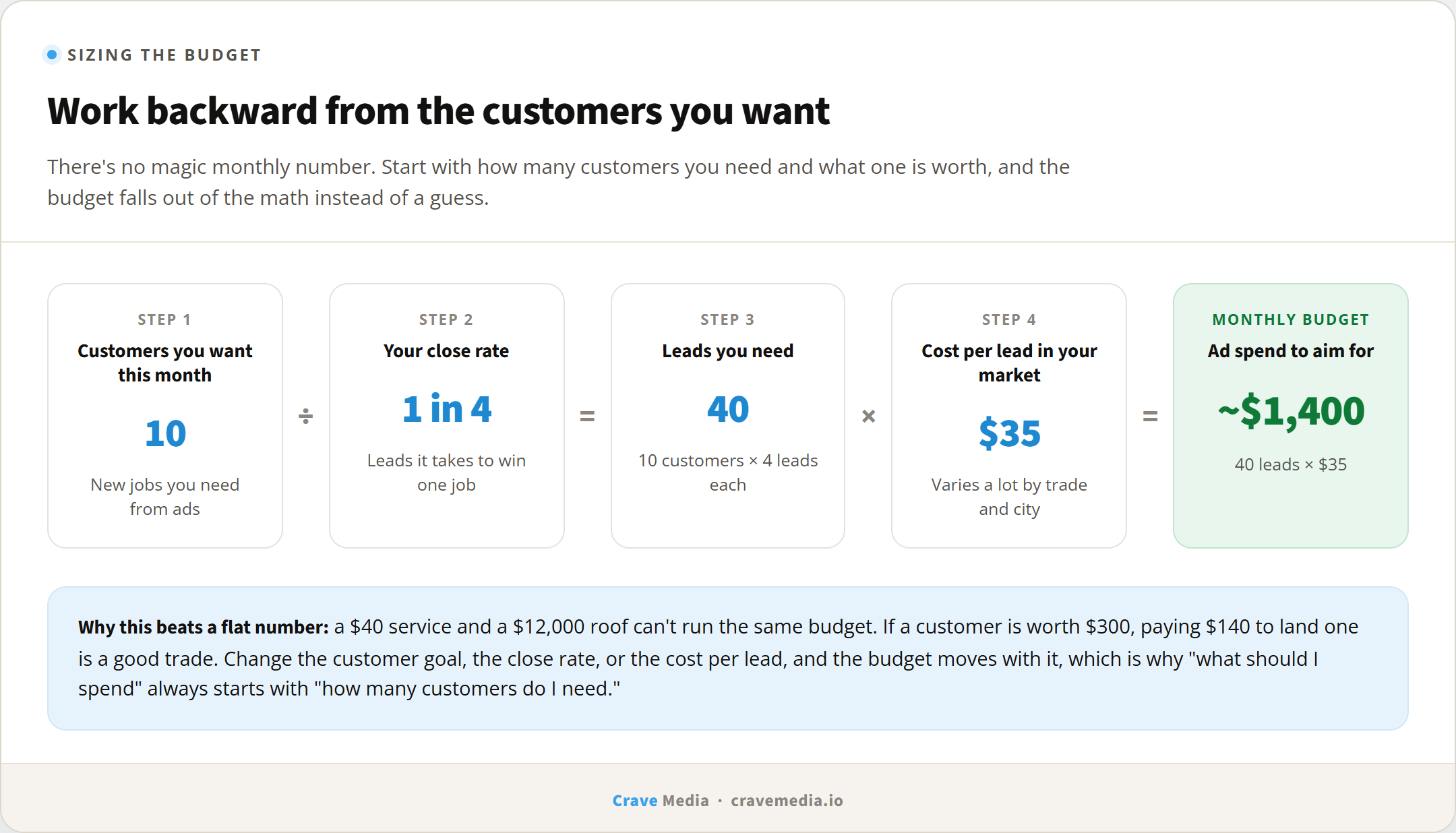
Sizing the budget from the goal instead of guessing. Change the customer target or the cost per lead and the number moves with it.
What a click actually costs
The reason budgets vary so much is that clicks aren't priced the same across trades. You pay each time someone clicks your ad, and in competitive, high-value categories that click gets expensive fast.
A click in a low-competition local service might run a dollar or two. In trades where every job is worth thousands and competitors bid hard, like water damage, legal, or HVAC in summer, a single click can run $20, $50, or more. That's not Google gouging you. It's an auction, and a click is worth more when the job behind it is worth more, so everyone bids up.
This is why the same $1,500 buys a flood of clicks in one market and a trickle in another. Before you set a number, it's worth knowing what your specific keywords cost in your city, because that's what decides whether a given budget is generous or hopeless.
Why a too-small budget wastes money
There's a floor below which Google Ads simply can't teach you anything. A few hundred dollars a month in a trade where clicks cost $15 buys you maybe twenty clicks, and twenty clicks isn't enough data to know which searches make you money and which don't.
A budget that small tends to get spent in the first week, sit dark for three, and leave you with no leads and no lessons. If you can't fund enough clicks to produce a handful of leads a week, you're usually better off putting that money into local SEO and your Google Business Profile until you can budget enough for paid search to compete.
The minimum that works depends entirely on your click cost. Cheap-click markets can get going on a modest budget. Expensive trades need real money on the table before the campaign has enough to optimize against.
Follow the cost per customer, not the click
Once you're running, the click price stops being the number that matters. Cost per lead, and ultimately cost per customer, is the only thing that tells you whether the spend is working.
A campaign with expensive clicks and a high conversion rate can beat one with cheap clicks that never call. We manage one account where the paid campaigns brought in 1,740 conversions at a 13.46% conversion rate. That kind of efficiency doesn't come from finding cheaper clicks, it comes from sending the right clicks to a page built to convert and measuring all the way to the call.
You can't see any of that without conversion tracking and call tracking wired in from the start. If you're judging your Google Ads campaign on clicks or impressions, you're looking at the numbers that feel good instead of the ones that pay the bills.
Where local budgets get wasted
Most of the money lost in local accounts goes to a few predictable places, and none of them are about the size of the budget.
Broad keywords are the biggest leak. Bidding on vague terms like "plumber" or "remodeling" burns money on people who are comparing, reading, or three states away. Tighter, high-intent searches like "emergency plumber Ogden" cost more per click but produce far more calls per dollar.
Sending paid clicks to your homepage is the second. A homepage makes a visitor hunt for the next step, and on expensive traffic that hesitation is money. A focused landing page that loads fast and asks for one clear action converts more of the clicks you already paid for. It doesn't matter how good the campaign is if the website it points to is slow or cluttered.
The last one is running with no tracking at all. If you can't tell which keywords produce calls, you can't shift budget toward what works, so you keep paying premium prices for searches that never convert.
A realistic way to set your first number
If you're starting from zero, pick a budget you can run for at least three months without flinching, because the first month is mostly the campaign learning. Set it high enough to fund a meaningful number of clicks in your market, point it at your most profitable service rather than everything you offer, and watch cost per lead instead of click volume.
For a lot of local businesses in Utah and beyond, that lands somewhere in the four-figures-a-month range for ad spend, but the honest answer is that it depends on your market and your margins. A quiet rural market with cheap clicks needs far less than a competitive metro where everyone's bidding on the same emergency searches. If your trade also qualifies, it's worth weighing paid search against Local Service Ads, which charge per lead instead of per click and often deliver a lower cost per customer for home services.
And if you're torn between spending here or building organic traffic for the long run, that's a real tradeoff worth thinking through before you commit, which we covered in our breakdown of where to start between Google Ads and SEO.
Build the number, don't guess it
How much you should spend on Google Ads comes down to how many customers you need, what one is worth to you, and what a lead costs in your market. Build the number from those three and you'll have a budget you can defend, not a guess you hope works out. A budget too small to gather data is the one truly wasteful choice, and it's the one a lot of businesses default to.
If you'd rather not guess, that's exactly what a free audit sorts out. Reach out and we'll look at what clicks cost in your market, what your competitors are spending, and what budget it would realistically take to hit your goals, then tell you honestly whether paid search is your best first dollar or not.

About the author
Zac Spencer is an online marketing specialist and the owner of Crave Media, based in Salt Lake City, Utah. Since 2013 he has managed hundreds of Google Ads accounts across dozens of industries — with budgets from a few hundred dollars to $250K a month — and run SEO for local businesses, ecommerce shops, and international franchises.