
Strategy · May 29, 2026
Google Ads vs SEO: where a local business should start

By Zac Spencer · Owner, Crave Media
Every business owner who's looked into marketing has hit this fork. Do you pay for Google Ads and start getting clicks tomorrow, or invest in SEO and climb the rankings over time? Both put you in front of people searching for what you sell. They just work in opposite ways, and picking wrong for your situation wastes money you didn't need to spend.
The honest answer is that it depends on where your business is right now. But "it depends" isn't useful on its own, so let's break down how each one works and give you a real way to decide.
How they differ
Google Ads buys your way to the top. You bid on searches like "emergency electrician Ogden," and when someone types that, your ad can appear above the regular results. You pay each time someone clicks. Turn it on and you can have leads by this afternoon. Turn it off and they stop the same day.
SEO earns the top instead of renting it. You improve your website and your Google Business Profile so the regular, unpaid results start ranking you higher. It takes months to build, but once you're there, the traffic keeps coming without paying per click.
The simplest way to hold the difference in your head: ads are like renting, SEO is like buying. Renting gets you in the door immediately with no commitment. Buying costs more upfront and pays off over the long haul.
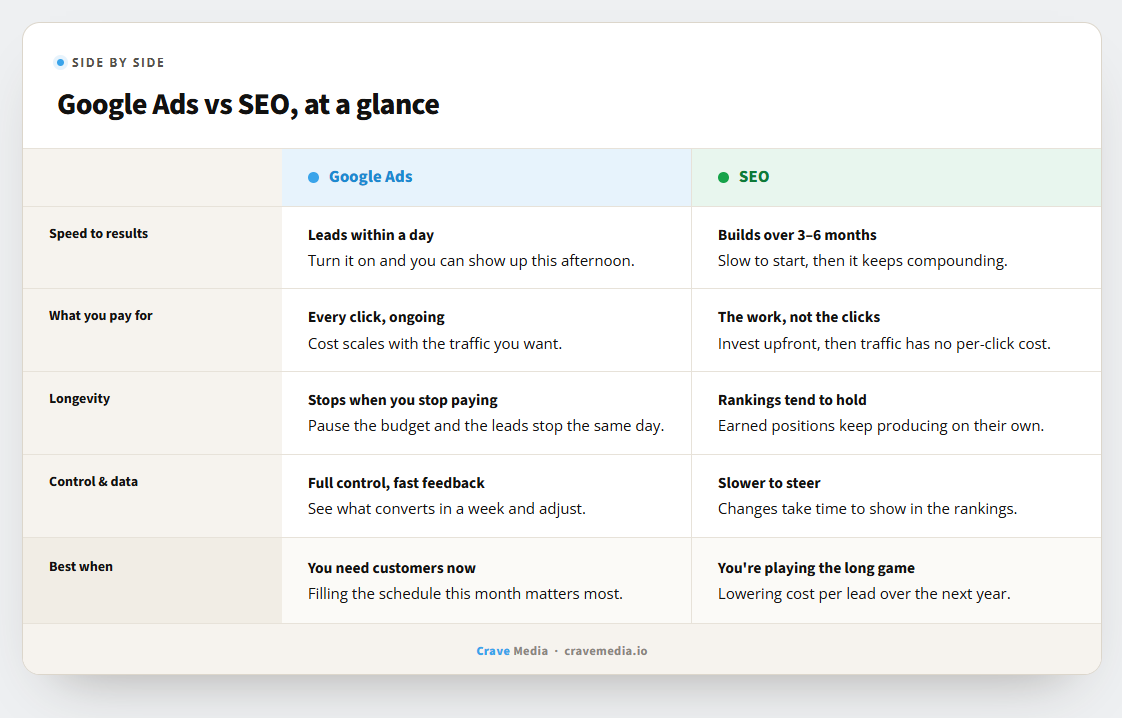
The short version. Most established businesses end up running both, but where you start depends on which row matters most right now.
What each one really costs
The price tag isn't just the obvious number.
With Google Ads, you're paying for every click, and clicks in competitive trades aren't cheap. The cost is ongoing and it scales with how much traffic you want. The upside is total control and fast feedback. You can see within a week which searches make you money and which don't, and shift the budget accordingly. A well-run Google Ads campaign can be profitable from the first month if the math works for your trade.
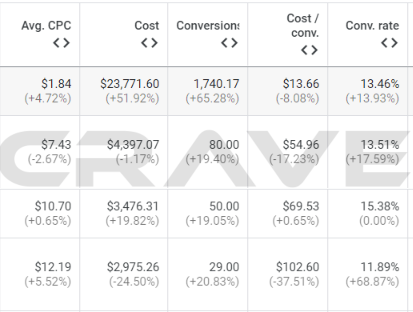
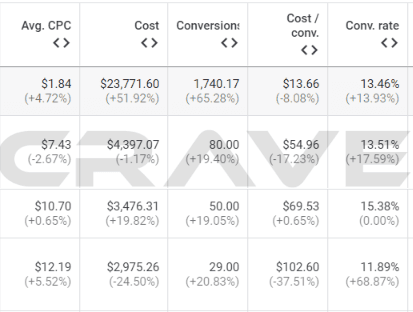
A Google Ads account we manage: 1,740 conversions at a 13.46% conversion rate. Paid traffic works fast, but only when it's pointed at the right searches.
SEO costs more in time than in clicks. You're not paying Google per visitor, but you are investing in the work over several months before it pays off. The reward is that the traffic eventually comes in without a per-click cost, and rankings you've earned tend to hold. A year in, strong SEO often delivers leads at a fraction of what the same volume would cost through ads.
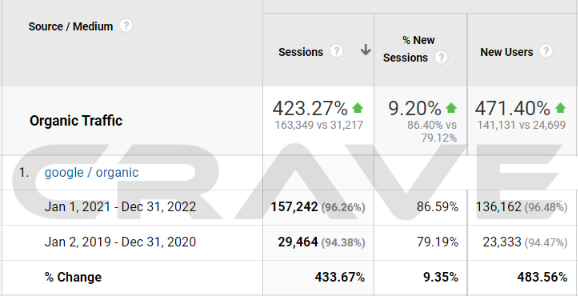
The same client's organic traffic, up 423% year over year. That growth took months to build, and it keeps producing without paying for clicks.
A simple way to decide
Forget the theory for a second and look at your own situation. A few questions sort most businesses pretty quickly.
Do you need customers this month to keep the lights on? Start with Google Ads. SEO is the better long-term play, but it won't fill your schedule in the next two weeks, and a slow month doesn't care about your six-month strategy.
Is your market quiet, with not many people searching for what you do? Lean toward SEO and the map pack. If search volume is low, paid clicks are scarce and expensive, and showing up in the local map results for free matters more.
Are you in a competitive trade where everyone's bidding hard? You probably need both eventually, but SEO becomes more important over time, because you can't outspend bigger competitors on ads forever. Earned rankings give you a position they can't simply buy out from under you.
Just getting started with no track record? Ads give you fast data about what your customers actually search for and what they're worth, which makes your SEO work sharper later. Sometimes the smart move is a small ad budget to learn, while SEO builds in the background.
Why most established businesses run both
For a business that's past the survival stage, the question usually stops being "ads or SEO" and becomes "how much of each." They work better together than apart.
Ads cover the now. They catch the urgent searches, fill gaps when SEO dips, and let you push hard on your most profitable services. SEO covers the long term, lowering your overall cost per lead as the months go on so you're not paying for every single click forever.
They also feed each other. The keyword data from your ads tells you which searches are worth targeting in SEO. Strong organic rankings build the brand recognition that makes people more likely to click your ad when they do see it. And both rely on the same foundation, a website that loads fast and converts, because it doesn't matter how someone reaches your page if the page itself loses them.
If you run home services, there's a third piece worth folding in: Local Service Ads, which sit above both and charge per lead instead of per click. For a lot of trades, the strongest setup is all three working at once.
The bottom line
There's no universal winner between Google Ads and SEO. Ads buy you speed and control at an ongoing cost. SEO buys you durable, cheaper traffic if you're willing to wait for it. The right starting point depends on whether you need leads now or can invest for later, and how much competition you're up against.
If you're not sure which fits your business, that's exactly the kind of thing we sort out for free. Reach out for an audit and we'll look at your market, your competitors, and your goals, then tell you honestly where your first dollar should go.

About the author
Zac Spencer is an online marketing specialist and the owner of Crave Media, based in Salt Lake City, Utah. Since 2013 he has managed hundreds of Google Ads accounts across dozens of industries — with budgets from a few hundred dollars to $250K a month — and run SEO for local businesses, ecommerce shops, and international franchises.