
Facebook Ads · August 4, 2026
How retargeting ads win back visitors who don't convert

By Zac Spencer · Owner, Crave Media
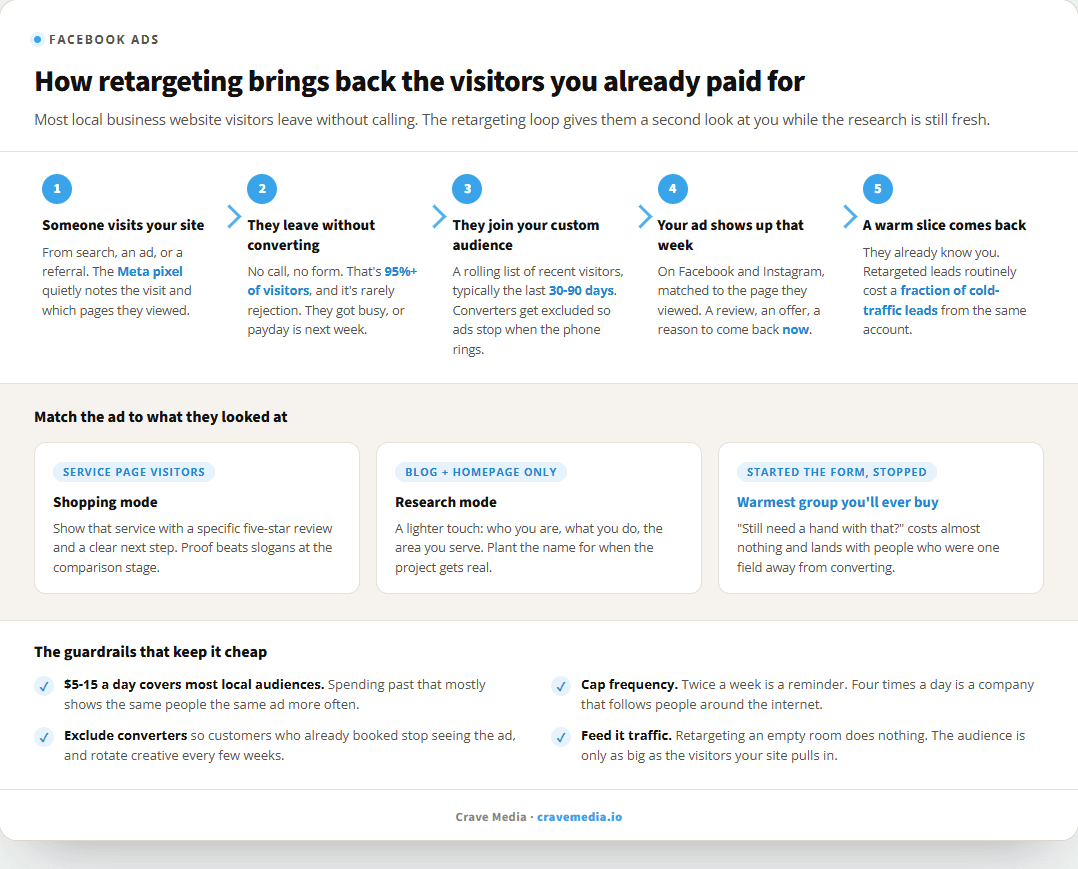
The visitors you already paid for
Check your website analytics and you'll find an uncomfortable number: the overwhelming majority of people who visit a local business website leave without calling, filling out the form, or booking anything. Somewhere north of 95% is typical. You paid to get every one of them there, through ads, SEO work, or years of reputation building, and they walked out the door.
Retargeting ads exist for exactly this. They put your business back in front of the people who visited and didn't convert, while they scroll Facebook or Instagram over the following days. For most local businesses, retargeting is the cheapest advertising you will ever run, because the audience is small, already familiar with you, and much closer to a decision than a stranger. We covered where Facebook ads fit for local businesses in a broader post; this one walks through the tactic from that post that pays off first.
Why people leave without converting
It's rarely rejection. Someone searched for a bathroom remodeler, opened four tabs, got called into a meeting, and never came back to yours. A homeowner looked up furnace replacement costs on their lunch break and planned to deal with it after payday. A driveway full of leaves reminded someone to research gutter guards, then the weekend arrived.
These people had real intent. What they didn't have was urgency, and memory is short. A week later they can't tell you which of the four companies they looked at was which. The one that shows up again, with a familiar name and a reason to come back, has a real edge over the three that vanished.
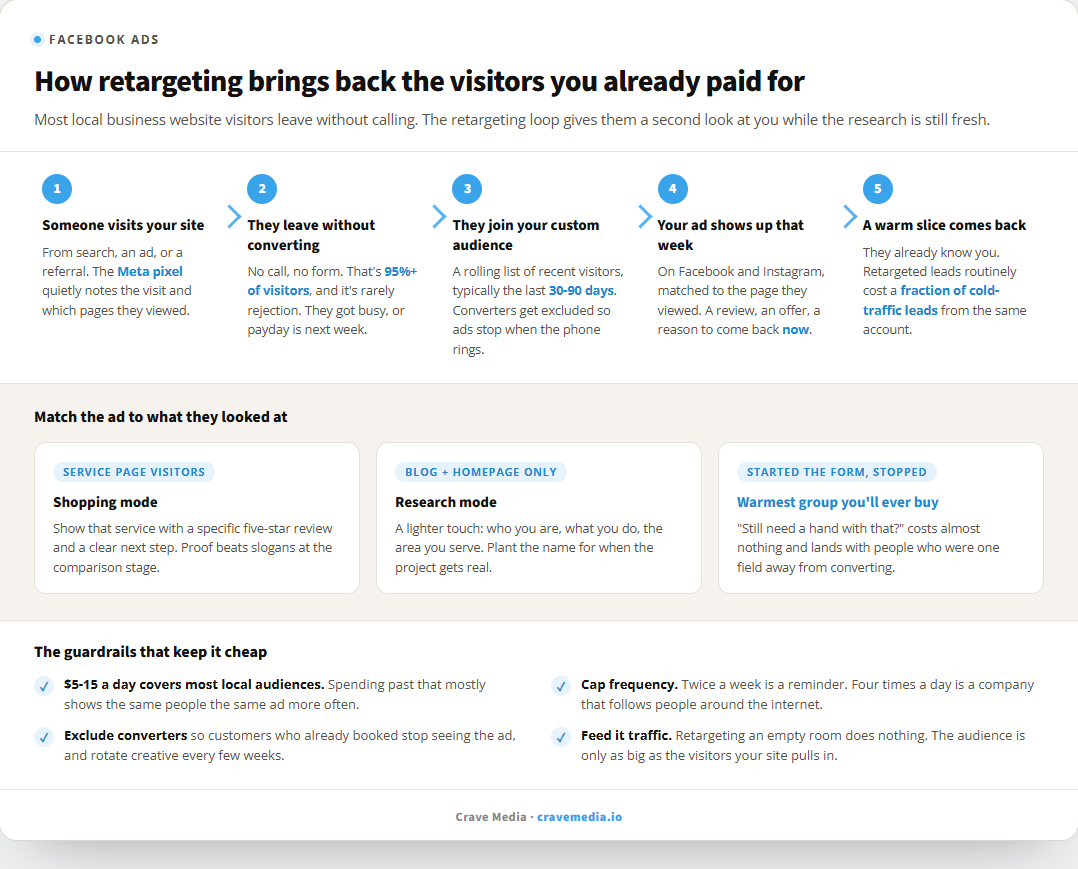
The retargeting loop: the pixel tags every visitor, the ones who didn't convert see your ad for the next few weeks, and a slice of them come back and buy.
How retargeting ads work
Retargeting runs on a small piece of code called the Meta pixel (Google has an equivalent for its own retargeting). You install it once on your website, and from then on it quietly notes every visitor who also has a Facebook or Instagram account, which is most of them.
From that traffic, Meta builds what it calls a custom audience: a rolling list of everyone who visited your site in the last 30, 90, or up to 180 days. You never see names or numbers, and you can't message anyone directly. You can only pay to show ads to the group. When someone converts, you exclude them so they stop seeing the ads, and when someone's visit ages past your window, they fall off the list on their own.
Setup takes an afternoon, and it's the part most owners get stuck on, usually because the pixel was installed years ago by a web designer nobody can reach, or it's firing on the homepage and nothing else. If you're not sure yours works, Meta's Pixel Helper browser extension gives you an answer in about a minute.
Segment by what they looked at
A visitor who read your blog post about paver patios and a visitor who hit your contact page and bailed are in very different places. Retargeting works noticeably better when the ad matches the page.
The simplest useful split for a local service business is two audiences. People who visited a service page get an ad about that service, with a review and a clear next step. People who only touched the blog or the homepage get a lighter touch, something that says who you are and what you do, since they were researching rather than shopping. If you have the traffic to support it, a third audience of people who started the contact form and stopped is the warmest of the bunch, and a "still need a hand with that?" message to them costs almost nothing.
Don't over-slice it. Retargeting audiences for a local business are small to begin with, and an audience of 80 people can't teach the algorithm anything. Two or three segments is plenty until your traffic grows.
What the ads should say
The person seeing this ad has already been to your website. Introducing yourself again wastes the impression. What moves them is a reason to come back now instead of eventually.
Reviews do the heaviest lifting. A short ad built around one specific five-star review, "they replaced our water heater the same afternoon", outperforms a generic "quality service since 1998" ad with this audience, because the reader is at the comparison stage and proof is what they're comparing. A modest offer works too: a free estimate, a seasonal discount, $50 off a first service. And rotate the creative every few weeks. The audience is small, so the same ad gets stale fast, and stale ads get expensive.
One of our clients runs Google Ads that pulled 1,740 conversions at a 13.46% conversion rate, and the retargeting layer behind it runs on a fraction of that budget. That's the usual shape: retargeting is not the engine of a local marketing plan, it's the net that catches what the engine shakes loose.
What it costs and how to cap it
Retargeting budgets are small because the audience is small. For most local businesses, $5 to $15 a day covers the entire pool of recent visitors, and spending more past that point mostly shows the same people the same ad more often. That's where frequency caps matter. Seeing your ad twice a week is a reminder; seeing it four times a day is a company that follows you around the internet, and people notice the difference.
Judge it on cost per lead, the same way you'd judge any other channel. Retargeting leads routinely come in at a fraction of the cost of cold-traffic leads, and when they don't, the problem is usually upstream: not enough site traffic feeding the audience, or a website that's losing people for a fixable reason. Retargeting an empty room does nothing, and retargeting a slow, hard-to-use website just pays to re-deliver people to the same bad experience.
The mistakes that quietly burn the budget
A few patterns show up over and over in accounts we take over. No exclusion audience, so customers who already booked keep seeing the ad for a month, which annoys them and wastes money. One ad, never rotated, running for six months. Audiences windowed at 180 days for a service people buy within a week of researching. All the clicks dumped on the homepage instead of the page that matches the ad. Each one is a ten-minute fix, and together they're often the difference between "retargeting didn't work for us" and a steady trickle of cheap, warm leads.
The other common failure is giving up at thirty days. Retargeting compounds with traffic: the more visitors your SEO and ads bring in, the bigger and fresher the audience gets, and the better the numbers look. It's a system that gets stronger as the rest of your Facebook and Instagram advertising and search presence grows.
The cheapest audience you'll ever buy
Every month, hundreds of people visit your website, think about calling, and don't. They're the closest thing to free leads that exist in paid advertising, and most local businesses let every one of them go.
If you want a second set of eyes on whether retargeting fits your traffic, or a check on why your current campaign isn't paying its way, request a free audit and we'll look at the pixel, the audiences, and the ads and tell you what we'd change.

About the author
Zac Spencer is an online marketing specialist and the owner of Crave Media, based in Salt Lake City, Utah. Since 2013 he has managed hundreds of Google Ads accounts across dozens of industries — with budgets from a few hundred dollars to $250K a month — and run SEO for local businesses, ecommerce shops, and international franchises.