
Facebook Ads · September 8, 2026
Facebook ad creative for local businesses that gets clicked

By Zac Spencer · Owner, Crave Media
The ad is the targeting now
For years, running Facebook ads meant fiddling with audiences: stacking interests, narrowing age ranges, guessing which zip codes contain people with dirty gutters. Meta has quietly taken most of those controls away and handed the job to its delivery system, which watches who engages with your ad and finds more people like them.
That changes what matters. When the algorithm picks the audience, your Facebook ad creative is the input it learns from. A local business that shows a real crew photo and names a specific problem teaches the system to find homeowners with that problem. A generic graphic teaches it nothing. The budget settings are the steering wheel everyone fights over, but the creative is the engine, and most local ad accounts we open up are running on the weakest part.
This matters twice over because Facebook is an interruption channel. Nobody scrolls their feed looking for a plumber, which we covered in whether Facebook ads still work for local businesses. Your ad has to stop a thumb that wasn't looking for you. Search ads get found; feed ads have to earn the pause.
Your worst photo beats their best stock image
If you take one thing from this post: the photos already on your office manager's phone outperform anything a designer builds from stock assets. We'd rather run a slightly crooked shot of your actual crew unloading a truck than a polished graphic of a smiling model in a hard hat, and it isn't close.
The reason is what a feed is. People scroll past professional-looking content all day, and their brains have a fast filter for "this is an ad." A real photo, with real lighting and a lawn that needs mowing in the background, doesn't trip the filter. It reads like a post from a neighbor, which earns the half second where the hook can do its work.
The shots that work are the ones that feel almost too ordinary to use. The tech in the crawlspace with a headlamp. The before-and-after driveway split. The dumpster full of a hoarder cleanout. The handwritten thank-you note a customer left on the counter. Local service work is visually interesting to homeowners in a way owners stop noticing, because to you it's Tuesday.
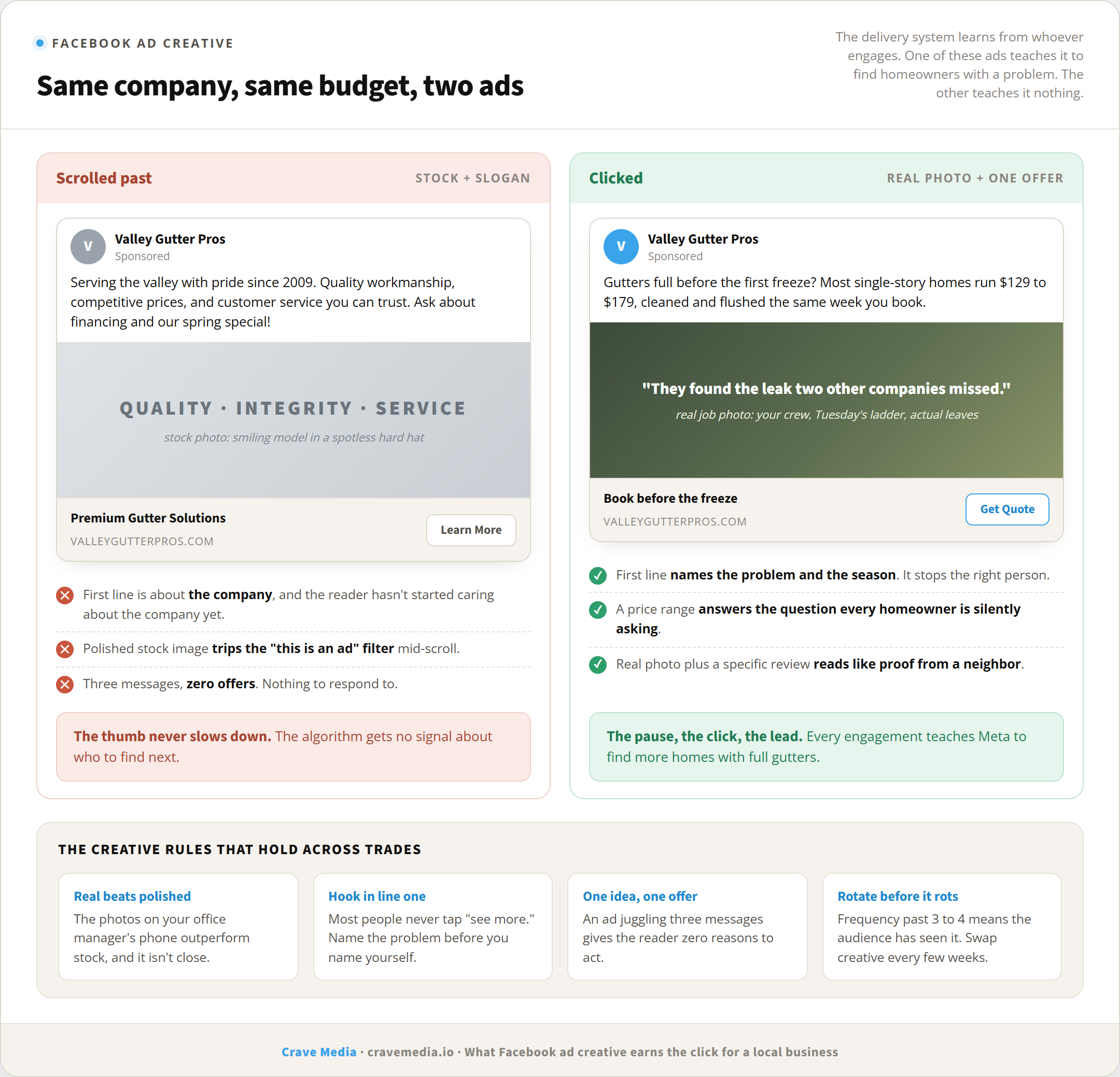
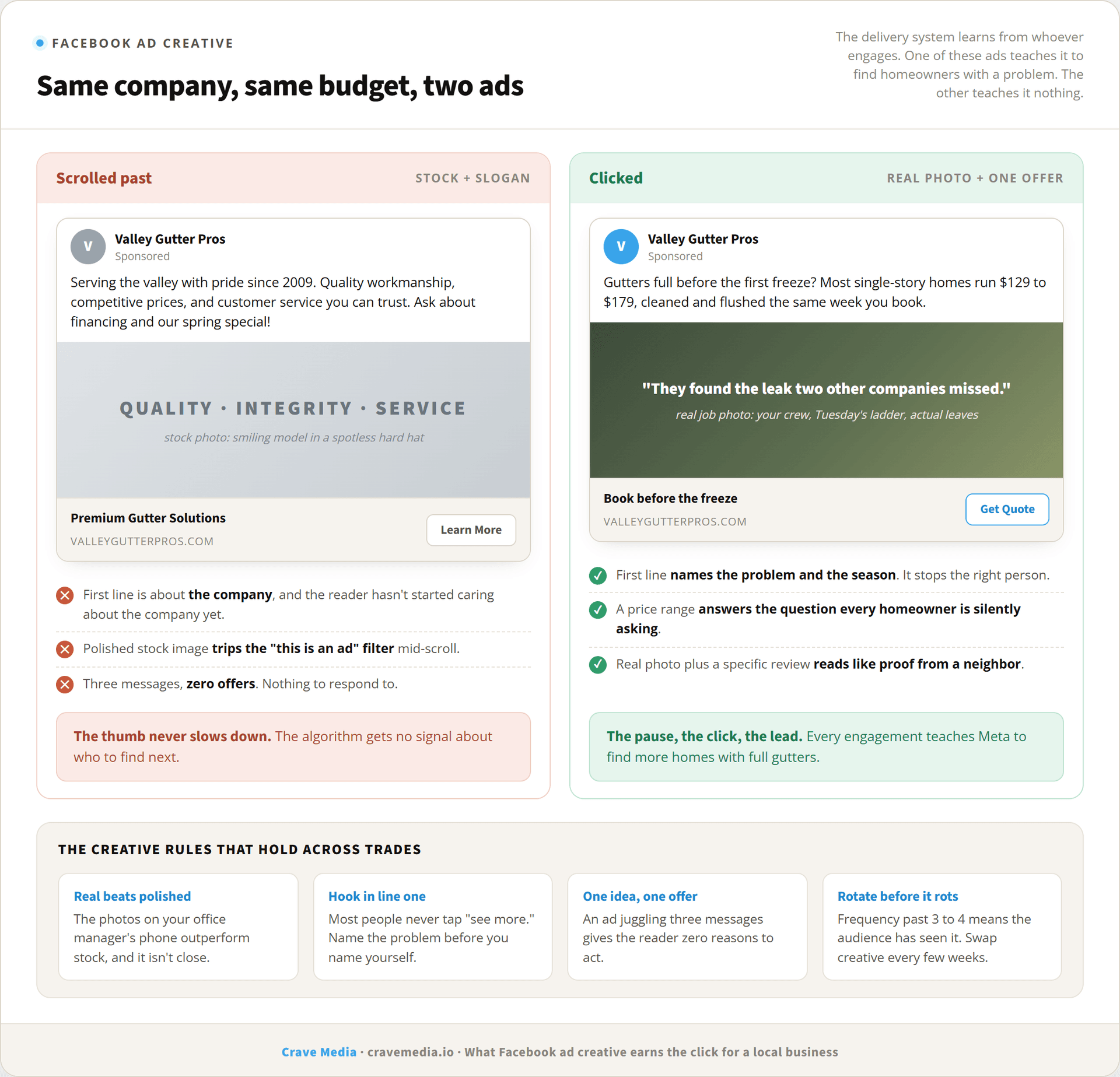
The same company, the same budget, two ads. The difference is a real photo, a first line that names the problem, and one specific offer instead of a slogan.
The first line does the heavy lifting
Most people never tap "see more," so the opening line of your primary text is most of your copy. Write it like you'd say it to the homeowner across the street, and make it name the problem or the moment rather than your company.
"Gutters full before the first freeze?" stops the right person. "Serving the valley with pride since 2009" stops no one, because it's about you, and the reader hasn't started caring about you yet. Specifics beat adjectives every time: "We replaced 41 water heaters in August" carries more weight than "fast, reliable service," and a line like "Most driveways run $180 to $250" will out-click almost anything, because price is the question every homeowner is silently asking.
After the hook, keep it short. One idea, one offer, one way to respond. An ad that mentions your spring special, your financing options, and your five-star rating in the same breath gives the algorithm three signals and the reader zero reasons.
Reviews are creative too
A single five-star review, quoted big over a plain background or a job photo, is one of the most reliable local ad formats there is. Not a badge that says "5 stars on Google," but the actual words: "They found the leak two other companies missed."
The specificity is the whole trick. A review that names the service, the situation, or the neighborhood does the convincing for you, in a neighbor's voice. If your reviews are thin, that's worth fixing before you spend heavily on ads at all, and it pays into every other channel at the same time.
Rotate the review you feature. The same quote running for two months goes invisible along with everything else.
Video that works costs nothing to make
The video that performs for local businesses is embarrassingly simple: fifteen to thirty seconds, shot vertically on a phone, of a person talking or a job happening. The owner explaining the one thing homeowners get wrong about their furnace. A time-lapse of a tree coming down. A tech narrating what a failed sump pump sounds like.
Produced video, with drone shots and a licensed soundtrack, mostly performs worse. It reads as an ad instantly and it costs a hundred times more per attempt, which means you'll test one of them a year instead of one a week. The phone video loses nothing that matters and lets you find out cheaply what your market responds to.
Captions are not optional. Most feed video plays on mute, so either burn subtitles in or make the visual carry the point without sound.
Good ads wear out in weeks
Local audiences are small, and a good ad shown to the same few thousand people for weeks stops being a good ad. You'll see it in the numbers before you feel it: cost per result creeps up, click-through drifts down, frequency climbs past 3 or 4. That's fatigue, and the fix is a refresh, no matter how well the ad did in its first month.
The practical rhythm is to keep two or three ads live per campaign, watch which one Meta feeds the budget to, and swap the loser for a new attempt every few weeks. Keep a running folder of job photos and review screenshots so a new ad is a twenty-minute job instead of a project. Retargeting audiences are tiny, so they burn through creative fastest of all.
What you shouldn't do is redesign everything on a hunch. Change one element at a time when you can, because "new photo, same hook" teaches you something and "new everything" teaches you nothing.
Where the click should land
Creative gets the click; the landing spot converts it or wastes it. An ad about your $99 gutter cleaning special that dumps people on your homepage makes them hunt for the offer they tapped, and most won't. Send ad traffic to a page that continues the ad's one conversation, the same rule we walked through for landing pages versus homepages. For lead-form ads that keep people on Facebook, speed is the whole game: those leads cool off in minutes, so somebody's phone needs to buzz the moment one arrives.
Nail the creative and botch the follow-up, and the ad spend still leaves as smoke. The two halves are one system.
The unfair advantage is sitting in your camera roll
Big brands can't shoot a crooked photo of Tuesday's crawlspace job, and the agencies running your competitors' ads mostly won't bother to ask for one. That's the opening. The raw material for creative that out-clicks everyone in your market costs nothing and accumulates every day you're on the job.
If your Facebook and Instagram campaigns are running on stock photos and a slogan, request a free audit and we'll show you which creative is earning the budget and what we'd test in its place.

About the author
Zac Spencer is an online marketing specialist and the owner of Crave Media, based in Salt Lake City, Utah. Since 2013 he has managed hundreds of Google Ads accounts across dozens of industries — with budgets from a few hundred dollars to $250K a month — and run SEO for local businesses, ecommerce shops, and international franchises.