
Websites · August 14, 2026
Landing pages vs homepages: where ad traffic should go

By Zac Spencer · Owner, Crave Media
Every ad click has a price on it. Two dollars for some keywords, forty for others. So the question of where that click lands, a dedicated landing page or your homepage, is really a question about how much of your ad budget turns into phone calls and how much evaporates.
The landing page vs homepage decision sounds like a technicality. It's one of the bigger levers in a local ad campaign. Same ads, same budget, same keywords, and the campaign pointed at focused landing pages routinely produces far more leads. The homepage isn't doing anything wrong. It was built for a different job.
The two pages have different jobs
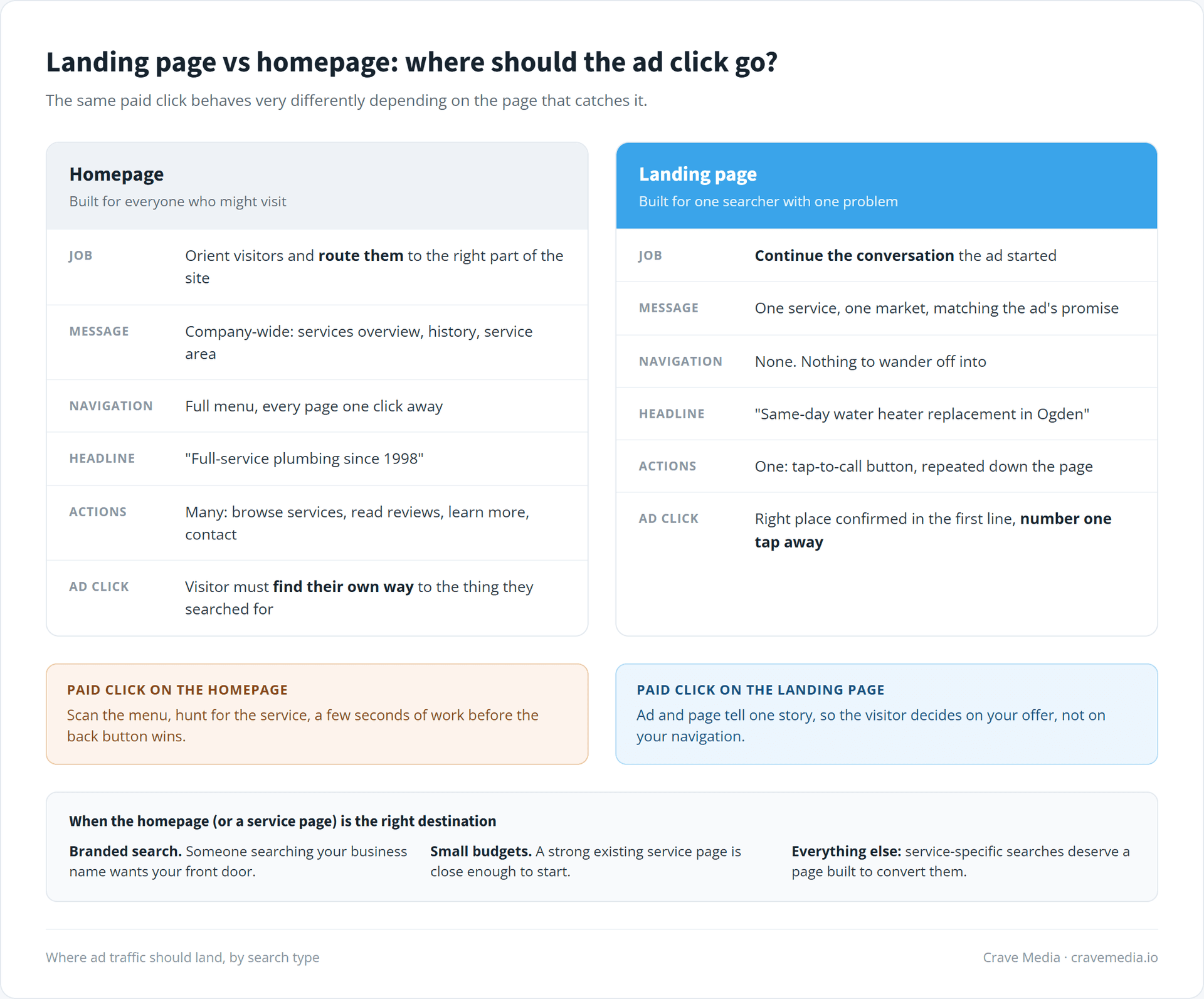
Your homepage is the front door of the business. It has to greet everyone: the person comparison shopping, the past customer looking for your number, the job applicant, the supplier, the person who half-remembers your name from a truck they saw. Its job is to orient people and route them, which is why it has a menu, a services overview, an about section, reviews, and six different places to click.
A landing page has one visitor in mind: the person who just searched for a specific thing and clicked an ad about it. Its job is to continue that one conversation. Someone searched "water heater replacement," your ad said you replace water heaters, and the page's only task is to confirm they're in the right place and make it easy to act. One service, one message, one thing to do.
Neither page is better. They're different tools. The problem starts when you make one do the other's job, and in practice that always means ad traffic getting dumped on the homepage.
What happens to a paid click on your homepage
Follow the click. Someone with a leaking water heater taps your ad and lands on a homepage that says you're a full-service plumbing company, family owned since 1998, serving the greater metro area. Now it's their job to find the water heater page. They scan the menu, maybe they open "Services," maybe they spot the right link on the third try.
Every one of those steps sheds people. They still need the plumber. But a stranger on a phone gives you a few seconds before the back button, and you spent those seconds making them navigate. The menu that helps a browsing visitor is an exit ramp for a paid one; every link that isn't "call now" is somewhere to leak.
There's a quieter cost too. The homepage speaks in general terms because it has to, so the person who searched a specific phrase never sees their exact problem reflected back. The ad promised one thing and the page changed the subject. We walked through this leak and several others in why your Google Ads aren't converting, and it's usually the first thing we check when a campaign's numbers look sick: where do the clicks land?
The homepage routes many kinds of visitors. The landing page continues one conversation the ad started, which is why paid traffic converts better on it.
What a landing page needs on it
A landing page for ads is built around message match: the headline picks up the exact promise of the ad. If the ad says "$79 drain cleaning," the page leads with $79 drain cleaning. If the ad says same-day water heater replacement in Ogden, the first line of the page says it back.
From there it needs less than most people think. Proof that you're legitimate and local: reviews, a license number, photos of your crew rather than stock photos. The answer to "do you serve my area," stated plainly. And a single action, repeated: a tap-to-call button at the top, again after the proof, again at the bottom. If you use a form, keep it to name, number, and what they need.
Just as important is what's not on it. No full navigation menu, no links to your other services, no blog sidebar. That feels wrong to owners at first, like hiding the rest of the store. But the visitor arrived with one problem, and everything unrelated to that problem is a place to wander off. We covered the broader conversion mechanics in what a high-converting local business website looks like; the landing page is that logic boiled down to one page for one searcher.
When the homepage is the right destination
An honest caveat: sometimes the homepage is the correct choice.
Branded campaigns are the clearest case. When someone searches your business name, they want your front door, and sending them to a narrow service page would be strange. Homepage wins.
Very small campaigns are a judgment call. If you're spending a few hundred dollars a month on one service you offer, and your site already has a strong, specific page for that service, point the ads at that service page. A well-built service page is a workable landing page; that's close enough to start, and better than delaying the campaign a month to build something custom.
What shouldn't land on the homepage is non-branded, service-specific search. "Furnace repair near me" is a person with a furnace problem, and the click costs the same whether you send it somewhere built to convert it or not.
How many landing pages you need
Fewer than you'd guess. The rule of thumb we use: one page per service you're actively advertising, and, if you advertise the same service across clearly separate markets, one per market. A campaign running drain cleaning, water heaters, and repipes needs three pages, because those three searchers need three different first lines.
Start with wherever most of the spend goes. If 70% of the budget is on emergency calls, build that page first and let the smaller ad groups share a page temporarily. You can always split later when the spend justifies it. What you're avoiding is the trap of one generic "our plumbing services" page catching every ad group, which recreates the homepage problem with extra steps.
This is also where the quality of the build matters. A landing page that loads slowly on a phone gives back everything the focus gained. It has to load fast and work with a thumb. The boring fundamentals carry more weight here than anywhere else on your site, because every visitor is one you paid for.
The page is part of the ad
Owners tend to treat the ad account and the website as separate projects with separate budgets and separate people. The searcher experiences them as one motion: search, click, land, decide. The page is the second half of the ad, and it's usually the half that decides the cost per lead.
So before raising a budget that isn't converting, look at where the clicks land. In our experience, fixing the destination tends to move the numbers further than another round of bid tweaks, and it's a one-time fix instead of a monthly one.
If you want a second set of eyes on it, we'll look at where your ad traffic is landing as part of a free audit. We build focused, fast landing pages as part of our site building service, and we'd rather tell you your current service page is close enough than sell you a page you don't need.

About the author
Zac Spencer is an online marketing specialist and the owner of Crave Media, based in Salt Lake City, Utah. Since 2013 he has managed hundreds of Google Ads accounts across dozens of industries — with budgets from a few hundred dollars to $250K a month — and run SEO for local businesses, ecommerce shops, and international franchises.