
Facebook Ads · July 10, 2026
Facebook vs Google Ads for local lead generation

By Zac Spencer · Owner, Crave Media
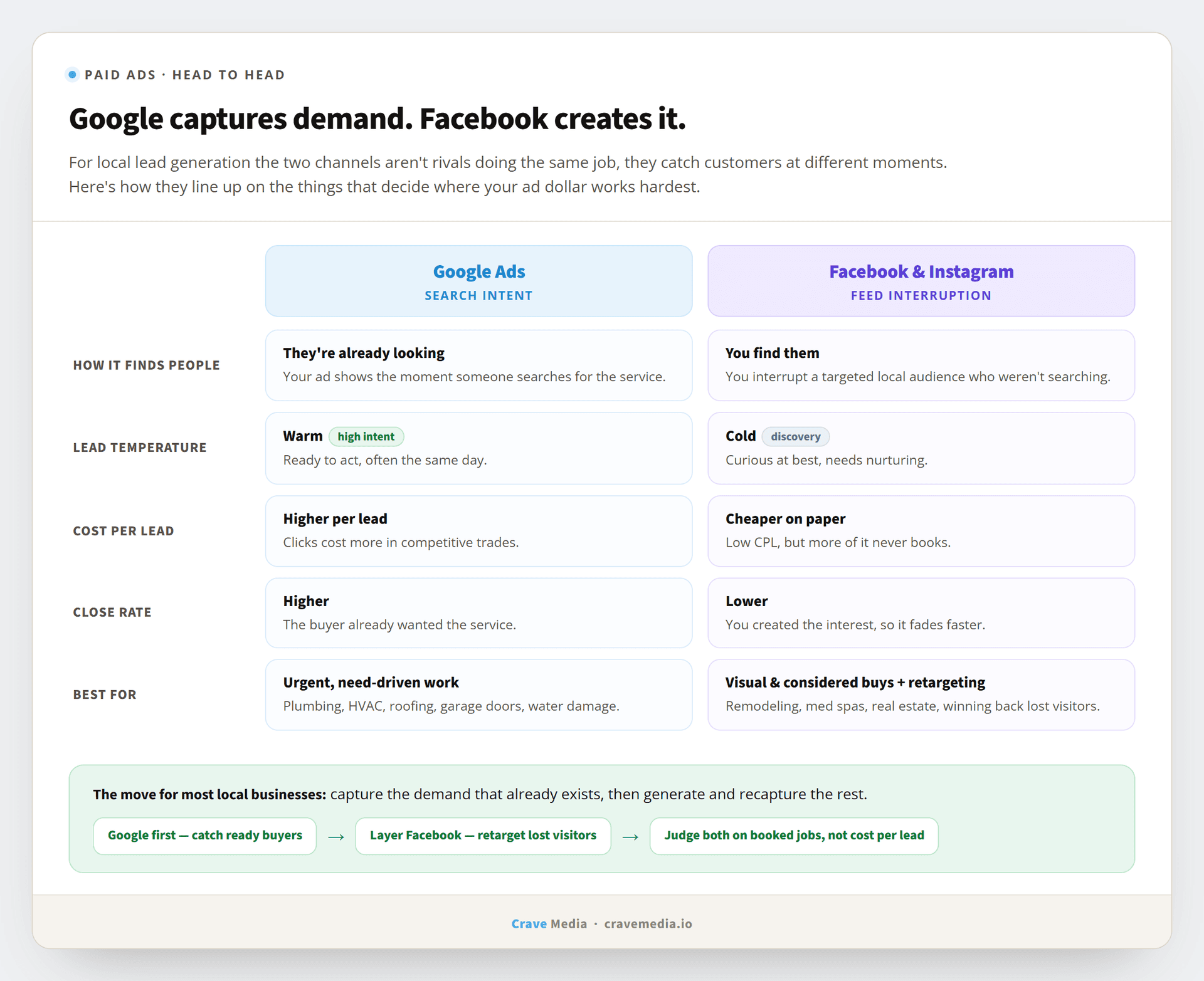
Just about every local business owner eventually asks some version of the same question: should I be running Google Ads or Facebook ads? Usually they're hoping for a clean answer, one channel that's simply better, so they can put their money there and stop wondering.
It doesn't work like that, and the reason is worth understanding, because it's the whole key to spending your ad budget well. Facebook and Google aren't two versions of the same thing competing for the same job. They catch customers at completely different moments, and once you see the difference, picking between them (or deciding to run both) gets a lot easier.
Intent versus interruption
Here's the distinction the entire decision hangs on.
Google Ads is intent. Someone types "emergency plumber near me" or "roof leak repair" into their phone, and your ad shows up at the exact moment they've decided they need what you sell. You're not convincing anyone to want the service. They already want it. You're just there when they reach for it.
Facebook and Instagram ads are interruption. Nobody opens Instagram looking for a plumber. They're there for their nephew's photos and a recipe video, and your ad slides into the feed between them. You're putting yourself in front of people who match your ideal customer but weren't thinking about you at all. That's not a weakness, it's just a different job: you're creating demand instead of catching it.
Every real difference between the two channels flows from that one split. Lead temperature, cost, close rate, which businesses each one suits, all of it traces back to whether you're catching a customer who's already looking or interrupting one who isn't.
Where Google Ads wins for local leads
For most local service businesses, Google is the workhorse of lead generation, and it's because of that intent.
When someone searches for your service, they're usually ready to act soon, sometimes within the hour. That makes search leads warmer and easier to close. A person searching "AC not blowing cold Memphis" is a different prospect than someone who happened to scroll past your cooling ad. They have the problem right now. The urgency is already there, and you didn't have to manufacture it.
That's why Google tends to win for anything urgent or need-driven: plumbing, HVAC, roofing, garage doors, water damage, locksmiths, towing. If your business gets called when something breaks, search is where that call starts. The trade-off is cost. Clicks in competitive trades aren't cheap, and you're limited to the demand that already exists, meaning you can't sell more than the number of people currently searching. But those leads close, which is what actually matters. If you're weighing search against organic rankings for the long game, we broke that down in Google Ads vs SEO and where a local business should start.
Where Facebook and Instagram win
Facebook earns its place in a different set of situations, and writing it off as "social media stuff" leaves money on the table.
Its strengths are reach and targeting. You can put your business in front of a huge local audience for relatively little, and you can slice that audience finely, by location, age, interests, and life events like a recent move or a new home. That makes it strong for services people don't search for the second they need them: remodeling, landscaping design, med spas, gyms, pest control plans, real estate. Nobody googles "I should probably redo my kitchen" at 9 p.m., but a good before-and-after photo in their feed can plant the idea.
The other thing Facebook does better than almost anything is retargeting. Someone visits your website, doesn't call, and leaves, which is what most visitors do. Facebook can put your business back in front of that person for days afterward, turning a lost visitor into a second chance. Even businesses that live on Google Ads often run Facebook purely to catch the people who slipped away. If you want the fuller picture on the channel, we wrote about whether Facebook ads still work for local businesses, and the short version is that they do, as long as you know what you're buying.
The lead-quality gap that fools people
This is where a lot of owners make the wrong call. They run both for a month, look at the cost per lead, see that Facebook's is lower, and shift their budget to Facebook. On paper it looks obvious. In reality it's often a mistake.
Facebook leads are usually cheaper because they're colder. You interrupted someone who wasn't looking, so more of those leads go nowhere, take longer to close, or were never that serious to begin with. Google leads cost more per lead but close at a higher rate, because the person was already trying to buy. When you do the math on cost per booked job instead of cost per lead, the "expensive" channel frequently turns out cheaper.
This is the single most common measurement trap in local advertising, and it's worth its own read: we covered exactly why in what a good cost per lead actually looks like. The number on the invoice is not the number that pays your bills. Judge every channel on jobs booked, not on the tempting cheap lead.
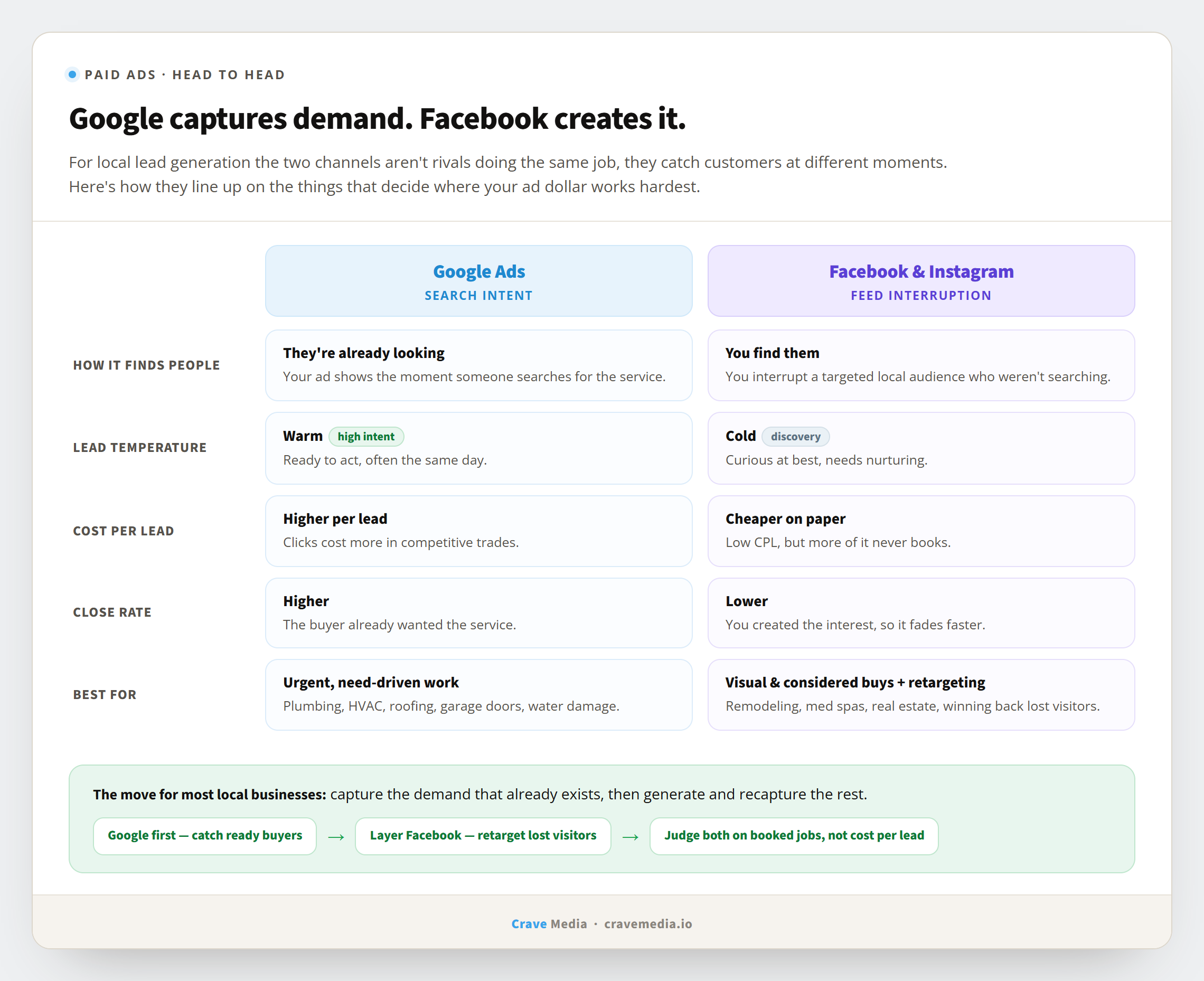
The two channels catch customers at different moments. Google captures the demand that already exists; Facebook creates and retargets demand that doesn't. Cheaper Facebook leads are usually colder, so judge both on booked jobs.
So which one should you run?
For most local service businesses that need the phone to ring, the honest answer is to start with Google. It captures people already looking for you, the leads close, and you can turn it on today and measure it fast. When someone's home is flooding, you want to be in the search results, not hoping they remember a video from last Tuesday.
Once your search campaigns are converting and you can see the numbers, Facebook becomes the layer you add on top. Use it to retarget the visitors Google sent who didn't call, to build awareness in your service area, and to sell the discretionary work people don't search for on impulse. Businesses built on visual results or bigger, considered purchases can lean on Facebook harder from the start, but even then it usually works best alongside search, not instead of it.
The other input is budget. If you can only fund one channel well, most lead-driven local businesses should put it into the one that catches ready buyers. A stretched budget split across both often underperforms one channel run properly, which is also why we're careful about how much a local business really spends on Google Ads before adding a second front.
Measure both fairly or don't bother
Whichever you run, the whole comparison falls apart without tracking, because you can't compare two channels you can't actually see.
You need call tracking and form tracking that tell you which channel each lead came from, and ideally which ones turned into booked jobs. Without that, you're comparing a Facebook cost per lead to a Google cost per lead and drawing confident conclusions from numbers that don't mean what you think. One business we worked with pulled 1,740 conversions from search with paid campaigns converting at 13.46%, and the reason we can say that plainly is that every lead was tracked to its source and its outcome. Set the measurement up first. Then let the booked jobs, not the cost per lead, tell you where the money should go.
Different tools, different jobs
Facebook versus Google was never really the right question. One catches customers who are already looking for you; the other introduces you to customers who aren't yet. Most local businesses that depend on leads do best starting with Google to capture live demand, then layering Facebook to retarget and generate more of it. Which mix fits you depends on your trade, your margins, and how people actually decide to buy what you sell.
If you'd like someone to look at your setup and tell you where your next ad dollar will do the most, our Facebook ads and Google Ads teams do exactly that, and a free audit usually finds the answer fast. The right channel is just the one that books you jobs, and that's a question with a real answer once you measure it.

About the author
Zac Spencer is an online marketing specialist and the owner of Crave Media, based in Salt Lake City, Utah. Since 2013 he has managed hundreds of Google Ads accounts across dozens of industries — with budgets from a few hundred dollars to $250K a month — and run SEO for local businesses, ecommerce shops, and international franchises.