
Local Service Ads · August 28, 2026
Why your Local Service Ads stopped producing leads

By Zac Spencer · Owner, Crave Media
The account used to ring. Twelve, fifteen leads a week, most of them real, and the badge sat at the top of the page like it owned the place. Then sometime in the last month or two it went quiet. Same budget, same profile, same phone. Two leads last week, one of them a wrong number.
When Local Service Ads stop working, almost nobody changed anything on purpose. That's what makes it confusing. The causes are mostly quiet ones, like a responsiveness score that slid a few points a week or an insurance certificate that expired in the background. Below are the reasons we find when we open a dried-up LSA account, roughly in the order we find them, and a 30-minute check you can run before you call anyone.
Google changed what LSA rewards
Two years ago you could get away with a slow phone and a middling review count if your budget was healthy. That's over. Google has steadily pushed Local Service Ads toward a ranking model where responsiveness and reviews weigh more than they used to, and budget weighs less than owners assume.
The reason is Google's own incentive. A homeowner who taps "Call" and gets voicemail blames Google, not you. So the system learned to promote the pros who pick up and to quietly demote the ones who don't, regardless of how much they're willing to pay per lead. If your account was built for the old rules, that alone can explain a slow slide over a few months.
Missed calls are the most common cause
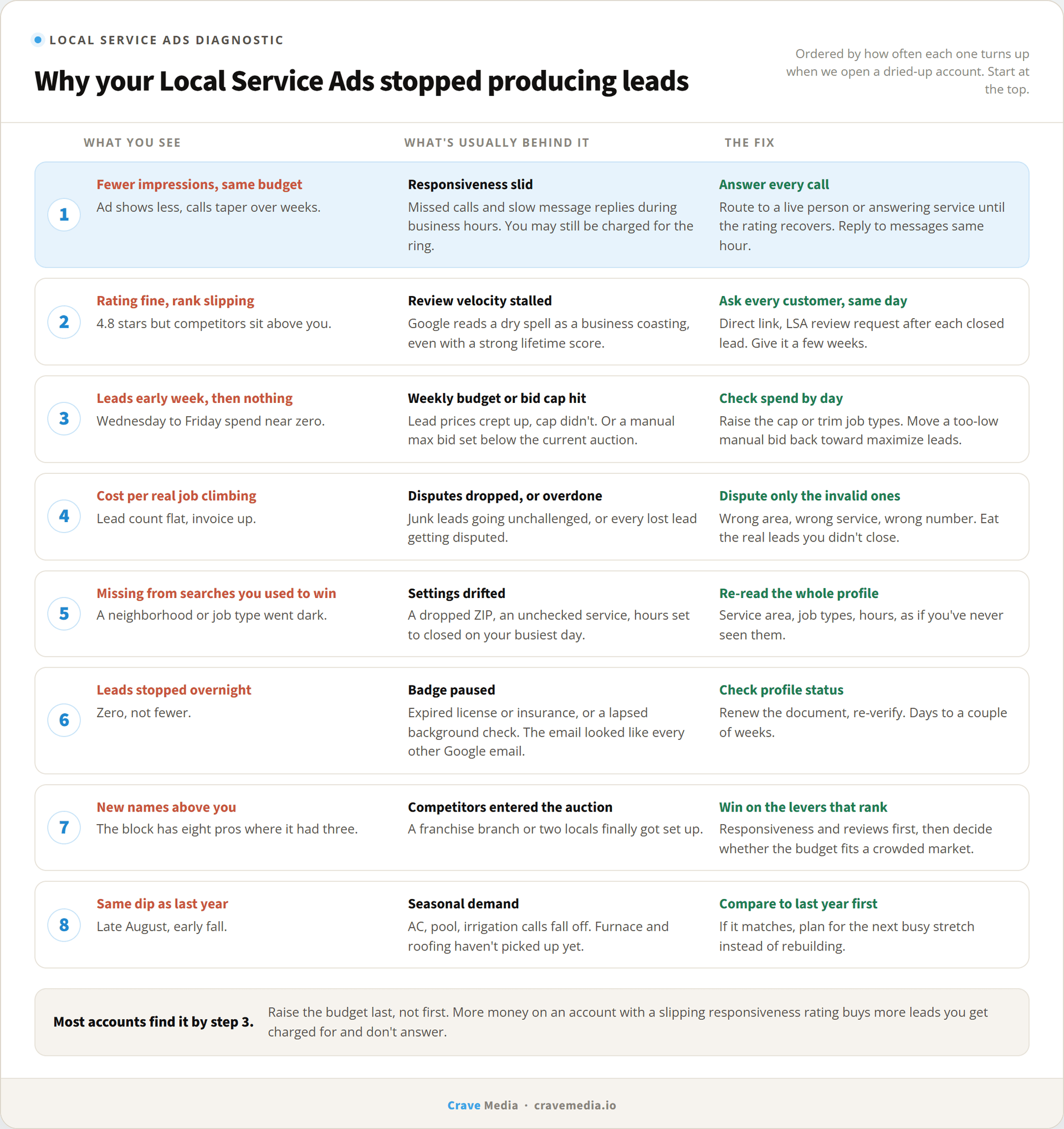
Every LSA account has a responsiveness rating, and it's the first thing we look at. It counts how often you answer the calls Google sends and how quickly you reply to messages. Let calls ring out during business hours, send them to a voicemail that fills up, take a day to answer a message, and the rating drops. When it drops, you show up less. When you show up less, you get fewer calls, and the ones you do get feel more precious, so a missed one hurts twice.
We see this with good businesses constantly. A two-truck plumbing company gets busy in July, the owner stops answering unknown numbers while on jobs, and by late August the ad has gone cold. Nothing was "broken." The phone was.
Here's the uncomfortable part: Google may still charge you for a call you didn't answer, if it rang long enough to count as a lead. A dead ad and a bill at the same time is the LSA version of a leaking faucet.
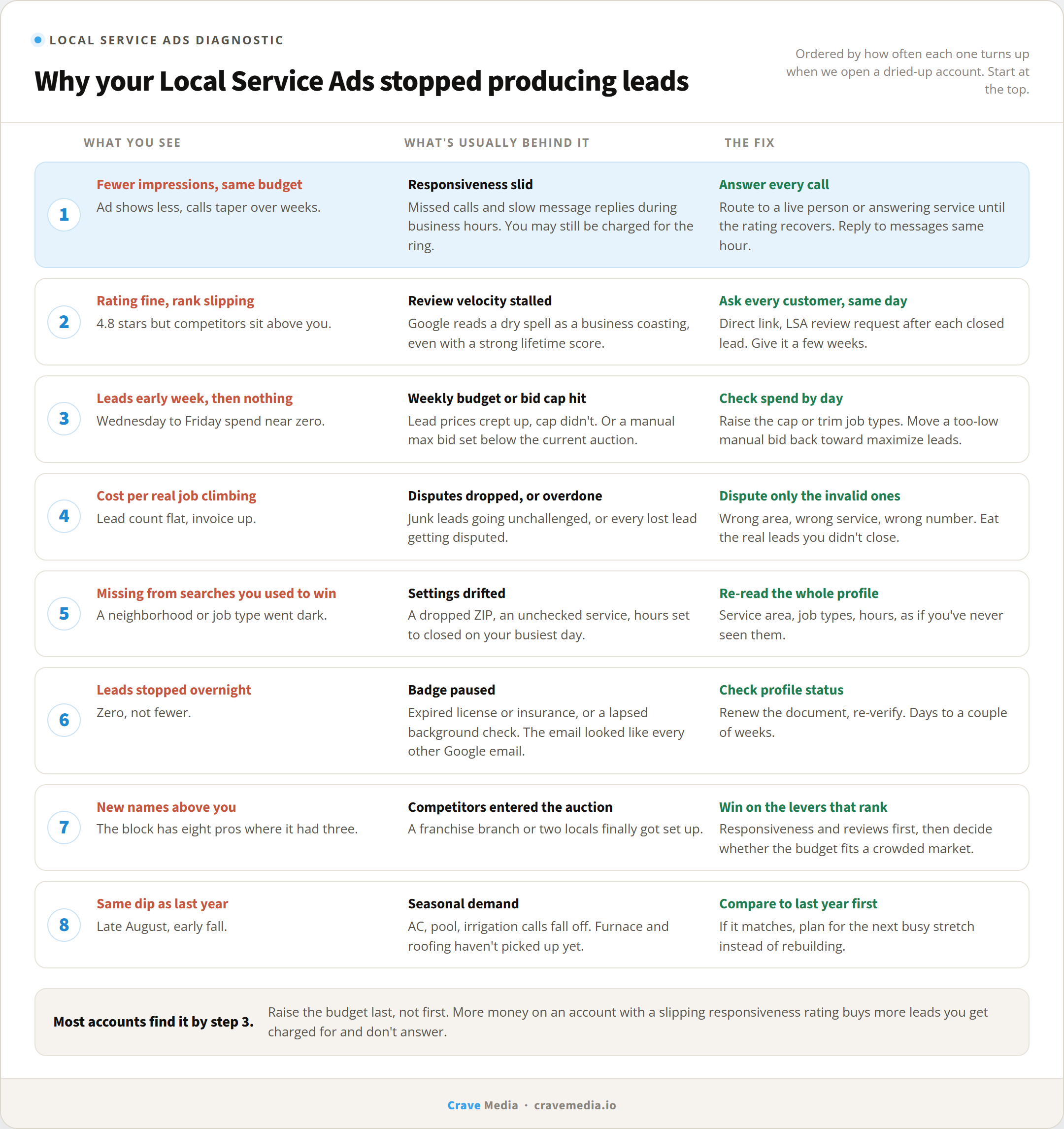
What a dried-up LSA account usually looks like from the outside, what's causing it underneath, and the fix, in rough order of how often each one turns up.
Your reviews stopped, even if your rating didn't
Owners look at their star rating and see 4.8 and assume reviews are fine. Google looks at velocity. A profile that collected 40 reviews last year and four this year reads as a business that's coasting, and the pros who are still collecting steadily tend to slide above you in the LSA block.
The fix is not a campaign. It's a habit: ask every customer, the same day, with a direct link, and let the LSA review request feature do its part after each charged lead closes. If you don't have that system, our guide on how to get more Google reviews lays one out. Expect a few weeks before the ranking notices.
The budget ran out on Tuesday
Easy to miss, because the ad isn't off. It's just gone for most of the week. Local Service Ads use a weekly budget, and Google can spend a good chunk of it early when demand spikes. If your budget hasn't moved since you set it up but lead prices in your category have crept up, you might be buying half as many leads as you were and running dry by midweek.
Check the spend by day. If Wednesday through Friday show near zero, that's your answer, and you'll have to decide whether to raise the cap or narrow what you're paying for. The other budget trap is a bid change. If you (or a previous manager) switched from the maximize-leads setting to a manual max-per-lead bid, and set it too low for the current auction, you'll simply lose most auctions without any warning.
You stopped disputing, or you disputed too much
Junk leads are part of the format. Wrong numbers, or a caller forty miles outside your service area who wants a quote anyway. Google gives you a window to dispute those and get credited, and if you've fallen out of the habit, your real cost per lead has quietly gone up even if the lead count didn't.
The reverse also shows up. A few accounts we've taken over were disputing almost everything, including legitimate leads that just didn't book. Google doesn't publish what it does with that pattern, but in our experience accounts that dispute aggressively and lose most of them don't tend to get better placement afterward. Dispute what's genuinely invalid. Eat the ones that were real leads you didn't close, and fix the closing.
Something drifted in your settings
Service areas and job types get edited more often than owners remember. A ZIP code gets dropped during a cleanup. A tech unchecks "water heater installation" because he was tired of those calls. A second location gets added and the budget gets split. Any of these can shrink the searches you're eligible for without touching the ad itself.
Open the profile and read every setting as if you've never seen it. Compare the service area to where your crews will really go, and the job types to the work you want. Then look at your hours, because LSA uses them to decide when you're shown. A business that set "closed Saturdays" during a slow winter is invisible on the busiest day of the week for a lot of trades.
The badge got paused and nobody noticed
The Google Guaranteed badge depends on a current license, current liability insurance, and passed background checks. When any of those lapse, Google can pause the profile until the document is renewed and re-verified, and the email telling you this looks like every other email from Google.
This one is a five-second check: the account shows a status, and the status shouldn't say anything other than active. If it does, the fix is paperwork, and re-verification takes days to a couple of weeks. We covered the full screening process in our piece on how the Google Guaranteed badge works, and the same steps apply to getting it back.
New competitors moved into the auction
Sometimes nothing about your account changed at all. A franchise opened a branch in your county, or two competitors who used to ignore LSA got set up over the summer, and the block that used to show three names now has eight pros fighting for the same spots.
Search your own service from a phone, in incognito, from a couple of neighborhoods you serve, and count who's above you. New names, new story. You can't buy your way past a competitor with faster responsiveness and steadier reviews, so the answer is the same two levers as above, plus a decision about whether your weekly budget still fits a more crowded market. Our breakdown of Local Service Ads versus Google Ads covers what to do when the LSA slot stops being enough on its own.
It might just be the calendar
Late August into early fall is a real dip for some trades. Air conditioning calls fall off as the heat breaks, pool and irrigation work winds down, and a lot of homeowners are spending on school instead of the house. Furnace and roofing demand picks up later, not yet.
Before you conclude the ad is broken, look at the same weeks last year. If the drop is seasonal, the fix is patience and a plan for the next busy stretch, not a rebuild.
The 30-minute check, in order
Do these in this sequence, because the first ones are both the most common and the cheapest to fix.
- Open the LSA dashboard and read the profile status. Anything other than active means paperwork first.
- Look at the responsiveness rating and the last two weeks of missed calls and unanswered messages.
- Check review count against 90 days ago. Fewer than five new ones and velocity is a problem.
- Look at spend by day of the week. Near-zero Wednesday through Friday means the budget or bid is the constraint.
- Read every service area, job type, and business hour on the profile as if for the first time.
- Open the leads list and count charged leads you haven't reviewed for disputes.
- Search your trade from a phone in two neighborhoods you serve and write down who's above you.
- Pull last year's same month and compare.
Most owners find their answer by step three. If you get to the end and everything looks fine, the account may have a deeper problem worth a rebuild. For scale, one of our clients' Local Service Ads accounts ran up 283 charged leads over a stretch, with another sitting at 176. A healthy account in a decent market produces. When yours doesn't, the format is rarely the reason.
Fix the phone before you touch the budget
When LSA leads dry up, the instinct is to raise the budget. Don't, at least not first. In most accounts we open, the phone and the reviews are what slid, and more money buys you more of the same problem: leads you're charged for and don't answer.
Get every call answered during business hours, even if that means a call-answering service for the two weeks it takes to prove it. Start asking for reviews again this week. Then look at the budget with the responsiveness rating heading the right way, and you'll know whether the leads were ever really gone.
If you'd rather have someone go through the account with you, request a free audit and we'll run this check on your Local Service Ads, tell you which of these is the cause, and what it'll take to get the leads back.

About the author
Zac Spencer is an online marketing specialist and the owner of Crave Media, based in Salt Lake City, Utah. Since 2013 he has managed hundreds of Google Ads accounts across dozens of industries — with budgets from a few hundred dollars to $250K a month — and run SEO for local businesses, ecommerce shops, and international franchises.