
Local Service Ads · October 2, 2026
How reviews and responsiveness decide your LSA ranking

By Zac Spencer · Owner, Crave Media
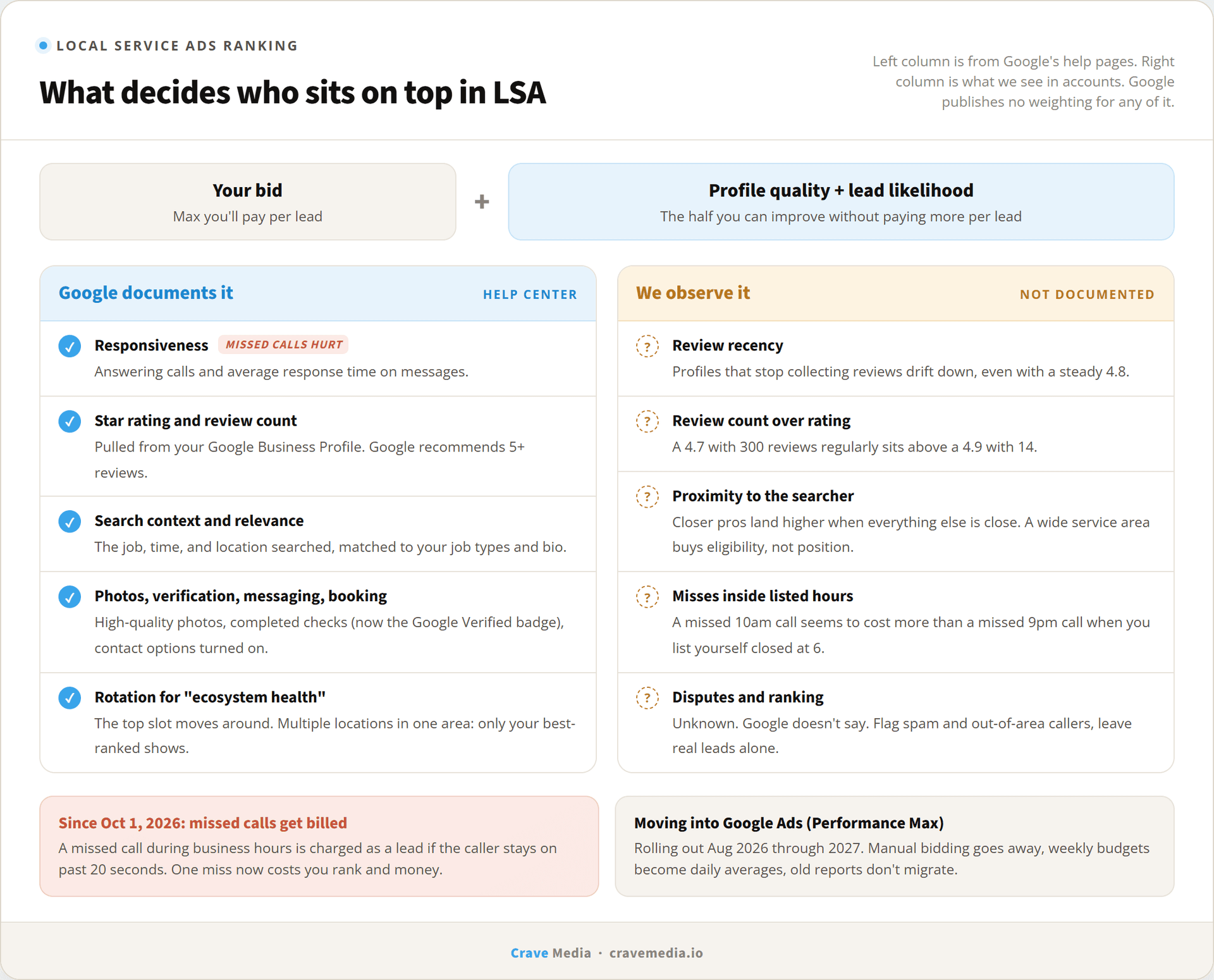
Most owners who run Local Service Ads have asked some version of the same question: why is that guy above me? Same trade, same town, maybe fewer trucks. Google does publish an answer, which surprises people. It's a short list on a help page, and it leaves out the part everyone wants, which is how much each item counts.
This post goes through the LSA ranking factors Google documents, then the ones we see move accounts that Google never puts in writing. Two things changed this fall that make the list more urgent. As of October 1, missed calls can be billed as leads. And Local Service Ads are moving into the regular Google Ads platform, which changes how bidding works.
The LSA ranking factors Google documents
Google's About ad rankings page says the order of the ads for any search comes from an auction that weighs your bid against the quality of your profile. The bid is the most you'll pay for a lead (Google notes you may pay less).
The quality side splits in two. First is how likely your ad is to turn into a lead, and responsiveness sits right at the top of that. The page says plainly that "missed calls may negatively affect your responsiveness." The same bucket covers the search itself, meaning the job, the time, and the location, plus how well your services and business bio match it. Having messaging and booking turned on helps here too.
Second is profile quality: your rating, your number of reviews, your average response time, high-quality photos, and the verification checks you've completed. That's the whole published list.
Two lines on that page get skipped a lot. Google says it optimizes for "the overall health and diversity" of the ads and gives "sufficient opportunity for all providers." In practice, the top slot rotates. Nobody owns it, and a business that shows up first on Monday may be third on Tuesday with nothing wrong. The other line: if you have several locations serving the same area, Google shows only your highest-ranking one.
A separate help page on reviews and ratings confirms that star rating and review count affect where you rank. That's about as specific as Google gets.
What Google leaves out
There's no published weighting. Google doesn't tell you whether ten more reviews beat a five-point jump in answer rate, or how far your shop can be from the searcher before it hurts you. Anyone who claims to know the exact formula is guessing, and so are we. What we can offer is what we've watched move accounts. Treat it as observation.
Recency is the big one. The help pages mention rating and count, never how recent your reviews are. In the accounts we manage, a profile that stops collecting reviews drifts down even while its star rating holds steady at 4.8.
Proximity shows up too. Google lists "location" as part of the search context and stops there, but pros closer to the searcher keep landing higher when everything else is roughly equal. And hours seem to set the bar for responsiveness. A call missed at 9pm when you list yourself closed at 6 appears to hurt less than one missed at 10am, which fits how the new billing rule below is written.
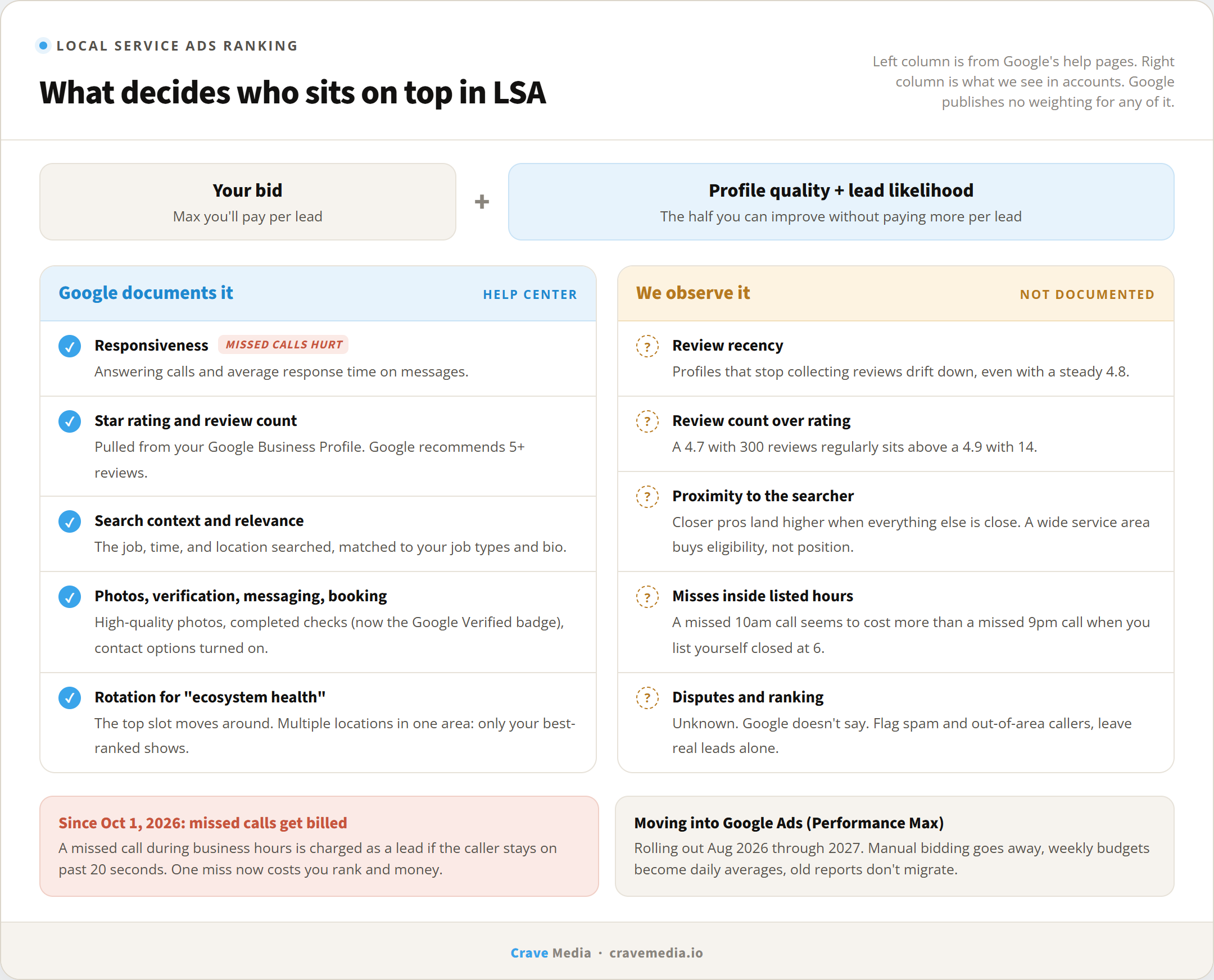
The LSA ranking factors Google puts in writing, next to the ones we see move accounts that it doesn't.
Responsiveness now costs you twice
Responsiveness was already the factor most owners could move fastest. On October 1 it got more expensive to ignore.
Google emailed advertisers in late August that starting October 1, 2026, a missed call during business hours gets charged as a valid lead if the caller stays on the line for more than 20 seconds (PPC Land and Search Engine Roundtable both covered the notice). If your phone system makes callers press a key to reach the right department, the 20 seconds start after they press it. Follow-up calls with the same customer can now be charged too, if the first call didn't qualify.
Google's stated reason is "rewarding businesses that provide excellent responsiveness." So a call that rings out in the middle of a Tuesday is a lead you paid for and a mark against your ranking. Before October it was only the second one.
Start with your listed hours, which should match the hours a person really answers. If nobody picks up after 5, don't list 7am to 9pm. List 24/7 only if someone is awake at 2am with the phone in hand.
Then put a live person behind the number for every one of those hours. For a three-truck crew that's on job sites all day, an answering service often pays for itself in avoided charges alone, and we'd rather see an owner spend there than on a bigger budget.
Turn on messaging, and reply within the hour. Google's performance tips say message leads "typically cost less than phone leads," and average response time is one of the profile-quality items it names. Last, cut the phone menu if you have one. Press-1-for-sales costs you callers.
If you don't know how many calls you miss, call tracking will tell you within a week. Look at the misses by hour. They usually bunch up around lunch and the last hour of the day.
How reviews feed your ranking
Google confirms two review signals, star rating and review count. Its performance page recommends five or more reviews and notes that some business types need five before the ad will show at all. LSA pulls those reviews from your Google Business Profile, so the reviews you collect for the map pack count here as well.
Count is the one owners underrate. In the markets we watch, a 4.9 with 14 reviews regularly sits below a 4.7 with 300. From the homeowner's side that's fair, since 300 reviews are a lot harder to fake. Past a few dozen, a steady trickle of new reviews does more for you than chasing a perfect score. The pros holding the top spots in Salt Lake and Ogden mostly don't have the best rating. They ask every customer, the same day the job wraps.
Google's reviews page gives you a business-specific link to send customers, and it points out that customers are more likely to leave a review when the request comes from you directly. Stay inside the rules, too. Reviews fall under Google's Maps contributed-content policies, and anything that breaks them gets removed. Our guide on getting more Google reviews without breaking the rules covers the asking system and what counts as gating.
Proximity, hours, and service area
You can't move your shop, so proximity is mostly out of your hands. What you can control is how you set the area around it.
Google's own advice is to set service areas broadly, a whole county instead of a handful of ZIP codes, and to check every job type you perform. For eligibility that's right. Broad settings make you eligible for more searches. The catch is that being eligible doesn't make you competitive. A plumber in Sandy who adds all of Davis County will show up there sometimes, below the Layton and Bountiful pros who are closer. The leads that do come in tend to be slower to reach and harder to book. Set the area as wide as you'll really drive, and let the far edge prove itself before you push it further.
Google also counts the time of the search as context, so the hours you list cut both ways. If you're closed Saturdays on the profile, you're out of the running on the busiest day of the week for a lot of trades.
Profile completeness and the badge
The profile items Google names are easy to finish and easy to forget. Add real photos of your crew and finished jobs; Google's guidance is team, work, or equipment, with nothing personally identifying. Write a business bio that names the services you want calls for, since relevance is judged partly from it. Check every job type you do.
Verification counts too. Starting in October 2025, Google folded the old Google Guaranteed, Google Screened, and License Verified badges, along with the Money Back Guarantee program, into a single Google Verified badge. The screening behind it still runs on your license, insurance, and background checks, which our earlier walkthrough of the Google Guaranteed screening process covers step by step under the old name. Let a document lapse and the profile can pause until it's re-verified.
Bad leads and credits
Disputes used to be a weekly chore. Since mid-2024, Google has credited many invalid leads on its own, with a lead-rating option where the old dispute button was (Search Engine Land covered the change). What your account shows depends on your category and region.
Google doesn't say whether disputing or rating leads affects ranking, so we won't pretend to know. Our habit is to flag spam and callers from outside the service area, and leave alone the real leads that just didn't book. Those are worth a conversation with whoever answered the phone.
Your bid counts, and it's the worst lever
You'll hear that you can't buy your way up in Local Service Ads. Google's own page says otherwise. Bid is the first thing it lists.
We'd still pull that lever last, every time. A bigger bid lifts you only as long as you keep paying it, and it does nothing for the profile-quality half of the auction. A better answer rate and a steadier review pace lift you without raising what you pay per lead, and they keep working after you stop thinking about them. Raise the bid on an account that misses a third of its calls and you've bought more missed calls, which Google now bills.
The bid itself is also getting harder to touch. Google's transition notice says LSA campaigns are moving into Google Ads as Performance Max campaigns with pay-per-lead goals, starting with US categories like plumbing, HVAC, roofing, and house cleaning in August 2026 and rolling through 2027. Manual bidding goes away. Your weekly budget gets divided by seven into a daily average, with monthly spend capped at that figure times 30.4, and one campaign-level target replaces per-service targets. Historical reports don't migrate, so download yours from the old dashboard before your account moves.
Earn the spot instead of renting it
The account above you probably isn't outbidding you. It answers when you don't, and it has collected a review a week for two years while yours collected one a month. Fix the phone first. Since October, it's the one that shows up on the bill.
If you want help, our Local Service Ads management starts with the responsiveness and review numbers before anyone touches the bid. Or get a free audit and we'll pull your answer rate and review pace and show you which factor is costing you the most placement.

About the author
Zac Spencer is an online marketing specialist and the owner of Crave Media, based in Salt Lake City, Utah. Since 2013 he has managed hundreds of Google Ads accounts across dozens of industries — with budgets from a few hundred dollars to $250K a month — and run SEO for local businesses, ecommerce shops, and international franchises.