
Strategy · November 24, 2026
Questions to ask before hiring a marketing agency

By Zac Spencer · Owner, Crave Media
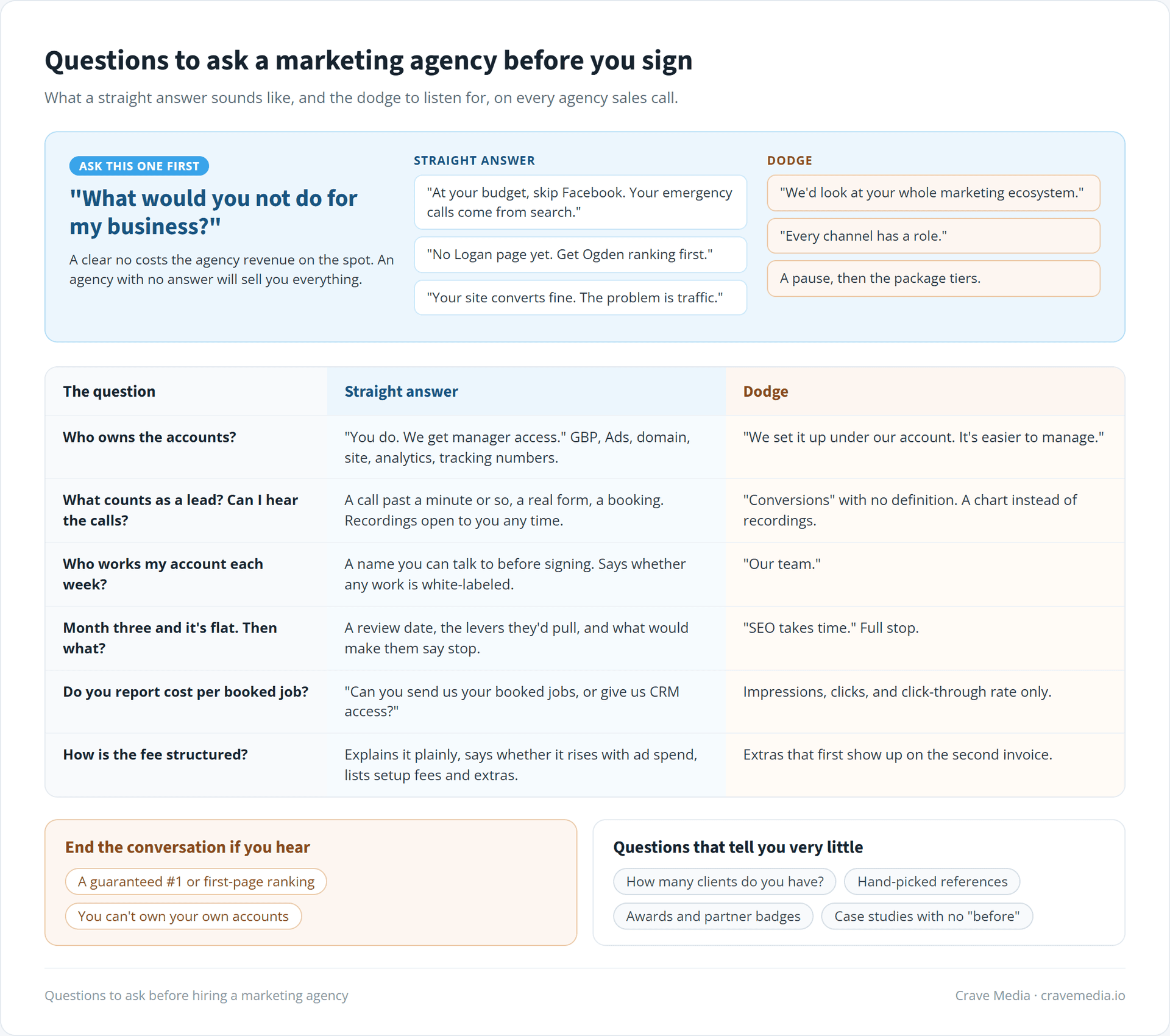
December is when a lot of owners line up next year's marketing. An HVAC company in Ogden takes three agency calls in a week, gets three decks with the same charts on them, and ends up picking the one whose salesperson was easiest to talk to. That's a fine way to pick a lunch spot, and a rough way to pick who spends next year's ad budget.
The decks won't separate them. The questions to ask a marketing agency on those calls will, if you know what a straight answer sounds like and what a dodge sounds like.
We should say where we sit. We're an agency, and we get asked most of these on sales calls. A couple of them are pretty uncomfortable to answer, which is a decent sign you're asking the right ones.
The best question to ask a marketing agency
If you only get one question in, make it this one. "What would you not do for my business?"
It works because it cuts against how agencies make money. More channels mean more work and a bigger invoice, so an agency's default incentive is to say yes to everything: SEO, Google Ads, Facebook, a new website, a TikTok strategy. A clear no costs them revenue on the spot. When an agency tells you what to skip, they're giving up money to tell you the truth, and that's about the most reliable signal you'll get in a sales call.
A good answer is specific to you. Something like:
- "At your budget, we'd skip Facebook for now. Your emergency calls come from search, and we'd rather put every dollar there."
- "We wouldn't build a page for Logan yet. Get Ogden ranking first, then expand."
- "We wouldn't touch your website this year. It converts fine. The problem is traffic."
- "If you're booked out through March, we'd pull back on ads and not chase more leads you can't run."
An evasive answer sounds like "we'd look at your whole marketing ecosystem," or "every channel has a role," or a pivot back to the package tiers. Sometimes there's just a pause and then a pitch. Any of those tells you the plan was written before they learned anything about you.
Our take: an agency with no answer to this question will sell you everything. Usually that's a homework problem more than an honesty problem. They haven't thought hard enough about your business to know what doesn't fit, and you'll pay for that gap every month.
A related question is "Would you ever tell me to spend less?" Ask for an example of when they did. An agency that has told a client to cut a channel or lower a budget will have a story ready, usually with a reason attached (a slow season, a crew they couldn't staff, a channel that never paid). An agency that hasn't will talk about "optimizing spend" and change the subject.
Who owns the accounts when we part ways
Ask who owns the Google Business Profile, the Google Ads account, the domain, the website, the analytics, and the call tracking numbers. The answer you want is short: "You do. We get manager access."
The dodge is "we set everything up under our account, it's easier to manage." Easier for them, sure. If you ever leave, your ad history, your conversion data, and sometimes the phone numbers on your trucks stay behind. We covered the full ownership checklist in why month-to-month beats long marketing contracts, and it's worth running before you sign with anyone, us included.
What counts as a lead, and can you hear the calls
"Leads" is the most stretchable word in marketing. Ask the agency to define it for your account. A good answer is concrete: a phone call that lasts past a minute or so, a form with a real name and number, a booked appointment. Then ask whether you can hear the recorded calls and see the raw form submissions yourself, any time, without asking.
Watch out for answers built on "conversions" with no definition. In Google Ads, a conversion is whatever someone told the account to count. It can be a ten-second call, a click on the phone number that never turned into a call, or a visit to the contact page. A report showing 140 conversions can mean 140 leads or 30 leads and a lot of noise. If you want to check the numbers yourself, reading a Google Ads report takes about ten minutes once you know where to look. Start with the conversion actions list and see what's being counted.
Who will work on my account each week
The person on the sales call is often not the person doing the work. That's normal at most agencies, and it's not a problem by itself. Ask anyway: "Who builds and manages my campaigns week to week, and can I talk to them before I sign?"
Then ask whether any of the work is outsourced or white-labeled to another company. Plenty of agencies resell someone else's SEO or ad management, and you should know whose hands are on your account. If every answer comes back as "our team," ask for a first name. And find out who you call when the tracking breaks on a Friday afternoon.
What happens in month three if it isn't working
Every channel takes some time, so a fair agency won't promise results in week two. What you want to hear is how they'll judge progress before results show up. For Google Ads, that's usually conversion data within the first couple of months. For SEO, it's leading signals like impressions, new pages indexed, and calls from your Google Business Profile, long before rankings settle.
Ask: "If we're three months in and the numbers are flat, what do you change, and what would make you tell me to stop?" Listen for a review date and the levers they'd pull. "SEO takes time," full stop, leaves you no way to tell a slow start from a stalled one (and you'll hear it in month nine, too).
Do you report cost per booked job
Cost per lead is the number most agencies report. Cost per booked job is the number that pays your crew. A channel can produce cheap leads that never book, and a report built on cost per lead will make that channel look like your best one.
An agency can't see your bookings unless you share them, so the good answer to this question is a question back: "Can you send us your booked jobs each month, or give us read access to your CRM?" That agency plans to judge itself on revenue. If all you get is a sample report full of impressions, clicks, and click-through rate, those numbers are real, but none of them books a job. Our post on what a good cost per lead looks like walks through why the booked-job number is the one to hold an agency to.
How the fee is structured
You'll ask what it costs. Ask how it's built, too. "How is the fee structured, and does it rise when ad spend rises?"
Flat monthly fees, a percentage of ad spend, and hybrids of the two are all common, and none of them is wrong on its own. Each one creates a different pull. A percentage-of-spend agency earns more when you spend more, which is exactly why the "would you ever tell me to spend less" answer carries extra weight there. A flat fee removes that pull but can drift toward doing the minimum. Either way, ask what's included, whether there's a setup fee, and whether call tracking, landing pages, or reporting tools are billed separately. We've seen owners find a tracking-software line on the second invoice that nobody mentioned on the call.
The questions to ask on every agency call, with the answer you want and the dodge to listen for.
Questions that tell you very little
Some questions feel like due diligence and don't separate anyone. "How many clients do you have?" A big number can mean a big team or a lot of accounts per person. "Can I talk to a reference?" Ask, but know you'll be handed the happiest client they've got. Awards and partner badges mostly tell you an agency filled out a form or hit a spend threshold.
Case studies are more useful if you push on them. Ask what the client's business looked like before, what the agency did in the first 90 days, and whether that client is still with them. A result with no before picture is a brochure.
How to choose a marketing agency after the calls
Once the calls are done, lay the answers side by side and ignore how good the deck looked. Count the specifics. The agency that named something it wouldn't sell you and asked for your booked jobs is planning to be measured.
Two answers should end the conversation on their own. One is a guaranteed first-page ranking. Google's own guidance on hiring an SEO says "no one can guarantee a #1 ranking on Google" and warns about companies that are secretive or won't clearly explain what they intend to do. The other is an agency that won't let you own your accounts.
If you're still deciding whether you need outside help at all, start with whether to hire a marketing agency or do it yourself. Vetting a marketing agency gets easier once you know which jobs you're handing off.
Listen for the no
The agency worth hiring is usually the one that turned down some of your money on the first call. It told you which channel to skip, or that your website was fine and the money should go to traffic. An agency willing to say that before you've signed is planning around your results, and it'll probably keep saying it after.
Run these questions on us too. You can see how we approach SEO, Google Ads, Local Service Ads, and the rest of our services, or request a free audit and we'll look at what you're running now and tell you what we'd keep, what we'd fix, and what we wouldn't do for you at all.

About the author
Zac Spencer is an online marketing specialist and the owner of Crave Media, based in Salt Lake City, Utah. Since 2013 he has managed hundreds of Google Ads accounts across dozens of industries — with budgets from a few hundred dollars to $250K a month — and run SEO for local businesses, ecommerce shops, and international franchises.