
Strategy · September 29, 2026
Why month-to-month beats long marketing contracts

By Zac Spencer · Owner, Crave Media
The sales call went well. The agency seemed sharp, the plan made sense, and then the agreement shows up with a twelve-month term and a line about it being "industry standard." If you run a plumbing company or a roofing crew, you've probably seen some version of this, and you probably signed it, because everyone says marketing takes time.
Marketing does take time. That part is true. What doesn't follow is that you need to be locked in for a year to get it. For most local service businesses, a month to month marketing agency is the better deal, and the reasons have less to do with trust than with how fast a trade business changes over twelve months.
Fair warning about where we sit: every client we work with is month-to-month, so we have a side here. We'll also cover the cases where a longer commitment is reasonable, because there are a few.
Who a long contract protects
Think of a twelve-month agreement as an insurance policy and ask who collects on it. If the agency does good work, you'd have stayed anyway, so the contract changed nothing. It only pays out in the months you'd rather be gone. The agency is the beneficiary, and you're paying the premium in the form of lost options.
That isn't a moral judgment on agencies that use them. Onboarding a new client costs real hours, and an agency that loses accounts at month two loses money. The question is who should carry that risk: the business owner, or the people who control the quality of the work. We'd put it on the people doing the work, every time.
Your business changes faster than a year
The bigger problem with long contracts in the trades is that the plan you sign in March is often wrong by August, for reasons that have nothing to do with the agency.
A few of the ways it happens:
- You lose a tech and can't run the leads you're paying for.
- A hailstorm rolls through Davis County and a roofer is booked out for six weeks.
- You add drain cleaning or mini-splits and need that service pushed, not the one you started with.
- A competitor quits the market and your cost per lead drops so far that the old scope looks bloated.
- Winter arrives and demand for your service falls off a cliff.
Seasonality alone breaks most annual plans. A lawn care company in Ogden or an AC company in Salt Lake should be spending ahead of the busy season and tapering through the slow one, which we walked through in our seasonal marketing plan for service businesses. A fixed annual scope usually can't bend like that. Month-to-month can, because the conversation about next month's work happens every month.
Watch for ad spend minimums tucked into the management agreement, too. You can always pause a Google Ads campaign yourself, but some contracts require a minimum monthly spend as a condition of the management terms. When you're booked out three weeks and still obligated to buy leads, the contract is costing you twice.
Why a month to month marketing agency works harder
An agency that can lose you next month has to answer one question on every invoice: why should you pay again? That pressure is good for you. It means the monthly report has to show something, the calls have to get returned, and problems get fixed in week two instead of month five.
It also changes what the second year means. One of our clients has grown organic traffic 423% year over year, and nobody was contractually required to stick around for that second year. They stayed because the numbers kept showing up.
Month-to-month is not a quality guarantee, though. Plenty of mediocre agencies work without contracts and coast anyway, because they've learned most clients never check. The freedom to leave only helps if you use the information in front of you. If you're still deciding whether to hire outside help at all, our take on whether to hire a marketing agency or do it yourself covers that fork first.
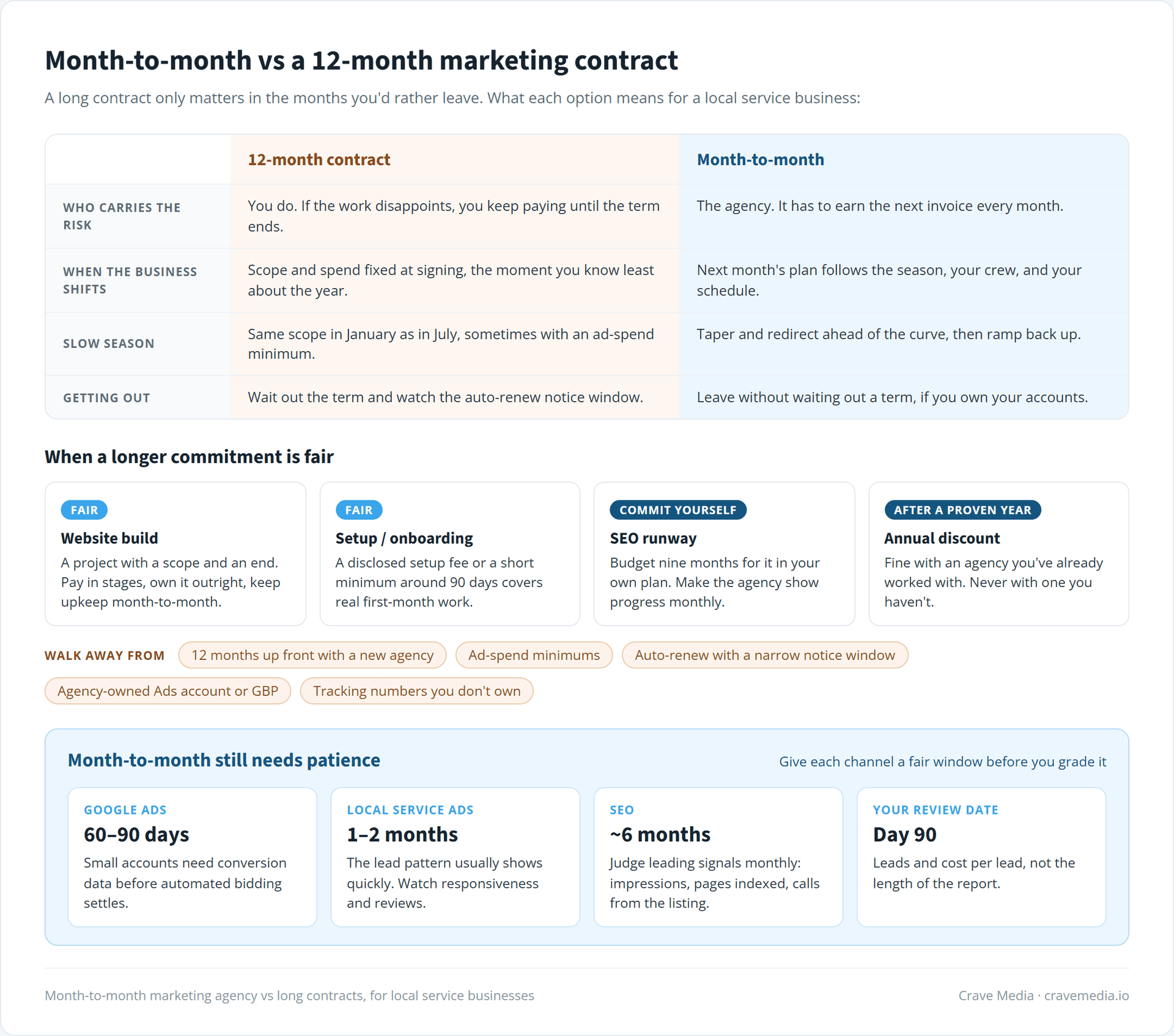
Where a commitment makes sense and where it doesn't, plus how long each channel needs before a month-to-month client should judge it.
When a longer commitment is fair
Now the other side. Some commitments are reasonable, and refusing all of them on principle can cost you a good partner.
A website build is a project, and it should be priced like one. It has a scope, milestones, and an end. Paying for it in stages or up front is normal. What isn't normal is a site you can only keep by paying a monthly fee for years, or one built on a platform you can't take with you. Buy the build as a project, own it outright, and keep the ongoing maintenance month-to-month.
Setup work is real. The first month of a new account is heavy: auditing what exists, fixing tracking, cleaning up the Google Business Profile, rebuilding campaigns. An agency asking for a disclosed setup fee, or a short minimum of around 90 days, is covering real cost. Ninety days is a fair ask for a new engagement. Twelve months up front is not.
SEO needs runway. Any agency that says otherwise is guessing. SEO usually takes six months or more to pay off in a meaningful way, and quitting at month three means you paid for the foundation and never got the house. So commit to that timeline yourself. Write nine months of SEO into your own budget, then make the agency show you progress every month. If they can, you'll stay without being told to. If they can't, month four is a fine time to find out.
Then there's the annual discount. Some agencies offer a lower rate in exchange for a year. That can be a fine trade, with one condition: sign a long contract with an agency you've already worked with, never with one you haven't. After a year of results you know what you're buying. Before the first month, you're buying a pitch.
The lock-in that isn't in the contract
A month-to-month agreement means little if the agency owns the accounts. The quieter lock-in is ownership, and it's worth checking this week whatever your contract says.
You should be able to log in yourself, with your own email, to:
- Your Google Business Profile, as the primary owner
- Your Google Ads account (the agency gets manager access, not the other way around)
- Your domain registrar and website hosting
- Your analytics and Search Console
Call tracking numbers deserve a look too. If the agency owns the numbers, your call history and every number printed on your trucks can leave with them. We covered how to set this up cleanly in our guide to tracking which marketing brings in calls. Leaving an agency that holds your accounts means rebuilding from scratch, and that's a harder exit than any contract clause.
How to judge a month-to-month agency
Month-to-month has one real downside: it makes it easy to quit too early. One slow month, a nervous owner cancels, and the next agency starts from zero on work that was about to pay off. The new agency redoes the audit and the setup, and the owner pays for month one twice.
Give each channel a fair window before you grade it. A small local Google Ads account often needs 60 to 90 days of conversion data before automated bidding settles down. Local Service Ads usually show their pattern within a month or two. SEO is slower, so judge it on leading signals, like impressions, new pages indexed, and calls from your listing, and expect rankings to move closer to month six. Our breakdown of the first 90 days of an SEO campaign lists what should exist by each point.
Put a review date on your calendar 90 days after you start. On that day, look at leads and cost per lead, not the length of the report. If you're not sure how to read what they send you, reading a Google Ads report takes about ten minutes once you know which three numbers to check first. If the numbers and the explanation both hold up, keep going. If neither does, month-to-month means you can leave without waiting out a term.
If you're already under contract
You don't need to break a contract. Just get ready for its end.
Find the end date and the renewal clause. Many agreements renew automatically unless you give written notice inside a set window, often 30 to 90 days before the term ends. Put that window on your calendar now. While things are still friendly, confirm you have admin access to everything on the ownership list above, and ask for it in writing if you don't. Getting access is much easier in month eight than on the day you give notice.
Stay because it's working
The best reason to keep paying an agency is that the phone rings more than it did before you hired them, and you can see why in the numbers. A contract can't create that. It can only keep you paying after it stops.
If you want to see how we run SEO, Google Ads, and the rest of our services on a month-to-month basis, the service pages lay it out. Or start with a free audit and we'll look at what you're running now, who owns what, and whether your current setup is earning its keep.

About the author
Zac Spencer is an online marketing specialist and the owner of Crave Media, based in Salt Lake City, Utah. Since 2013 he has managed hundreds of Google Ads accounts across dozens of industries — with budgets from a few hundred dollars to $250K a month — and run SEO for local businesses, ecommerce shops, and international franchises.