
Strategy · August 25, 2026
How to track which marketing brings in calls

By Zac Spencer · Owner, Crave Media
The phone rings and nobody knows why
Ask a new customer how they found you and you'll get the same answer almost every time: "Google." That answer sounds useful and tells you close to nothing. Google is your SEO, your Google Ads, your Local Service Ads, and your Business Profile, and those four things have wildly different price tags. If you can't track which marketing brings in calls, you're deciding next month's budget on a shrug.
For most local businesses the phone call is the lead. Form fills matter, but the customer who's ready to book picks up the phone. So the whole attribution question comes down to one thing: when the phone rings, can you tell which channel made it ring? The setup that answers this costs less than most owners expect and takes about an afternoon to plan. This post walks through it.
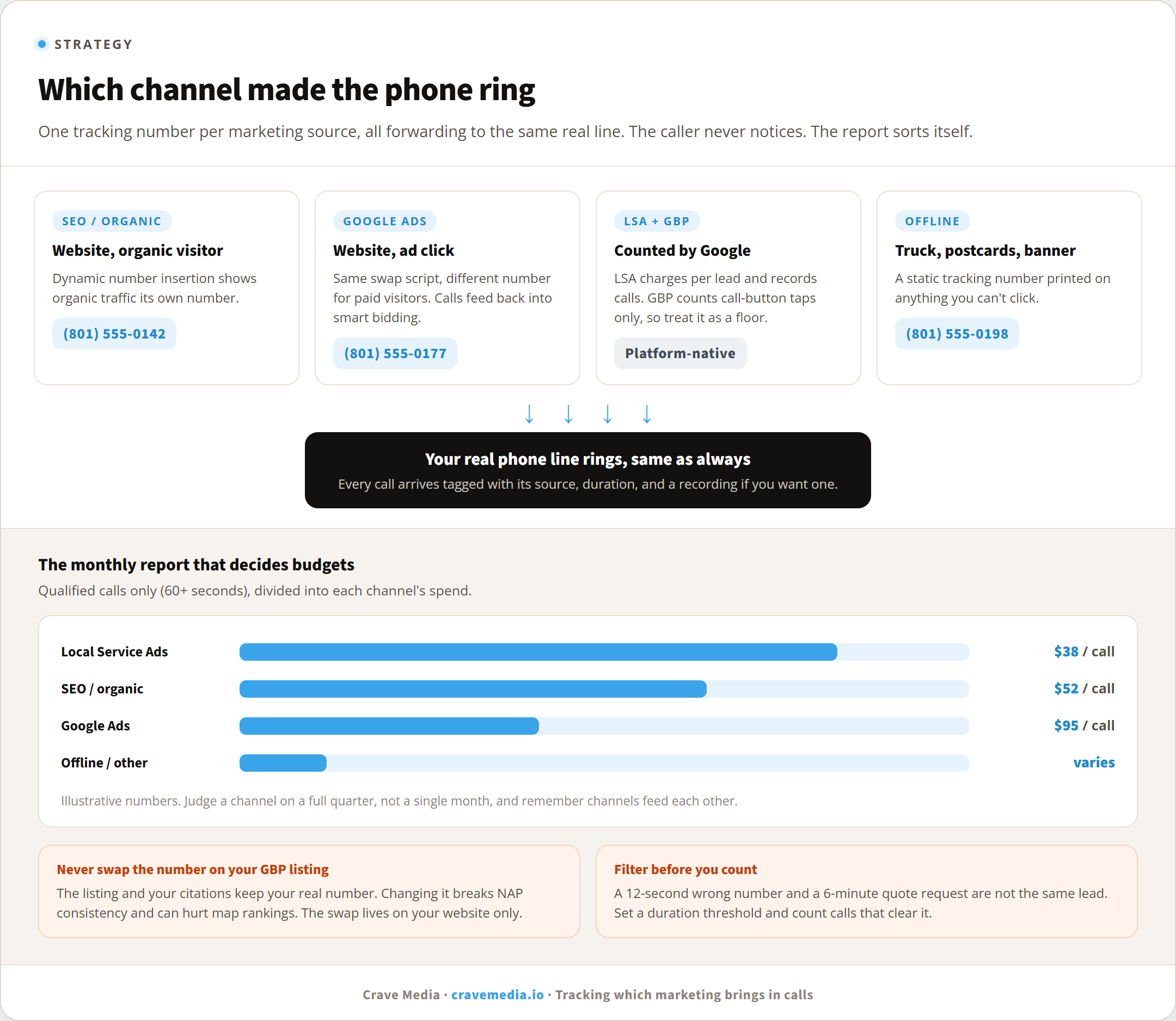
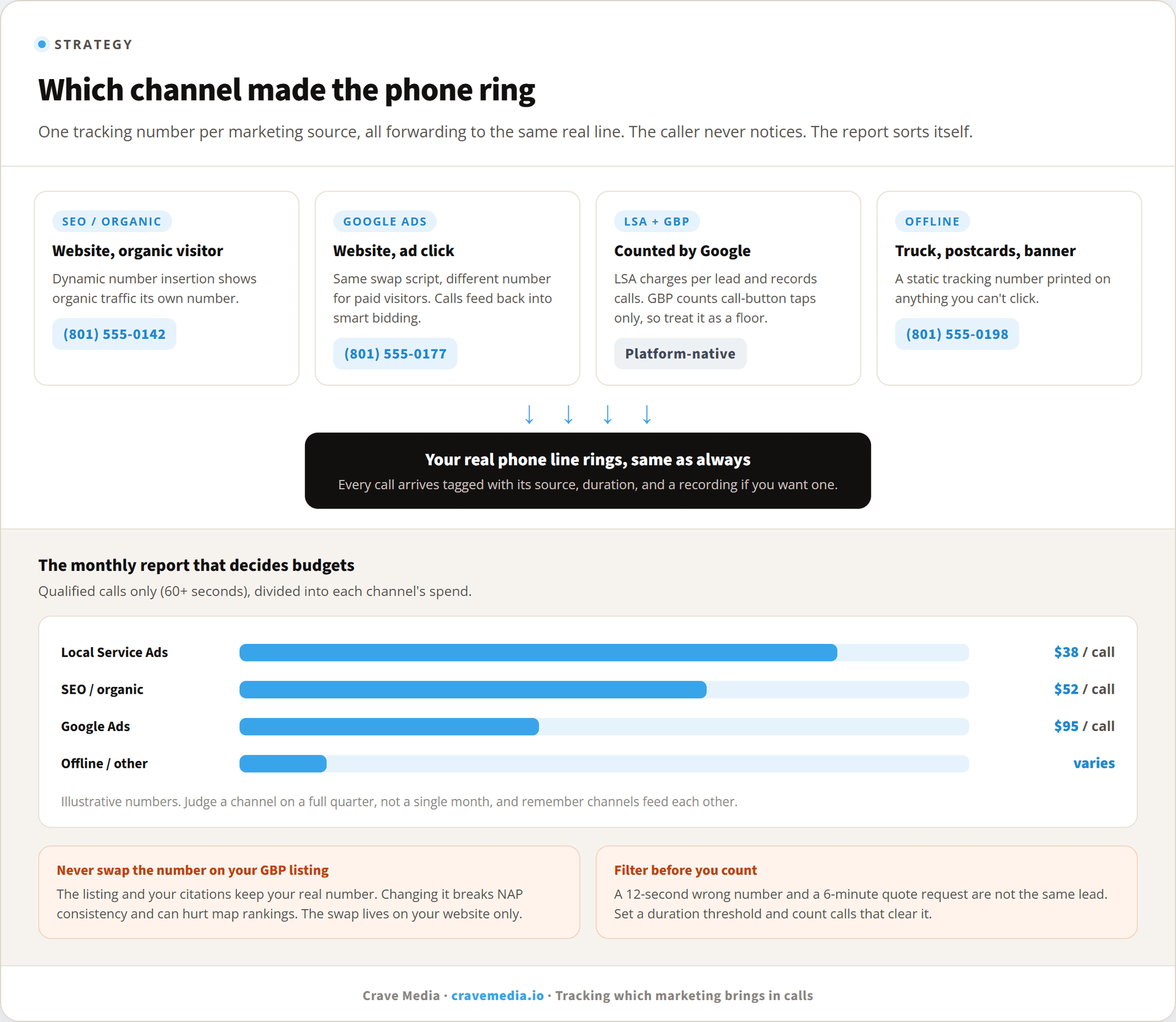
One tracking number per channel, every one forwarding to the same real line. The report at the end shows calls and cost per call by channel, which is the number that decides budgets.
Why asking customers doesn't work
Plenty of businesses try to solve this at the front desk. Train whoever answers to ask "how did you hear about us?" and log the answer. We've watched this play out across a lot of client accounts, and the data it produces is consistently wrong in the same directions.
Customers compress everything into the last thing they remember. The person who saw your truck, heard your name from a neighbor, then searched it and clicked your ad says "Google." The person who clicked your ad three weeks ago and came back through your Business Profile says "the map." And that's when the question gets asked at all. On a busy Tuesday with two lines ringing, it doesn't.
Keep asking, because the answers catch things software can't, like referrals and the truck wrap. Just don't budget off them.
One tracking number per channel
The fix is old, boring technology: tracking phone numbers. You buy a handful of local numbers, point each one at a different marketing source, and forward them all to your real line. The caller notices nothing. Your call log now sorts itself by channel.
The standard setup for a home service business looks like this. Your website gets dynamic number insertion, a small script that swaps the displayed number based on how the visitor arrived, so organic search traffic sees one number and ad clicks see another. Your Google Ads get their own numbers through that same swap, which we covered in detail in our post on call tracking for Google Ads. Any offline stuff you still run, postcards, truck wraps, a Little League banner, gets a static tracking number printed on it.
One warning that trips people up: never change the phone number on your Google Business Profile listing itself or in your directory citations. That number is part of your NAP consistency, and swapping it can hurt the local rankings you paid to build. The swap happens on your website, based on traffic source. The listing keeps your real number, and calls from the profile get counted a different way, which brings us to the platforms.
What each platform already tells you
Part of the job is done for you, unevenly, by the platforms themselves.
Local Service Ads are the easy one. Google charges you per lead, so the platform counts calls natively and you can hear recordings of every charged call. One of our clients ran 283 charged LSA leads in a stretch where regular search ads produced 176, and both numbers came straight out of the platforms with no extra tooling.
Your Google Business Profile reports calls too, but only the taps on the call button from your listing. It misses everyone who read your number off the profile and dialed it by hand, which on desktop is most people. Treat GBP call counts as a floor, not a total.
Google Ads is blind on calls unless you wire up call tracking, which is why the ads post above exists. And Facebook ads rarely produce direct calls at all for local businesses. They work higher up the funnel, so judge them on the form fills and the retargeting they feed, not on the phone.
Turning a call log into a budget decision
Raw call counts still aren't the answer, because a 12-second wrong number and a 6-minute quote request both count as one call. Every decent call tracking tool filters by duration. Set a threshold, usually 60 or 90 seconds, count only the calls that clear it, and treat those as leads.
Then the math gets satisfying. Divide each channel's monthly spend by its qualified calls and you have cost per call, by channel, in real dollars. We walked through what a good cost per lead looks like by channel in an earlier post, and this is where those benchmarks stop being abstract. When you can see that LSA calls cost you $38 and Google Ads calls cost $95, the next budget conversation writes itself.
Two cautions before you swing the axe. Give any channel at least a full quarter of data, because local call volume is noisy month to month and seasonal on top of that. And remember that channels feed each other. SEO content and a strong profile make your ads convert better, and people who find you through ads later come back as "direct" callers. A channel with a mediocre direct cost per call can still be earning its keep upstream. If the calls are cheap but the jobs aren't booking, that's a different problem, and usually a landing page or website problem rather than a channel problem.
The afternoon it takes to set up
The tooling is a call tracking platform (CallRail is the one we deploy most, and there are several good ones), a number pool for your website's dynamic insertion, and static numbers for anything printed. Costs typically land under $100 a month for a single-location business, which is usually less than one misallocated week of ad spend.
If you'd rather not wire it yourself, this is part of what we set up in the first month for every marketing client we take on, because we can't manage budgets honestly without it either. Either way, get the numbers in place before your next busy season starts, not during it.
Let the phone settle the argument
Every local business has an internal legend about what works. "All our business is word of mouth." "The ads never did anything." Sometimes the legend is right. The call log is how you find out, and it's the cheapest piece of your entire marketing stack.
If you want help getting it stood up, or a second opinion on what your current numbers are telling you, request a free audit and we'll go through the call data with you.

About the author
Zac Spencer is an online marketing specialist and the owner of Crave Media, based in Salt Lake City, Utah. Since 2013 he has managed hundreds of Google Ads accounts across dozens of industries — with budgets from a few hundred dollars to $250K a month — and run SEO for local businesses, ecommerce shops, and international franchises.