
SEO · August 11, 2026
The first 90 days of an SEO campaign

By Zac Spencer · Owner, Crave Media
What the first 90 days should look like
You signed with an agency, or you rolled up your sleeves to do it yourself, and now you're staring at the part of SEO nobody describes well: the stretch where you're paying and working but the phone isn't ringing any differently. The first 90 days of an SEO campaign are real work with almost no visible reward, which makes them the easiest 90 days to get ripped off in.
We've written before about how long SEO takes to produce results, and the short version is longer than 90 days. This post is about the other side of that deal. If results come later, what exactly are you paying for now? Below is what the first three months look like when the work is being done properly, month by month, plus the deliverables you're entitled to see along the way.
Month one is diagnosis and foundation
A campaign that starts with content on day one skipped a step. The first weeks are for finding out why the site isn't ranking already, because building on a broken foundation wastes everything stacked on top of it.
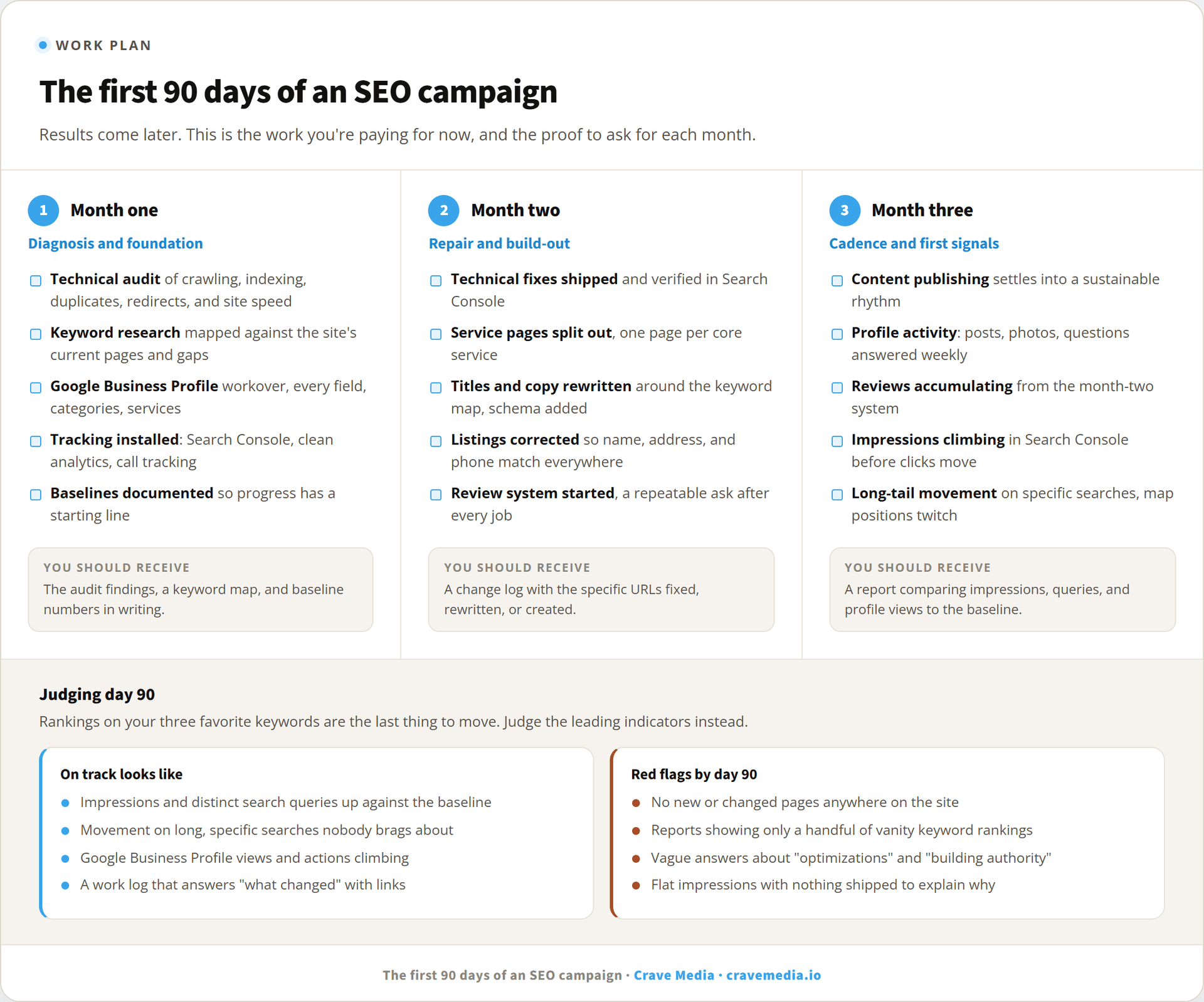
The technical audit comes first. Can Google crawl every page it should? Are there duplicate pages competing with each other, redirects pointing at dead ends, pages accidentally blocked from indexing? On local sites we audit, the same problems come up over and over: a services page that's one giant wall of text, title tags that say "Home" instead of what the business does, and load times that hemorrhage mobile visitors.
While that's underway, three other things should be happening. Keyword research that maps what your customers search against what your site covers, and turns the gaps into a content plan. A full workover of your Google Business Profile, since a profile built to rank moves the map pack faster than anything on your website. And measurement: Search Console verified, analytics clean, call tracking in place if calls are how you make money. Skipping the measurement step means that in month six nobody can prove anything worked.
One more piece of month one is unglamorous but load-bearing: baselines. Screenshot the current rankings, impressions, and traffic now. Progress claims mean nothing without a documented starting line.
Month two turns findings into changed pages
The audit stops being a document in month two. Technical fixes go live. The site gets restructured where it needs it, usually meaning every core service gets its own page instead of sharing one crowded "Services" page. Title tags and page copy get rewritten around the keyword map. Schema markup gets added so search engines can read the business details without guessing.
Off the site, the cleanup continues. Business listings across directories get corrected so your name, address, and phone number match everywhere, because conflicting data quietly erodes Google's confidence in your profile. And the review system should start this month: a consistent way of asking happy customers, not a one-time push. Reviews are the single biggest accelerator in local SEO, and a steady flow of new ones beats a big number gathering dust.
The first new content usually lands late in month two. Not a burst of twelve posts, just the start of a cadence the campaign can sustain.
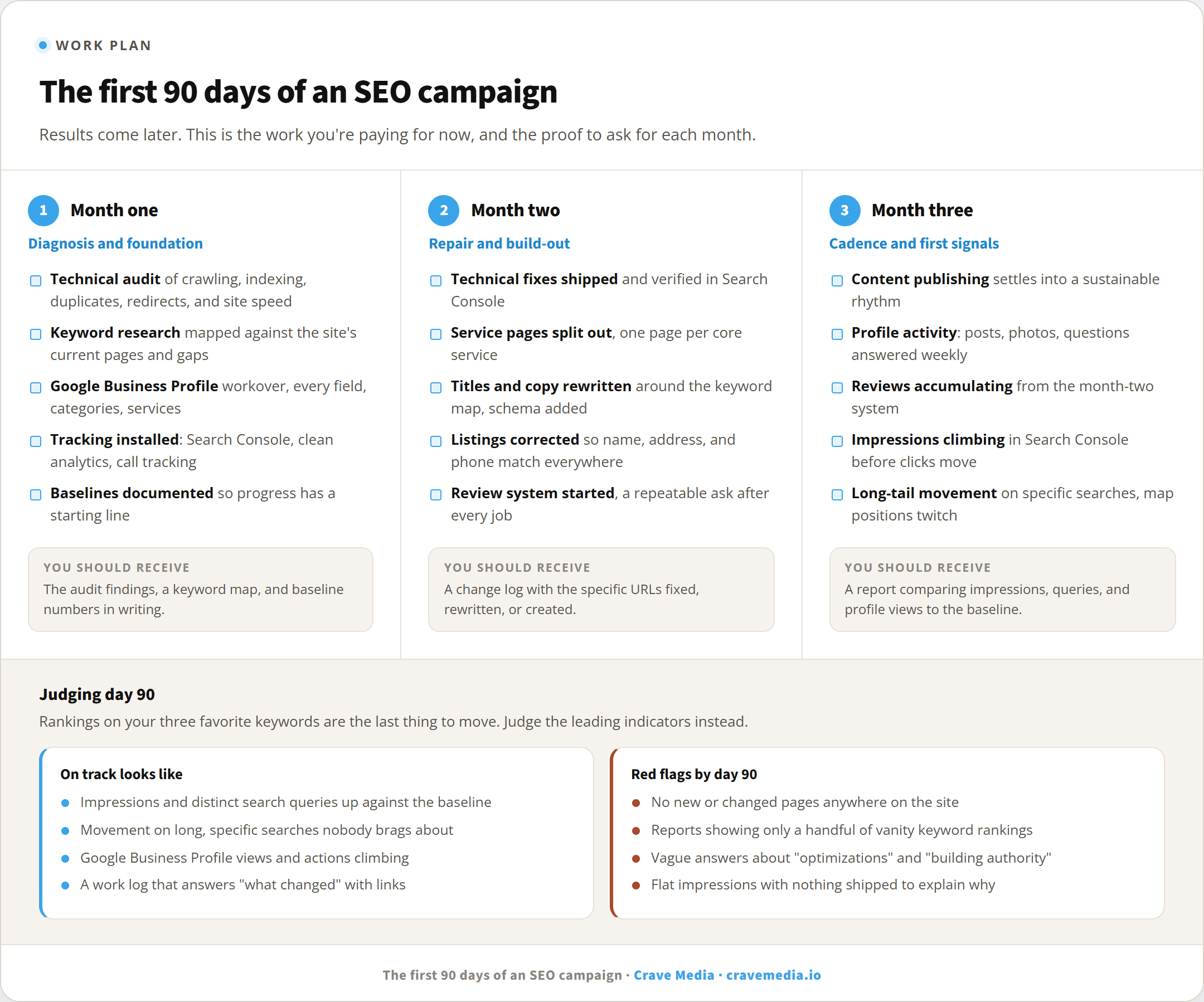
The first 90 days of an SEO campaign as they should run: diagnose, repair, build, and start the engines that compound later. Each month has deliverables you can ask to see.
By month three the engines are running
The one-time work is mostly behind you at this point, and the repeating work takes over. Content publishing settles into rhythm. The Google Business Profile gets ongoing attention, with posts, photos, and answered questions instead of a set-it-and-forget-it profile. Reviews keep arriving because the system from month two keeps running.
This is also when the first evidence shows up, if you know where to look. Search Console impressions start climbing before clicks do. The site begins appearing for long, specific searches, the "emergency water heater repair Bountiful" kind, while the big keywords sit still. Map pack positions can twitch early too, especially if the profile was neglected before.
Don't expect the phone to sound different yet. For most local businesses that shift lands in months four to six. What you should expect by day 90 is directional proof: more impressions, more distinct search queries, long-tail movement, and a Google Business Profile getting more views than it did at the baseline.
The deliverables you're entitled to see
Every month of a real campaign produces artifacts. Month one should hand you an audit document with the problems found, a keyword map, and baseline numbers. Month two should show you fixes shipped, pages rewritten or created, and listings corrected, specific URLs, not summaries. Month three should bring a report comparing leading indicators against the baseline.
If you're doing SEO yourself, the same list works as your plan. Diagnose before you build, fix before you publish, measure from day one, and judge yourself on impressions and query count at day 90 instead of rankings on your three favorite keywords.
If you've hired it out, ask for the work log. An agency doing the work can answer "what changed on my site last month" in thirty seconds with links. Vague answers about "optimizations" and "building authority," a report showing only three vanity keyword rankings, or zero new or changed pages in 90 days: those are the signatures of a retainer with nothing behind it. We've inherited enough accounts in that condition to say the pattern is depressingly common.
Why the slow start is worth it
Nothing in the first 90 days looks impressive from the outside. That's the nature of foundation work. The payoff arrives in months four through twelve, when pages age into authority and every new piece of content ranks faster because the groundwork underneath it holds. One of our clients went from that kind of start to 3.41 million impressions and 64.8 thousand clicks over six months, with organic traffic up 423 percent year over year. The curve was flat for a stretch before it was steep, and the flat part was these 90 days.
If you're about to start a campaign, or you're mid-campaign and can't tell whether any of this is happening on your account, our SEO service starts with the audit described above, and we'll show you the findings whether or not you hire us. Request a free audit and you'll know exactly what your first 90 days should contain.

About the author
Zac Spencer is an online marketing specialist and the owner of Crave Media, based in Salt Lake City, Utah. Since 2013 he has managed hundreds of Google Ads accounts across dozens of industries — with budgets from a few hundred dollars to $250K a month — and run SEO for local businesses, ecommerce shops, and international franchises.