

Every owner who calls us about search asks the same question within the first five minutes, and it's a fair one. How long does SEO take before the phone starts ringing?
The honest answer for most local businesses is three to six months before you see gains you'd call real, and closer to a year before the compounding shows up. That's slower than anyone wants to hear, and it's the reason a lot of owners quit at month three, right before the part where it starts paying.
What follows is the timeline as it usually runs, and how you can tell the work is landing well before your rankings do anything you'd notice.
Why nobody can give you one number
The reason you get a vague answer from every agency is that the starting line moves a lot from business to business.
A ten-year-old plumbing site with a claimed Google Business Profile, 200 reviews, and a few dozen pages already indexed is standing much closer to the finish than a brand-new site with a half-filled profile and four pages. The first one can move in six weeks. The second is looking at nine months before it competes for anything worth having.
Competition matters just as much. Ranking a dentist in a Salt Lake City suburb is a different job than ranking one in downtown Denver, where a dozen practices have been running paid SEO for years. Smaller Utah markets like Ogden tend to move faster than a crowded metro simply because fewer competitors are pushing back.
Then there's the size of the hole you're starting in. If your site is technically broken, slow, or has never been touched, the first stretch of work is repair rather than growth. Repair doesn't show up in rankings for a while, and skipping it caps everything that comes after.
How long SEO takes, month by month
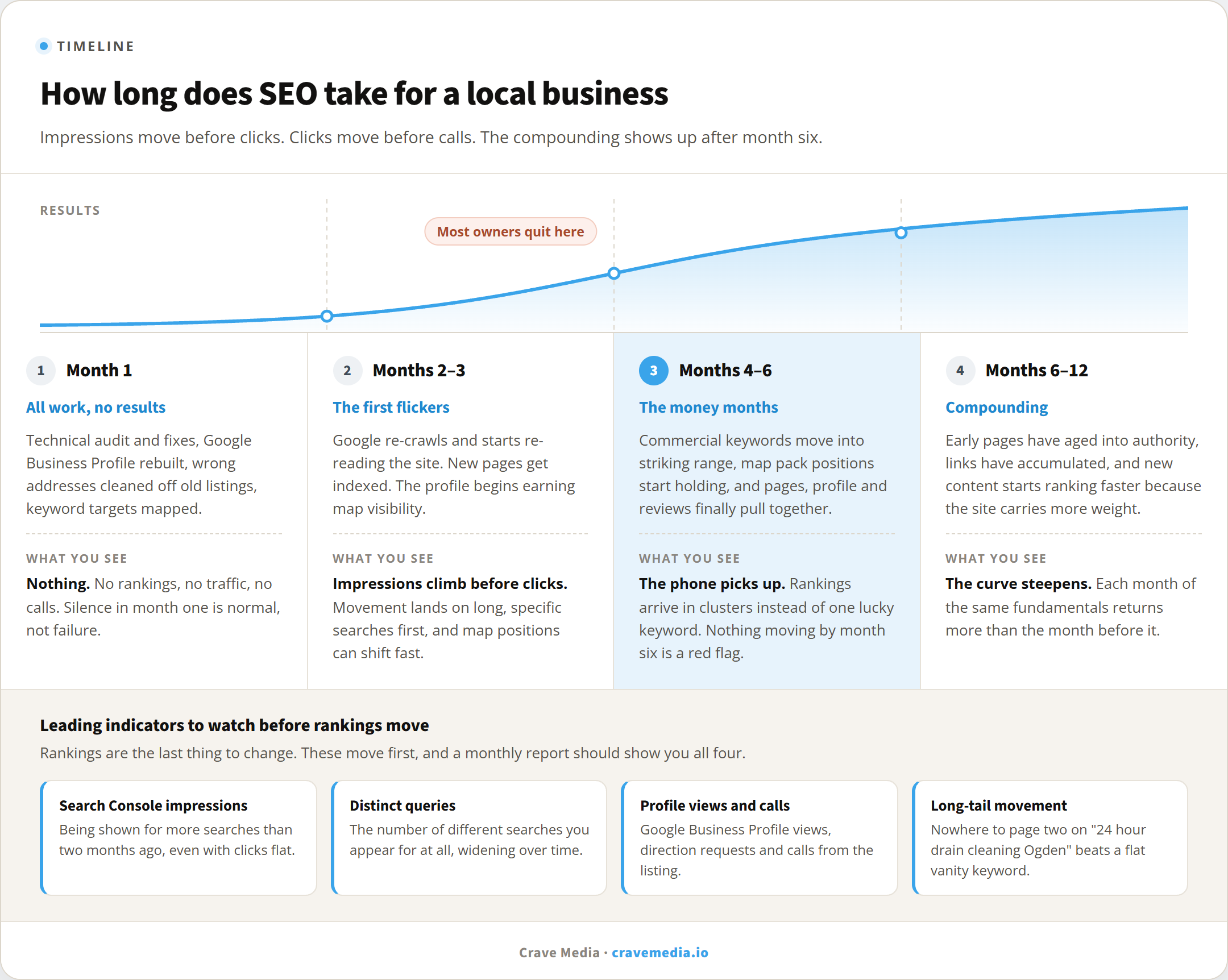
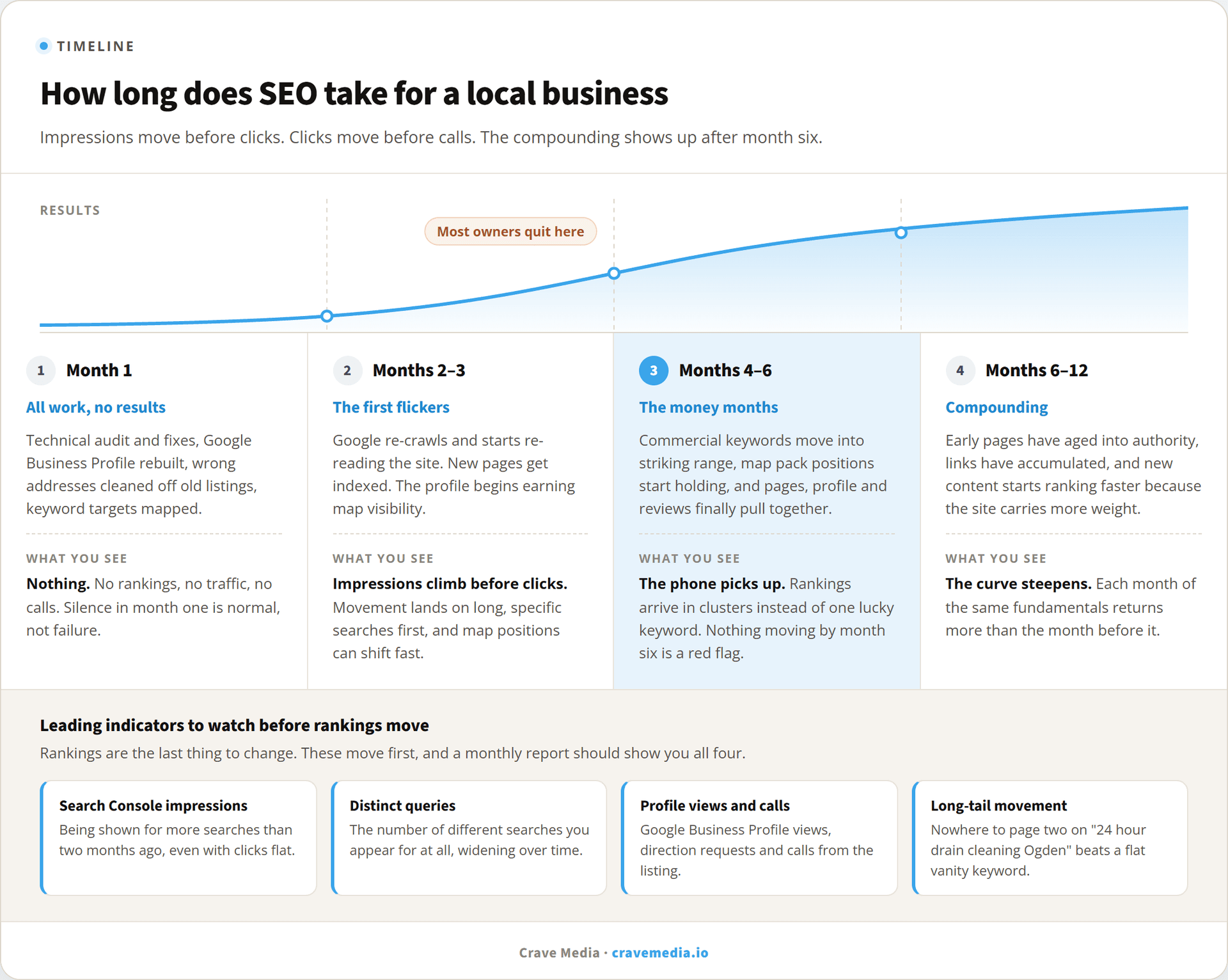
The SEO timeline as it usually runs for a local business. Impressions move before clicks, clicks move before calls, and the compounding shows up after month six.
Month one, all work and no results
The first month is audit, cleanup, and setup. Fixing the technical problems that keep pages from being crawled properly, rebuilding the Google Business Profile, correcting listings that have your old address on them, mapping which keywords are worth chasing.
You will see nothing in this month. No rankings, no traffic, no calls. This is the stretch where owners get nervous, and it's worth knowing in advance so you don't read the silence as failure.
Months two and three, the first flickers
Somewhere in here Google starts noticing. The first movement almost never lands on the keyword you care about most. It shows up on the long, specific searches. Think "emergency water heater repair Bountiful" months before you touch "plumber Salt Lake City."
Your Search Console impressions climb before your clicks do, which is the single most useful early sign. It means Google is putting you in front of more searches, even if you're sitting at position 14 where nobody clicks. Map pack positions can shift fast in this window too, especially if the profile was neglected and now isn't.
Months four to six, the money months
This is where most local businesses start seeing something they'd describe as working. Rankings for real commercial keywords move into striking range, the map pack starts holding steady, and the phone picks up.
The gains here also stop feeling random. Instead of one lucky keyword, you're ranking for clusters of related searches, because the pages and the profile and the reviews are finally pulling in the same direction.
If you've hit month six with no leading indicators moving at all, something is wrong, and that's a conversation worth having with whoever is doing the work.
Months six to twelve, compounding
The back half is where the economics turn. Pages you published in month two have aged into authority, links have accumulated, and new content ranks faster because the site itself carries more weight.
For one of our clients, that stretch produced 3.41 million search impressions and 64.8 thousand clicks over six months, with organic traffic up 423 percent year over year. That came from unglamorous fundamentals repeated every month, not from one clever trick. It's one client's result and not a promise of yours, but it shows the shape of the curve: slow, slow, then steep.
Local SEO is faster than the national kind
If you're comparing timelines you've read online, check which game the writer was describing. Most SEO timelines on the internet are written for national campaigns, and those run long.
Local search has a shortcut national search doesn't: the map pack. Getting into the top three of the map is driven heavily by your Google Business Profile, your reviews, and proximity, and those are things you can improve in weeks. National rankings are an authority game measured in backlinks and hundreds of pages, and that takes six to twelve months minimum. We broke down the difference in our guide to local SEO vs national SEO, and it's worth reading if you're not sure which one you're paying for.
For most local businesses in Utah, the fast lane is available. A Google Business Profile built to rank plus a steady flow of recent reviews can move map positions inside a couple of months, well ahead of anything happening on your website.
What speeds it up and what drags it out
Reviews are the biggest accelerator most owners are sitting on and ignoring. A business collecting a handful of new reviews every month climbs faster than one with a bigger review count that stopped asking two years ago. If you want a system for it, we wrote up how to get more Google reviews without pestering people.
Publishing consistently matters more than publishing a lot. Two solid pages a month for six months beats twelve pages in one burst followed by silence, because search engines respond to a site that keeps showing signs of life.
On the drag side, the usual suspects are a slow site, a thin Google Business Profile, inconsistent name and address data scattered across old directories, and a history of spammy link building that has to be cleaned up before anything new can work. Site speed is worth a look on its own, since a slow website costs you customers whether or not it's hurting your rankings.
Switching strategies every eight weeks quietly stretches the timeline too. SEO rewards a consistent direction, and every restart resets part of the clock.
How to tell it's working before rankings move
Waiting on rankings is a bad way to judge the first few months, because rankings are the last thing to change. Look at the signals underneath them instead.
Search Console impressions are the earliest honest indicator. If you're being shown for more searches than you were two months ago, the work is landing, even with clicks flat. Next comes the number of distinct queries you appear for, which tells you the site is being understood more broadly.
On the local side, watch the Google Business Profile insights: profile views, direction requests, and calls from the listing. Those move before your website traffic does, and they're closer to revenue anyway.
Then look at ranking movement on the long-tail terms nobody brags about. Going from nowhere to page two on "24 hour drain cleaning Ogden" is a stronger sign of health than a flat line on "plumber Ogden," because the long-tail always moves first.
A monthly report that shows you only your rank on three vanity keywords is hiding all of this. Ask for the leading indicators.
When patience becomes a bad investment
Being patient is right for the first four or five months. After that, patience without evidence is just paying for nothing.
The point to push back is when several months have gone by with flat impressions, no new indexed pages, no Google Business Profile movement, and reporting that never quite answers what was done. Slow results with visible progress underneath are normal. Slow results with nothing moving anywhere are a different problem, and the honest read is usually that the fundamentals aren't being done.
We've picked up plenty of accounts in exactly that condition, and the first month is often just doing the basics that were skipped a year earlier.
Where to start
If you're weighing whether to start SEO, or whether the SEO you're already paying for is going anywhere, the useful first step is finding out where you stand today. A site with good bones and a decent profile has a much shorter runway than a site that needs rebuilding, and you can't plan the timeline until you know which one you have.
That's what our free SEO audit is for. We look at your site, your Google Business Profile, and the competitors currently sitting where you want to be, then tell you plainly how long it should take in your market and what would have to happen first. Request yours here and you'll get a straight answer about your timeline, not a range copied off someone else's blog.

About the author
Zac Spencer is an online marketing specialist and the owner of Crave Media, based in Salt Lake City, Utah. Since 2013 he has managed hundreds of Google Ads accounts across dozens of industries — with budgets from a few hundred dollars to $250K a month — and run SEO for local businesses, ecommerce shops, and international franchises.