
SEO · July 14, 2026
Local SEO vs national SEO: which does your business need

By Zac Spencer · Owner, Crave Media
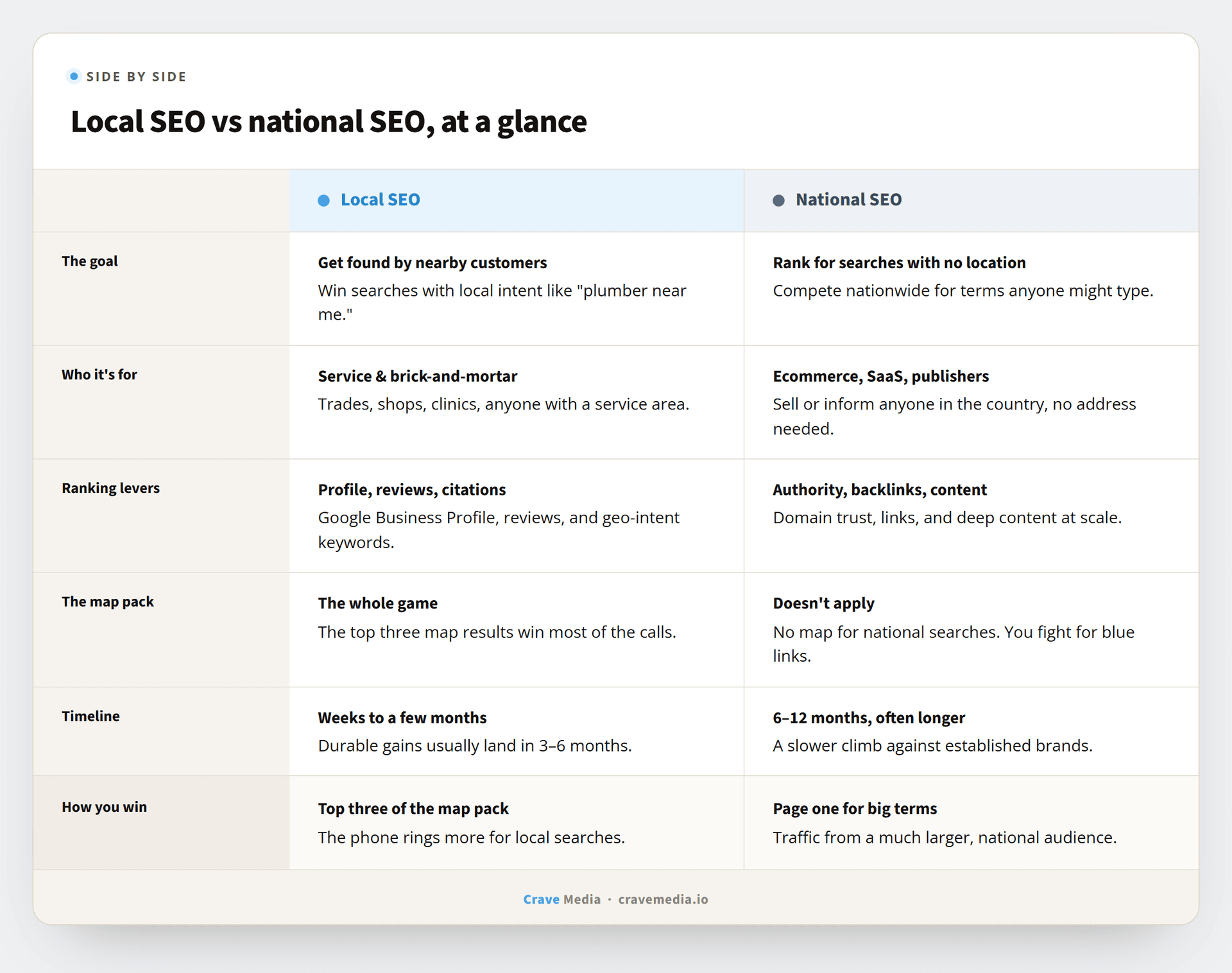
Most business owners who ask us about SEO are really asking two different questions without knowing it. Some want to show up when a person a few miles away searches "plumber near me." Others want to sell a product or a service to anyone in the country, no location attached. Those are two separate jobs, and the whole local SEO vs national SEO decision comes down to which one describes your business.
Get it right and every hour of work pushes toward the traffic that pays you. Get it wrong and you can spend a year chasing rankings that were never going to bring you a customer. So before you hire anyone or write a single blog post, it's worth being honest about which game you're actually playing.
What local SEO vs national SEO really means
Local SEO is the work of getting found by people near you. When someone in Salt Lake City searches for a service and Google shows a little map with three businesses pinned to it, that box is the Google map pack, and it's the prize. Local SEO is everything that gets you into it: a complete Google Business Profile, a steady flow of reviews, keywords tied to a place, and consistent listings across the web.
National SEO plays on a bigger field with no map at all. You're competing for searches that carry no geographic intent, like "best running shoes for flat feet" or "how to set up a payroll system." There's no map pack for those. Google ranks the regular blue links based on how much authority your site has, how many other sites link to you, and how deep and genuinely useful your content is. It's a slower, harder climb, and you're often up against national brands with years of head start.
The core difference is who you're trying to reach. Local SEO targets a customer standing within driving distance. National SEO targets anyone, anywhere, who's typing your search. Almost everything else about the work flows from that one fact.
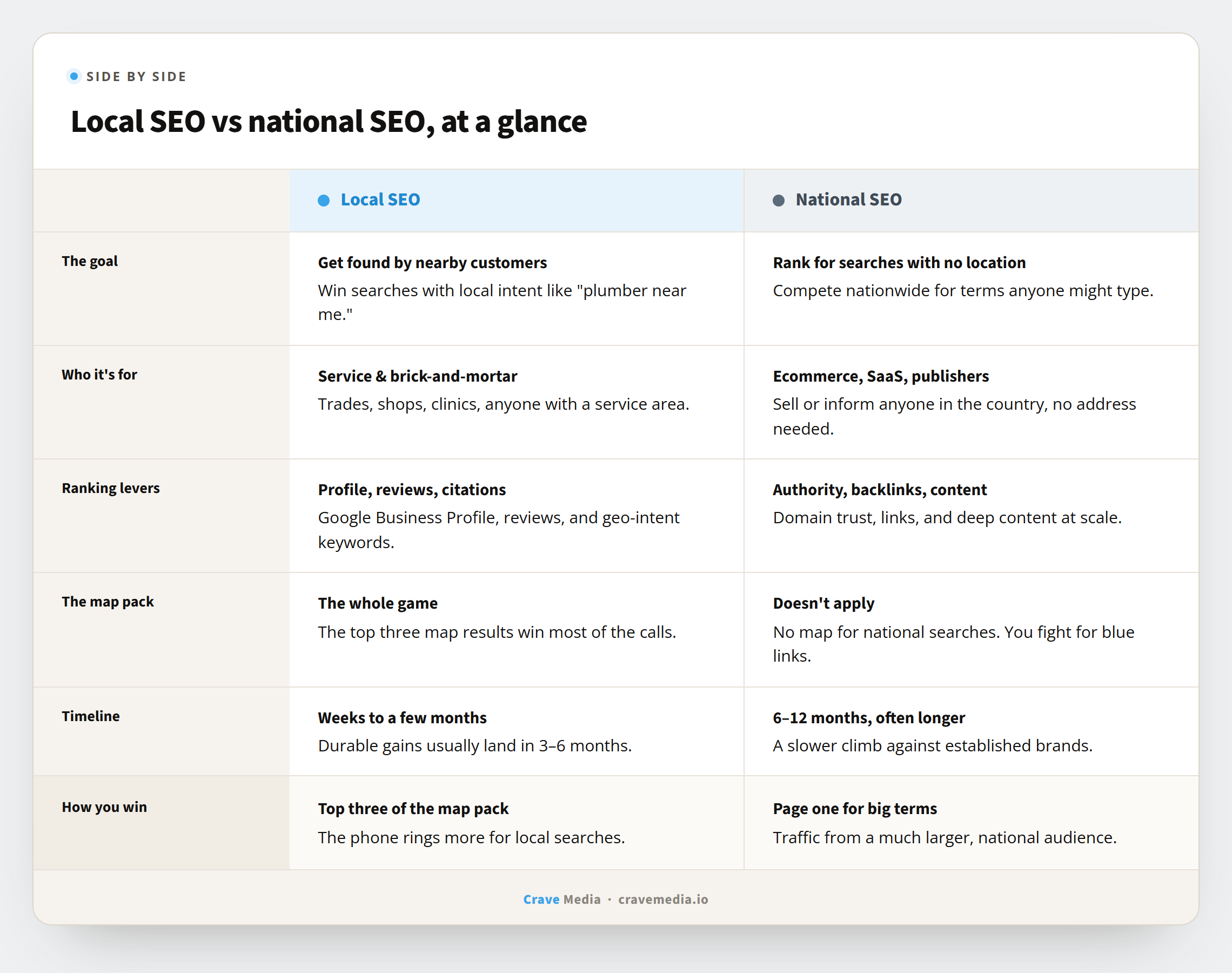
Local SEO vs national SEO, row by row. The levers that win the map pack are not the ones that win a national blue-link ranking.
Which one is your business
Forget the theory and look at how you actually make money. A few questions sort most businesses fast.
Do customers have to be near you to buy? If you fix furnaces in Ogden, clean carpets in Sandy, or pull teeth in Salt Lake City, you need local SEO. Nobody in Florida is booking your service. Your entire market is the radius your trucks or your front door can reach, and the map pack is where those people are looking. This covers nearly every service business, every brick-and-mortar shop, and every practice with a waiting room.
Can anyone in the country be your customer? An online store shipping nationwide, a software company, a blog that earns from ads, a course creator selling to people everywhere, these are national plays. There's no "near me" in how people find you, so a Google Business Profile does little, and the map pack isn't part of your world. You win on authority and content instead.
Are you somewhere in between? Plenty of businesses are, and we'll get to the overlap. But most owners already know the answer in their gut. If your revenue depends on people who live nearby, you're a local business, and that settles most of the local SEO vs national SEO question before you spend a dollar.
What changes about the actual work
The reason this decision matters so much is that the two paths optimize for different things. Point your effort at the wrong set and you're building a boat in a desert.
For local SEO, the heavy lifting sits with your Google Business Profile and your reviews. A Google Business Profile built to rank with the right primary category, real photos, and complete service listings often moves the needle more than anything you do on your website. Reviews come next, since a steady stream of recent, honest ones is the strongest signal that separates the map pack from everyone below it. Then it's location pages, local citations, and keeping your name, address, and phone identical everywhere they appear online.
For national SEO, none of that carries the weight. You're playing an authority game. That means earning backlinks from sites Google already trusts, publishing content deep and useful enough to outrank established competitors, and building topical coverage so thorough that Google sees you as a real authority on the subject. It's a technical and editorial grind measured in hundreds of pages and links, not in review counts and map pins.
Same word, "SEO," two different jobs. A business that pours months into national-style link building when its customers are all within ten miles has wasted the effort. And a national ecommerce brand fussing over its Google Business Profile is polishing something almost no buyer will ever see.
What winning looks like, and how long it takes
The finish lines look different too, which matters when you're deciding whether the work is paying off.
For a local business, winning is concrete and close to the money. You land in the top three of the map pack for the searches that bring real customers, your phone rings more, and you can watch it happen over a few months. Local SEO tends to be the faster of the two. If your profile was a mess and you clean it up, you might see movement in weeks, with durable gains usually landing in three to six months. Smaller Utah markets like Ogden can move faster than a crowded metro. We cover the local mechanics in detail in our guide to how local businesses rank across Salt Lake City and Ogden.
National SEO asks for more patience. Winning means ranking on page one for competitive, high-volume terms, and that can take six to twelve months of steady work before the traffic really turns on, sometimes longer in tough niches. The payoff can be large once it lands, because national search volume dwarfs any single town, but you have to be able to fund the climb while it's still quiet.
To put a real number on the local side: for one of our clients, steady local SEO produced 3.41 million search impressions and 64.8 thousand clicks over six months, with organic traffic up 423 percent year over year. That growth came from the unglamorous fundamentals, a complete profile, a flow of reviews, and pages built to match local searches, compounding month over month. Framed honestly as one client's result, not a promise of yours, it shows what the local path can build when the basics are done right.
When a business needs both
Not everyone fits in one box, and the overlap is real. Some businesses genuinely need local and national SEO at the same time, and pretending otherwise leaves money on the table.
A franchise or a multi-location brand is the clearest case. A gym with twelve Utah locations wants each one ranking in its own map pack, that's twelve local SEO jobs, while the main brand site also competes nationally for broader fitness searches. A product company that sells online but also has retail stores is another. You want national rankings for the product and local rankings for each storefront, running side by side.
The trap is treating a business that's mostly one type as if it were both. A single-location dentist in Salt Lake City does not need a national content strategy, no matter how much someone wants to sell them one. Their patients live here. If you're weighing where your budget goes across channels, our breakdown of Google Ads vs SEO for a local business walks through the same "start where the money is" logic that applies here. Spend on the SEO that reaches buyers who can actually hire you, and only branch into the other once the first is working.
Getting the call right
The local SEO vs national SEO question isn't really about which is better. It's about which one matches how your business earns. Local SEO wins you the customers nearby who are searching right now, and it tends to pay off faster. National SEO chases a much larger audience with no location attached, and it asks for more patience and a lot more content before it delivers.
Most local businesses in Utah only ever need the local path done well, and doing it well beats doing both halfway. If you're not sure which side of the line your business falls on, that's exactly what we sort out for free. Reach out for a free audit of your SEO and we'll look at your market and your customers, then tell you honestly which game you should be playing and where your first dollar should go. Grab yours here and you'll leave knowing your next move, whether you hire help or run with it yourself.

About the author
Zac Spencer is an online marketing specialist and the owner of Crave Media, based in Salt Lake City, Utah. Since 2013 he has managed hundreds of Google Ads accounts across dozens of industries — with budgets from a few hundred dollars to $250K a month — and run SEO for local businesses, ecommerce shops, and international franchises.