
Strategy · October 6, 2026
How to set next year's marketing budget by business size

By Zac Spencer · Owner, Crave Media
Most owners of a local service business set next year's marketing number the same way. They look at what they spent this year, round it, and maybe add a little if the year went well. Then the same mix of ads, software, and that one radio spot nobody can trace rolls into January untouched.
October is a good time to do it properly. You have nine months of real numbers, the busy season is behind you or close to it, and there's still time to line up anything that takes a while to build, like a website or an SEO push. This post walks through how to set a small business marketing budget for the whole year, across every channel, sized to where your business is right now.
We won't talk about our own fees here. Everything below is about your total spend on getting customers: ad spend, software, the website, and whatever you pay an agency or freelancer.
Start with a percentage of revenue
The most common starting point is a share of gross revenue. The figure that gets passed around most is 7 to 8 percent for businesses under about $5 million in sales with net margins in the 10 to 12 percent range. It's usually credited to the Small Business Administration, and it holds up as a rough first number for most trades.
Treat it as a range check, not an answer. A plumbing company doing $1.5 million a year would land around $105,000 to $120,000 at that rate, or roughly $9,000 to $10,000 a month. If your current spend is $3,000 a month, the percentage is telling you you're probably underinvested for your size. If you're at $25,000 a month, it's telling you to look hard at what that money is bringing back.
Margins move the number. A business running thin margins after a bad year can't spend 8 percent without starving payroll. A business with fat margins and open crew capacity can often justify 10 percent or more, because each extra job is profitable enough to pay for the marketing that found it.
What counts in the budget
A lot of budgets look smaller than they are because half the spending sits in other lines. Before you set a number for next year, add up everything you spent on getting customers this year. That usually includes:
- Google Ads, Local Service Ads, and Facebook or Instagram ad spend
- Agency, freelancer, or in-house marketing salaries
- Website hosting, updates, and any rebuild
- Software like call tracking, review requests, and scheduling tools with marketing features
- Truck wraps, yard signs, door hangers, and print
- Sponsorships, home shows, and local events
Ads are usually the biggest line. An owner who thinks they spend $4,000 a month on marketing often finds it's closer to $6,500 once the software subscriptions and the new trailer wrap are counted.
Budget by business size
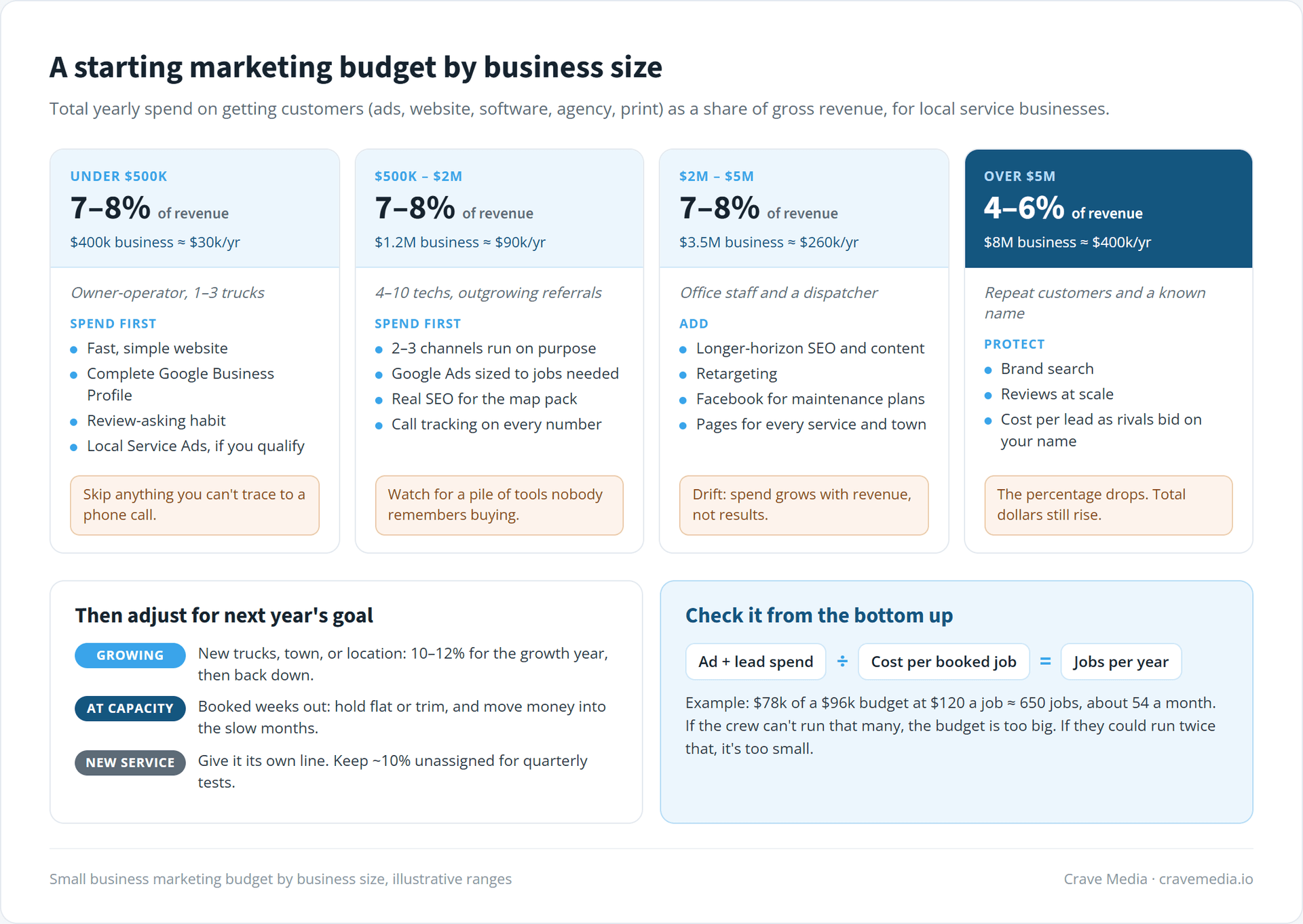
The percentage gives you a total. Where the money goes depends on your stage. These are the patterns we see most with local service businesses, roughly sorted by annual revenue.
Under $500,000
This is usually an owner-operator with one to three trucks, and the owner is still answering the phone. The budget is small, so it has to go where intent is highest.
Put the first dollars into the things every other channel depends on: a fast, simple website that makes calling easy, a complete Google Business Profile, and a steady habit of asking for reviews. After that, Local Service Ads are often the best paid option for trades that qualify, because you pay per lead instead of per click. Skip brand awareness, sponsorships, and anything you can't trace to a phone call. You don't have the money to wait for it to work.
$500,000 to $2 million
This is the growing middle, maybe four to ten techs, and it's where most of the budgeting mistakes happen. The business has outgrown referrals but hasn't built a system yet, so marketing tends to be a pile of tools someone signed up for at some point.
At this stage it usually makes sense to run two or three channels on purpose: search ads for volume you can turn on and off, LSA if you qualify, and a real SEO effort so the map pack starts carrying some of the load. We wrote up how to size the Google Ads piece by working backward from the jobs you need, and it slots right into this total. Call tracking stops being optional here. We'd rather see a $600,000 company spend 6 percent with tracking on every number than 10 percent without it, because the second company has no idea which half is working.
$2 million to $5 million
Established companies with office staff and a dispatcher can afford to think further out. SEO and content pay off on a timeline this size of business can wait for, and one of our clients has grown organic traffic 423% year over year by sticking with it. Retargeting, Facebook for maintenance plans, and a bigger website with pages for every service and town start to earn their place.
The risk at this size is drift. Budgets grow because revenue grew, not because anyone checked whether the extra spend brought extra jobs. Every channel should have a cost per booked job attached to it by now.
Over $5 million
Past this point the percentage tends to drop, often into the 4 to 6 percent range, because a large share of revenue comes from repeat customers, memberships, and a known name. Total dollars still go up. The money shifts toward protecting what you've built: brand search, reviews at scale, and keeping your cost per lead from creeping as competitors bid on your name.
A starting marketing budget by business size, with the channels that usually come first at each stage and the cost-per-job check that keeps the number honest.
Your goal moves the percentage
If you're in growth mode, adding trucks or opening a second location in Ogden or out toward Lehi, plan to spend above the range for a year. New markets and new service lines cost more per customer at first, because nobody knows you there yet and your Google listing has no history. Something like 10 to 12 percent for the growth year is common, coming back down once the new area is producing.
Booked three weeks out already? Then hold spending flat or trim it. More leads you can't run don't help anyone, and the money does more filling February than it does piling onto June.
A new service, like an HVAC company adding water heaters or a cleaner adding windows, gets its own small line. Lumped in with everything else, it gets whatever attention is left over, which is usually none.
Check the total against cost per job
The percentage is a top-down number. Before you commit to it, check it from the bottom up.
Take your average ticket and your rough cost per booked job from this year. Say a Salt Lake HVAC company averages $650 a job and has been paying about $120 in ad and lead spend for each booked call. Its $96,000 budget has about $78,000 going to channels that make the phone ring (the rest is software, the website, and wraps). At $120 a job, that's roughly 650 jobs, or 54 a month.
Can the crew take 54 marketing-driven jobs a month on top of repeat customers and referrals? If not, the budget is bigger than the business can use. If the dispatcher laughs and says they could run twice that, the percentage is probably too low.
This is also where you find out which channels deserve more. If LSA has been booking jobs at $90 and Facebook at $260, the two don't get the same raise next year. If you don't know your cost per job by channel, that's the first problem to fix, and our cost per lead benchmarks are a reasonable place to start comparing.
Spread it across the year
An annual number isn't a monthly number divided by twelve. Most service businesses should spend ahead of their busy season and pull back after it, with the slow months used for work that pays off later, like the website and SEO. We covered how to shape that in our seasonal marketing plan for service businesses, so we won't repeat it here. Set the yearly total first, then shape the months.
Hold back a test line
Keep around 10 percent of the budget unassigned. Use it to try one new thing a quarter: a Facebook campaign for maintenance plans, a push into a new town, a new service page with ads behind it. Give each test a budget, a timeframe, and a cost-per-job target before it starts. A test that beats your current channels earns a real line next year.
Without that reserve, the spare money tends to go to whichever sales rep called most recently. Usually it's the one selling a directory listing.
Budget the year you want
The number you set this month decides how many jobs you can buy next year, and it's a lot easier to set in October than to defend in a quiet week next summer, when every vendor calls with a deal and you can't remember why you picked it. Write down the reason next to each line now.
If you'd like a second set of eyes on it, you can see how we handle SEO, ads, and websites for local service businesses, or get a free audit and we'll look at what you're spending now, what each channel is bringing back, and where next year's money should go first.

About the author
Zac Spencer is an online marketing specialist and the owner of Crave Media, based in Salt Lake City, Utah. Since 2013 he has managed hundreds of Google Ads accounts across dozens of industries — with budgets from a few hundred dollars to $250K a month — and run SEO for local businesses, ecommerce shops, and international franchises.