
Websites · September 1, 2026
The five pages every local business website needs

By Zac Spencer · Owner, Crave Media
Most local sites have the wrong pages, not too few
Ask a web designer what a local business website needs and you'll get a quote for fifteen pages. Ask Google, and the answer is closer to five, done properly.
We audit a lot of local business websites, and the pattern repeats: a thin homepage, one crowded "Our Services" page, an About page written in 2019, and a contact form nobody tests. The pages don't line up with the two jobs a local business website has, which are ranking for the searches your customers type and converting the visitors those searches send. Five pages cover both jobs. Everything else is optional.
This post walks through the five local business website pages worth building, what belongs on each, and the one structural mistake that quietly caps most small business sites.
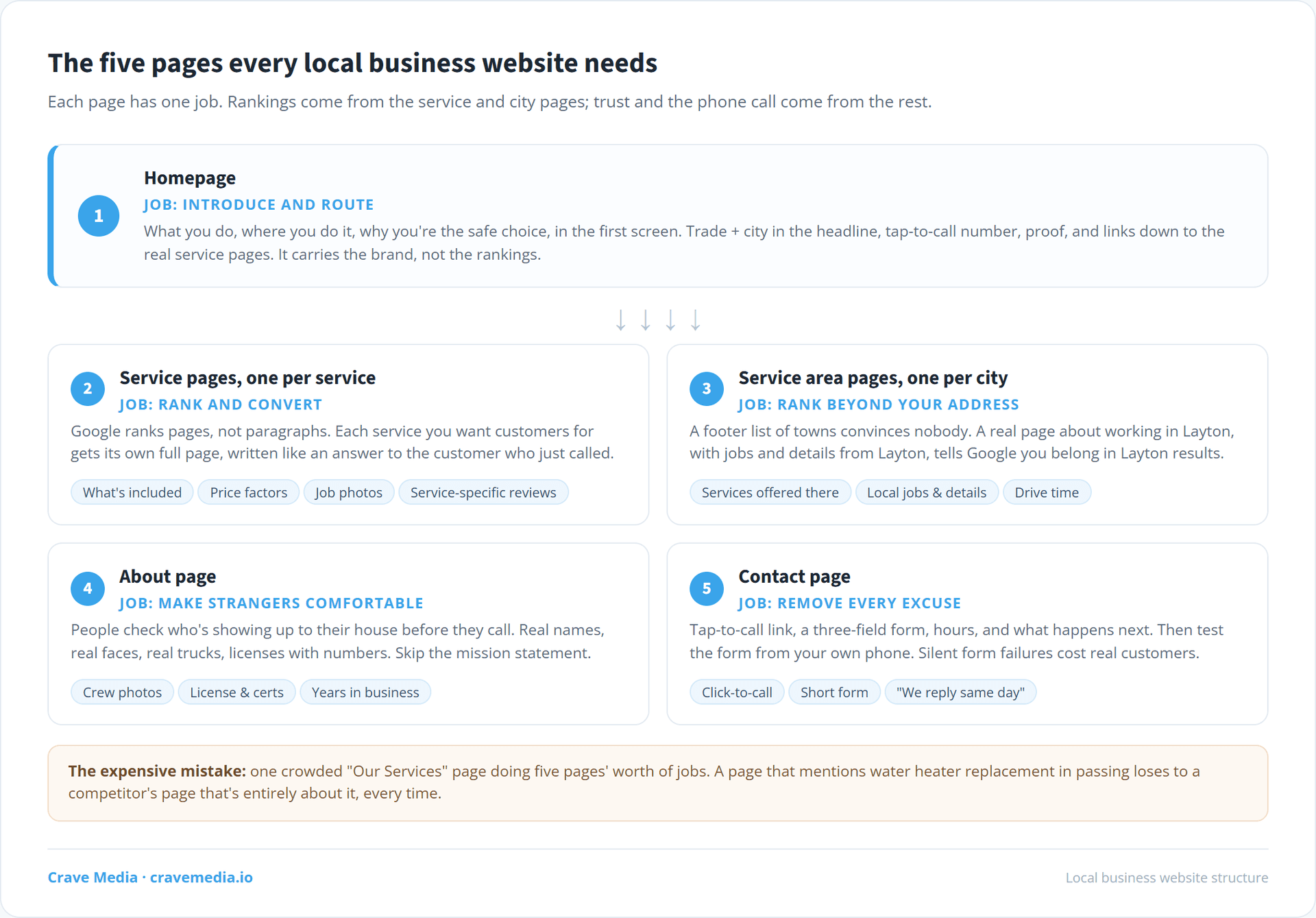
The five-page structure that covers both jobs of a local business website. Each service and each city gets its own page, because each is its own search.
The homepage carries the brand, not the rankings
Owners obsess over the homepage, and visitors do land there, so it deserves care. But understand what it's for. The homepage introduces the business to someone who searched your name or clicked through from your Google profile. It should say what you do, where you do it, and why you're the safe choice, in the first screen, without making anyone scroll to find out.
That means a headline with your trade and your city in it ("Plumbing repair and installation in Ogden"), a phone number that works with a thumb, a short services overview that links out to the real service pages, some proof (reviews, license, years, photos of your actual crew), and one clear call to action. What it shouldn't try to do is rank for every service you offer. A homepage stretched across ten keywords ranks for none of them. That work belongs one level down.
Service pages are where the money is
This is the section to slow down on, because it's where most local sites go wrong.
The single "Our Services" page, the one with four paragraphs each on drain cleaning, water heaters, remodels, and emergency calls, is the most expensive mistake in local web design. Google ranks pages, not paragraphs. When someone searches "water heater replacement," Google looks for a page about water heater replacement, and a page that mentions it in passing between three other topics loses to a competitor's page that's entirely about it. Every time.
So each service you want customers for gets its own page. Not a hundred words and a stock photo. A real page: what the service includes, what affects the price, how long it takes, the questions people ask on the phone, photos of the work, and reviews that mention that specific service. Write it like you're answering the customer who just called and asked, because that's who's reading it.
Two service pages built this way will outperform a ten-service summary page. Start with the service that makes you the most money, build the next one when the first is done, and let the list grow with the business. These pages also become the natural landing spots when you run ads, which is a whole subject on its own, and they're the backbone of everything we covered in what a high-converting local business website looks like.
Service area pages tell Google where you work
Google is cautious about showing your business outside the city your address sits in. If you're based in Ogden but half your jobs are in Layton and Clearfield, those cities can't just live in a footer list of town names. That list convinces nobody, including Google.
A service area page is a page about working in that specific city. What you serve there, jobs you've done there, anything you'd tell a customer from there ("we're about 20 minutes from most of Layton"). One page per city that matters to your revenue, written with something real to say about each. If you can't say anything specific about a town, that's a sign it doesn't need a page yet.
A warning worth heeding: this is not permission to generate thirty near-identical pages with the city name swapped out. Google has gotten good at ignoring those, and a site full of them looks worse, not better. Three real service area pages beat thirty templated ones.
The about page gets read before anyone calls
Nobody types "about us" into Google, so this page gets treated as filler. Then you watch real user sessions and see the same path over and over: homepage, service page, about page, call. People hire local businesses, and before they call a stranger to come to their house, they want to see who's showing up.
Keep it human and specific. Who owns the business, how long you've been at it, photos of the actual people and trucks, licenses and certifications with numbers, and the two or three sentences of story you'd tell at a neighborhood barbecue. Skip the mission statement. "We believe in integrity and excellence" has never earned a phone call. A photo of your crew in front of the shop has earned thousands of them.
The contact page should remove every excuse
The contact page is the simplest of the five and the most common place to find a broken step. Phone number as a tap-to-call link, a short form (name, phone, what do you need), your address and a map if customers come to you, and your hours. State what happens after they reach out: "We answer weekdays 7 to 6, and we return every message the same day."
Then test the form yourself, from your phone, this week. A meaningful share of the sites we audit have a contact form that fails silently or emails an inbox nobody checks. Every one of those submissions was a customer who chose you and got silence back.
What about a blog and everything else
The five pages are the skeleton. A blog helps when you'll feed it consistently, reviews pages and FAQ pages and photo galleries all have their place, and none of them matter until the skeleton is in place. A weak service page with a busy blog is a house with great curtains and no foundation.
Speed and mobile behavior sit underneath all five pages, since a slow website loses visitors before any page structure gets the chance to work. And if your current site has decent bones but the wrong pages, you may not need to start over; we walked through that call in whether you need a new website or a redesign.
If you're not sure which of the five you're missing, or your "Our Services" page is doing five pages' worth of jobs, we'll take a look. A free audit will show you which pages are earning their spot and which searches you're invisible for, and our site building service builds this exact structure when it's easier to have us do it. Five pages, each with one job, each doing it properly. That's the whole trick.

About the author
Zac Spencer is an online marketing specialist and the owner of Crave Media, based in Salt Lake City, Utah. Since 2013 he has managed hundreds of Google Ads accounts across dozens of industries — with budgets from a few hundred dollars to $250K a month — and run SEO for local businesses, ecommerce shops, and international franchises.