
Strategy · July 21, 2026
Marketing channels that work for home service businesses

By Zac Spencer · Owner, Crave Media
Every week someone tells a plumber, roofer, or HVAC owner about a marketing channel they "have to be on." TikTok. Billboards. A radio spot. Door hangers. A lead-selling service with a slick pitch. Say yes to all of it and you'll burn a year's budget finding out what a decade of home service marketing data already shows: a handful of channels produce most of the jobs, and the rest mostly produce invoices.
This is the honest version of that list. Not every channel that exists, but the ones that reliably bring home service businesses real, booked work, in the order we'd build them if we were starting your marketing from zero.
Intent is what separates the winners
The channels that work for home services share one trait: they catch people who are already looking. Nobody impulse-buys a water heater replacement. When a homeowner needs a roofer, they search, compare a few options, and call. Your job is to be findable and convincing in that moment.
That single idea sorts the whole landscape. Search-based channels, where the customer comes to you with a problem, consistently out-earn interruption channels, where you go to them hoping they have one. It's why a small crew with a strong Google presence routinely out-books a bigger competitor running ads on the radio.
The map pack and local SEO come first
When someone searches "drain cleaning near me," the three businesses in Google's map pack get the bulk of the calls. Earning one of those spots costs you work rather than ad spend: a fully built-out Google Business Profile, steady reviews, consistent listings, and a site that backs it all up. We broke down the specific levers in our guide to ranking in the Google map pack.
The tradeoff is time. Local SEO takes months to build, and nobody can promise you a spot. But once it's producing, the leads don't carry a per-click charge, and they're the warmest leads you can get, because the customer searched, saw you, and chose to call. One of our clients grew organic traffic 423% year over year, and those visits keep arriving month after month without a media bill attached. That compounding is why this channel is the foundation and not an add-on.
Local Service Ads for the trades that qualify
If your trade is eligible, Local Service Ads deserve a spot near the top. You appear above everything else with a Google Guaranteed badge, and you pay per lead instead of per click, so the math stays easy to read. For many home service categories, the cost per lead lands below regular search ads.
The catch is that Google controls eligibility, ranking, and the going rate per lead, so you have less to fine-tune than in a normal ad account. We ran the full comparison in Local Service Ads vs Google Ads, but the short version is: if you qualify, turn them on and manage your reviews and response speed, because both affect how often you show.
Google Ads when you need volume now
Search ads are the accelerator. SEO takes months; a well-built Google Ads campaign can put you in front of high-intent searches this afternoon, and you can dial spend up when the schedule is empty or down when the crews are slammed. That control is worth a lot to a seasonal business.
You pay for it. Clicks in competitive trades get expensive, and a sloppy campaign will eat a budget without ringing the phone. The waste usually hides in broad keywords, missing negative keywords, and ad traffic dumped on a slow homepage. Done right, the intent is strong: one of our clients pulled 1,740 conversions at a 13.46% conversion rate. Done wrong, it's the fastest way to conclude "marketing doesn't work" while funding Google's stock price.
Your website sets the exchange rate
A website doesn't generate demand on its own, but every channel above sends people to it, which means it silently sets the exchange rate on all of them. A slow, dated site that buries the phone number will quietly waste money you spent anywhere else. The same traffic hitting a fast site with clear services, visible reviews, and an obvious way to call can book twice the jobs from the same spend.
Before you scale any paid channel, make sure the site can hold the weight. We covered what that looks like in what a high-converting local business website looks like, and it's the first thing we check in an audit, because fixing it raises the return on every other line of the budget at once.
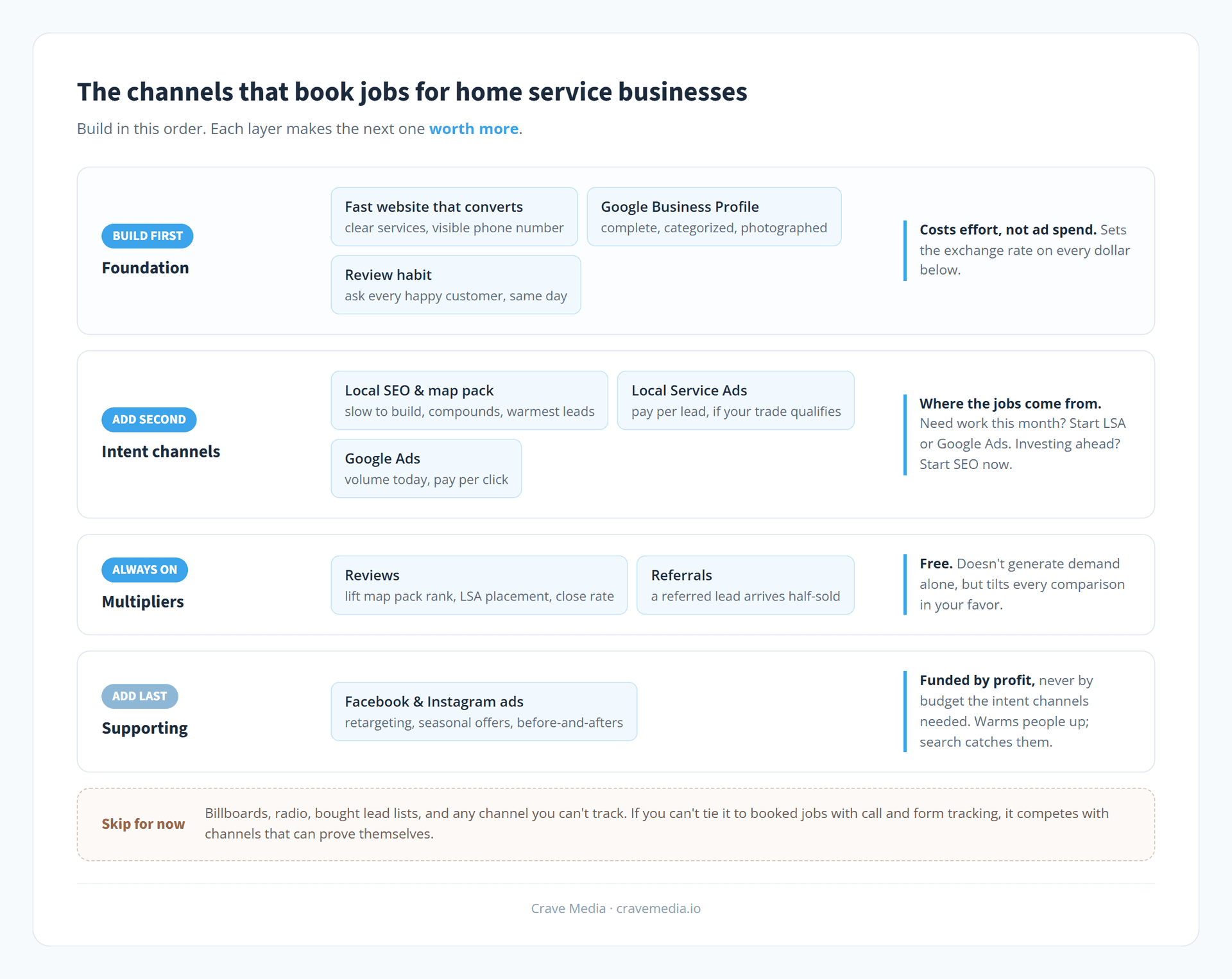
The build order that works for home service marketing: foundation first, intent channels second, multipliers always, interruption channels last, and only once the rest is producing.
Reviews and referrals multiply everything
Reviews are a multiplier on every channel you run. They move your map pack ranking, your Local Service Ads placement, and the close rate on every person who compares you against two competitors before calling. A business at 4.8 stars with 300 reviews wins ties against one at 4.2 with 40, over and over.
The good news is this one is free. It just takes a consistent habit of asking every happy customer, ideally the same day the job wraps. We laid out a system for it in how to get more Google reviews without breaking the rules. Referrals work the same way: a simple thank-you and a reason to pass your name along outperforms most paid awareness spend, because a referred lead arrives half-sold.
Where Facebook and Instagram fit
Social ads are the most misunderstood channel in home services. They rarely work as your primary lead source, because you're interrupting people who weren't looking, and those leads run colder and close less often. Judged purely on cost per booked job, they usually lose to search.
They earn a supporting role instead. Retargeting people who visited your site, staying visible in your service area between projects, promoting a seasonal offer, showing off dramatic before-and-afters for visual trades like roofing, painting, or landscaping. Treat social as the channel that warms people up and search as the channel that catches them when the problem hits.
The order we'd build it in
Put together, the sequence looks like this. Start with the foundation: a fast site that converts and a complete Google Business Profile, plus the review habit from day one. Those cost mostly effort and make everything after them work better.
Then add an intent channel based on your situation. If you need jobs this month, that's Local Service Ads if you're eligible, or Google Ads if you're not. If you can invest ahead, start the local SEO work early, because the clock on that only starts once you begin. Most established businesses end up running search ads and SEO together, using ads to fill the gaps while the organic side compounds.
Social, and anything interruption-based, comes last, funded by profit from the channels above, never by budget those channels needed. And any channel you run, track it with real call and form tracking, so next quarter's budget goes to what booked jobs instead of what felt busy.
Spend where the intent is
Home service marketing rewards businesses that fish where the fish already are. Be present when someone searches, look credible when they compare, convert them when they land, and let reviews tilt every close in your favor. Get that core producing before you spend a dollar interrupting strangers.
If you want a straight answer on which channels fit your trade and market, and where your current spend is leaking, our services cover the full stack and a free audit will show you exactly where you stand.

About the author
Zac Spencer is an online marketing specialist and the owner of Crave Media, based in Salt Lake City, Utah. Since 2013 he has managed hundreds of Google Ads accounts across dozens of industries — with budgets from a few hundred dollars to $250K a month — and run SEO for local businesses, ecommerce shops, and international franchises.