
Strategy · August 7, 2026
SEO vs Google Ads vs LSA: where home services should spend

By Zac Spencer · Owner, Crave Media
Three channels, one budget
If you run a plumbing, HVAC, roofing, or any other home service company, the three channels competing for your marketing dollars are SEO, Google Ads, and Local Service Ads. All three put you in front of people searching for what you do. All three work. And almost every owner we talk to is funding the wrong mix for where their business is right now.
The SEO vs Google Ads vs LSA question doesn't have a single answer, but it has a knowable one for your situation. It comes down to three things: how fast you need the phone to ring, whether your trade qualifies for LSA at all, and how much you can spend per month without sweating. This post walks through what each channel does best, then gets specific about splits at different budget levels.
What each channel is built to do
Local Service Ads are the pay-per-lead channel. You don't pay for clicks, you pay when someone contacts you through the ad, and the Google Guaranteed badge does real work on trust. For eligible home service trades, LSA leads usually come in cheaper than anything else you can buy. We compared the numbers in LSA vs Google Ads, where one client's account generated 283 LSA leads against 176 from traditional PPC. The catch is control and ceiling: you can't pick keywords, you can't write the ad, and in most markets LSA volume tops out well before your growth goals do.
Google Ads is the reach-and-control channel. It costs more per lead than LSA, but it takes budget as fast as you can supply it, targets exactly the searches you want, and works for every trade, including the ones LSA doesn't cover. When a new service line needs to ramp this month or a competitor is eating your branded searches, Google Ads is the lever you pull.
SEO is the only one of the three that builds an asset. Rankings, reviews, and content keep producing after the work is paid for, which is why the math looks bad at month three and great at month eighteen. One client's site now pulls 3.41 million impressions and 64,800 clicks a year from organic search, traffic that would take more than most companies' entire marketing budget to replace with paid clicks. The tradeoff is time: as we laid out in how long SEO takes, the first few months are all work and no results, and no reputable SEO company can shortcut that curve.
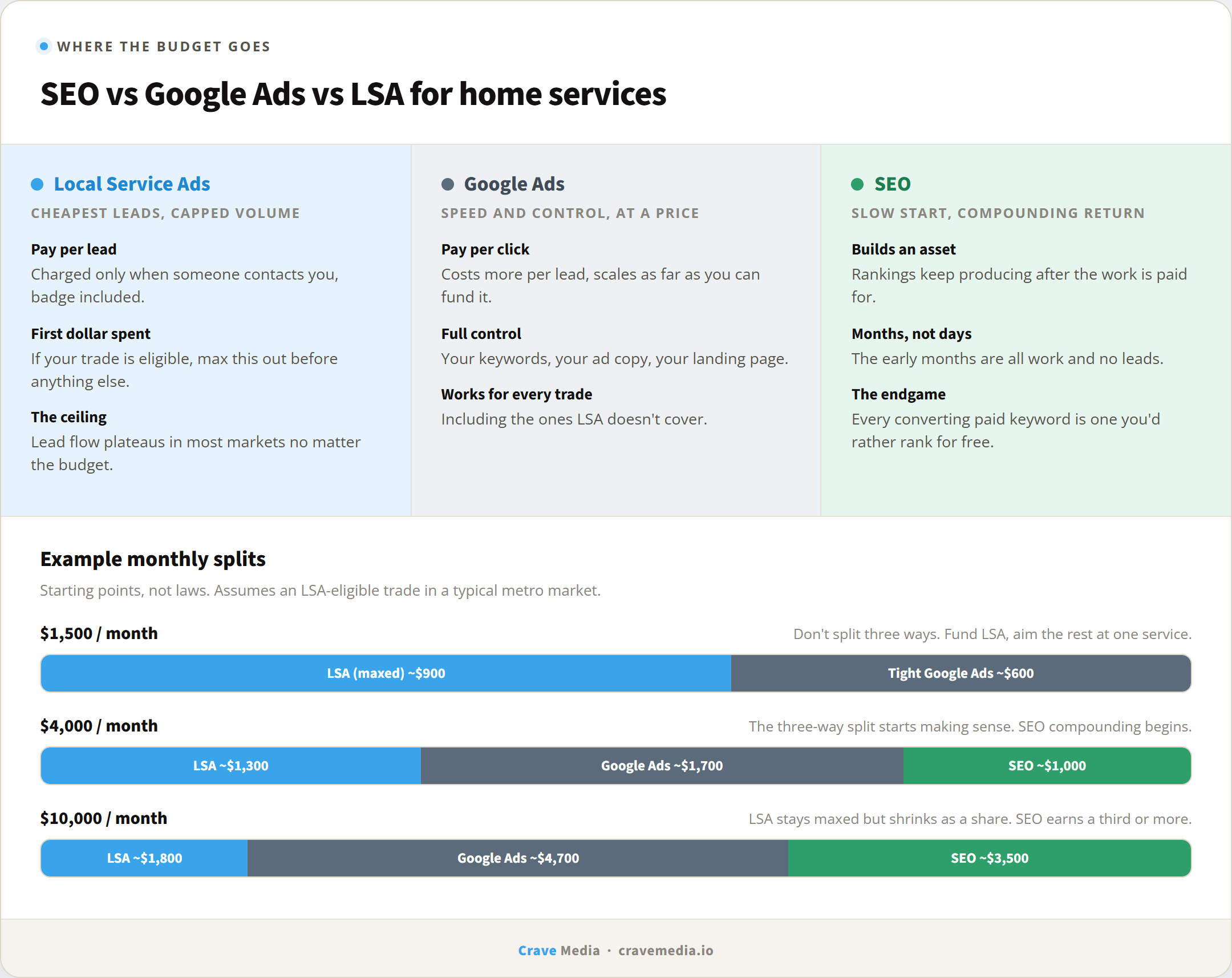
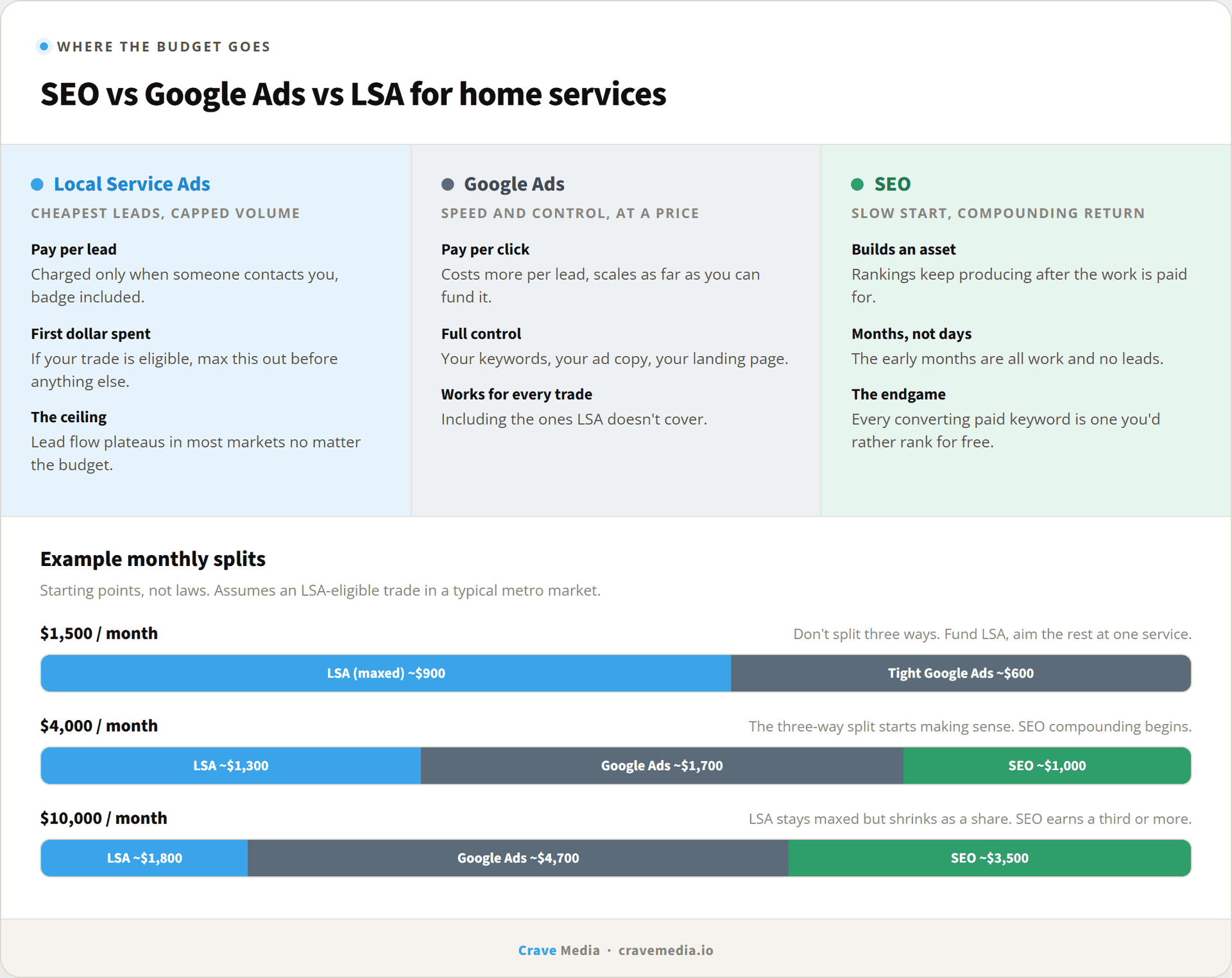
The three intent channels side by side, and how the split shifts as the monthly budget grows.
The eligibility question comes first
Before any budget math, check whether LSA exists for you. Google runs it for a specific list of home service categories, and getting live means passing background checks, licensing verification, and insurance documentation, the process we covered in our Google Guaranteed walkthrough. Plumbers, electricians, HVAC, garage door, roofers, locksmiths: generally yes. Specialty trades and newer service categories: often no.
If you're eligible, LSA is almost always the first dollar you spend, because the cost per lead is the lowest available and the setup cost is mostly paperwork. If you're not eligible, your decision simplifies to Google Ads for speed and SEO for the long game, and you can skip the three-way math entirely.
Example splits by budget
These are starting points, not laws. Adjust for your market's competitiveness and how full your schedule already is.
Around $1,500 a month, don't split three ways. Thin budgets spread across every channel produce three underfunded campaigns and zero momentum. Max out LSA first, since it only charges when a lead arrives, and put whatever it can't absorb into a small, tightly targeted Google Ads campaign on your highest-value service in your closest zips. SEO at this level means doing the free fundamentals well: a fast site, a complete Google Business Profile, and a steady flow of reviews.
Around $4,000 a month, the three-way split starts to make sense. Keep LSA fed to its natural ceiling, which in most metro markets lands somewhere in the $1,000 to $2,000 range before lead flow plateaus. Run Google Ads at a level that can actually compete, usually at least $1,500 in ad spend. Start real SEO with the remainder. This is the stage where the businesses that end up dominating their market three years later quietly begin the compounding work while their competitors stay 100% paid.
At $10,000 a month and up, the logic flips. LSA stays maxed but becomes a small slice of the total. Google Ads expands into every profitable service line and neighboring service area. And SEO deserves a third or more of the budget, because at this spend level you are buying enough paid traffic to know exactly which keywords convert, and every one of them is a keyword you'd rather rank for free. The endgame, which we described in Google Ads vs SEO, is paid ads as the accelerator, organic as the engine.
Reading your own numbers
Whatever split you run, judge it on cost per lead and cost per booked job, tracked per channel. LSA leads are cheap but some percentage are unbookable, and Google's dispute window matters. Google Ads leads cost more but you control exactly what they searched to find you. SEO leads look free on a report and aren't, since the content and links were paid for months earlier.
The mix should drift over time, and the drift has a direction: paid channels fund the present, SEO buys down your future cost per lead. If your split looks the same in year three as it did in month one, you're probably renting all of your leads and building nothing.
Where we'd start if it were our money
Eligible for LSA? Turn it on first and max it. Need more volume than LSA gives you? Add Google Ads next, sized to compete in your market. Planning to still own this company in five years? Get SEO started before you feel ready, because the timeline doesn't care when you start feeling ready.
If you want a specific recommendation for your trade, market, and budget instead of ranges, request a free audit and we'll show you where your current spend is going, what each channel would cost you locally, and the split we'd run in your position.

About the author
Zac Spencer is an online marketing specialist and the owner of Crave Media, based in Salt Lake City, Utah. Since 2013 he has managed hundreds of Google Ads accounts across dozens of industries — with budgets from a few hundred dollars to $250K a month — and run SEO for local businesses, ecommerce shops, and international franchises.