
Google Ads · November 17, 2026
Performance Max for local service businesses, honestly

By Zac Spencer · Owner, Crave Media
Sooner or later, a Google rep calls about Performance Max. Or the Recommendations tab keeps nudging you toward it, with a little score that goes up if you click "Apply." For a local business, the pitch sounds great. One campaign, every Google surface, and Google's AI finds the customers for you.
Sometimes that's true. More often, in the home service accounts we audit, a Performance Max campaign is spending a third of the budget and the owner can't say which calls it produced. Our position is firm: run Search first, and add PMax only after your conversion tracking counts real leads. By real we mean a call long enough to be a conversation, or better, a lead your office marked as booked. A form fill from a stranger in another state doesn't qualify, and neither does a 12-second call.
It's also about to become harder to avoid. Local Service Ads are moving into Google Ads as Performance Max campaigns, so plenty of plumbers and HVAC companies will have "Performance Max" in their account next year whether they asked for it or not. That's covered near the end, because it's a different animal from the PMax a rep is selling.
What Performance Max is, in plain English
A Search campaign shows text ads when someone types a search you chose keywords for. You decide the words, the bids follow your rules, and you can read every search that triggered an ad.
Performance Max works the other way around. You hand Google your goal, your budget, a pile of headlines, images and videos, and some "signals" about who your customers are. Google decides where the ads run: Search, Maps, YouTube, Display sites, Gmail, Discover. It decides which searches to show up for, too, and how to split the money between all of them. Your job is to supply the parts and tell it what counts as a win.
That last part is where local accounts go wrong. PMax chases whatever you've labeled a conversion, as hard as your budget allows. Tell it a contact form submission is a win and it will find you contact form submissions, from anywhere, at the lowest price it can. It has no way of knowing whether any of those people wanted their furnace fixed.
Performance Max vs search campaigns
PMax used to be a black box. It's less of one now, and the honest comparison has to say so.
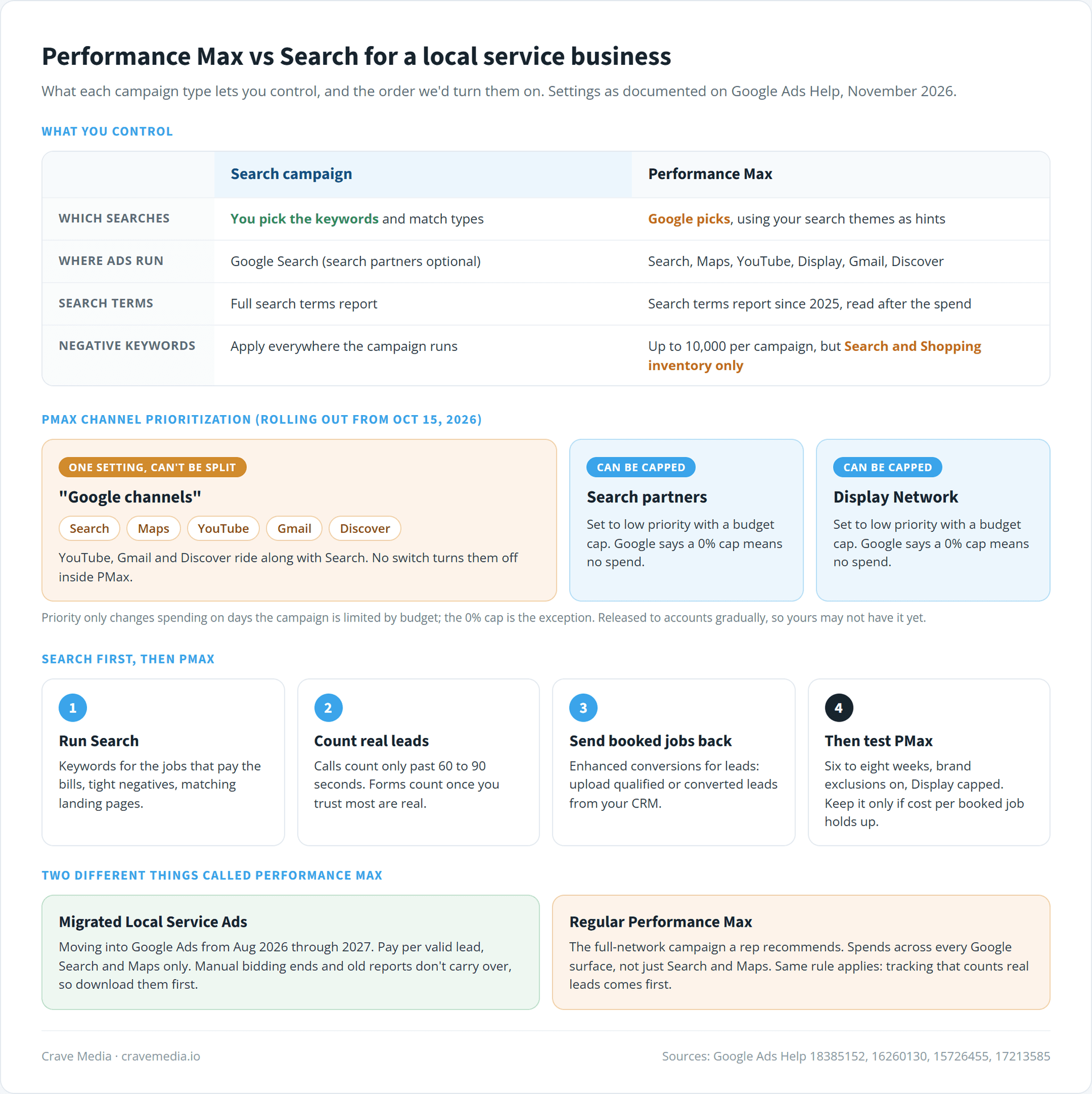
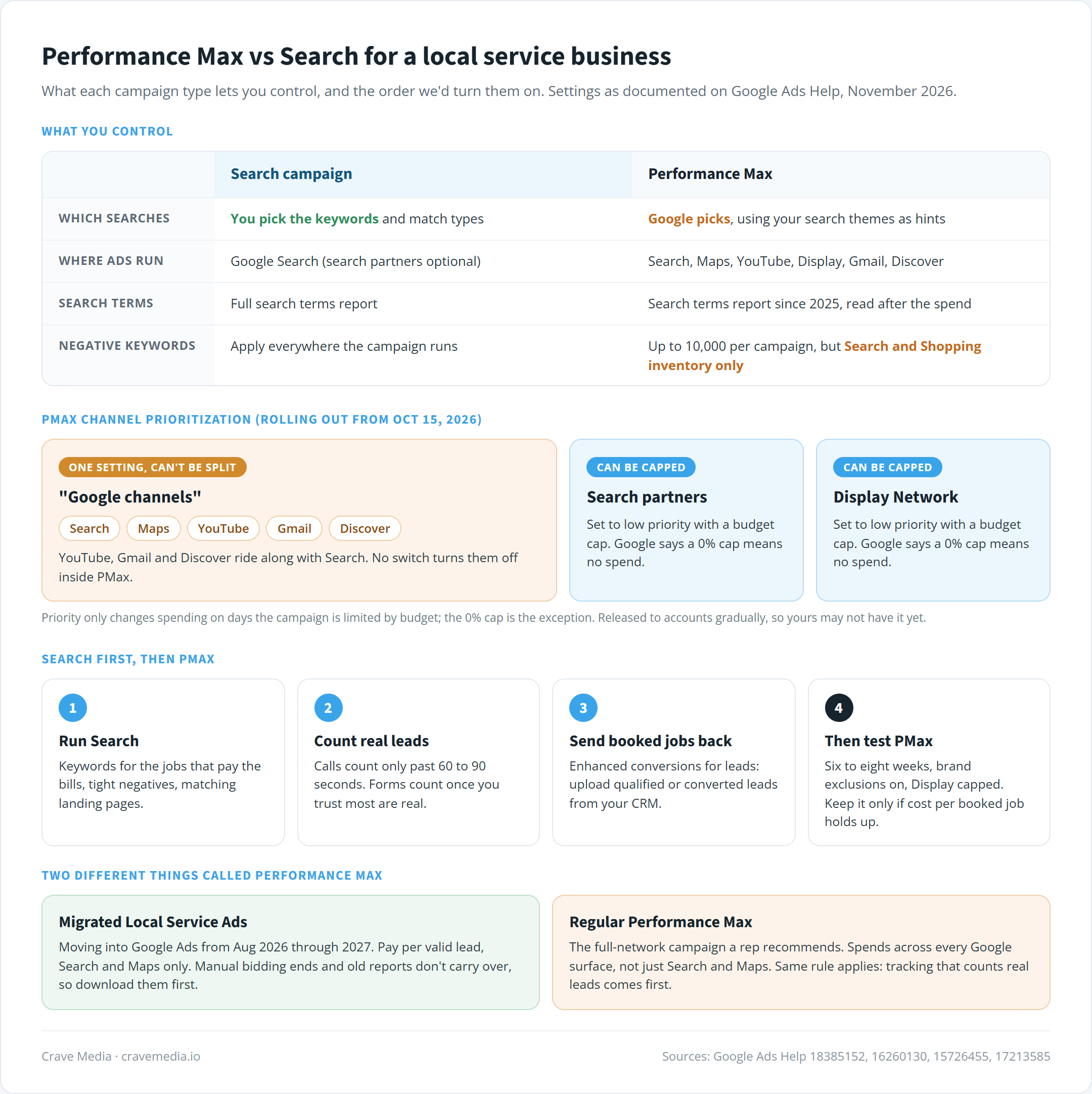
In April 2025 Google announced channel performance reporting for PMax, along with search term reporting at "the same granularity" as Search campaigns. Both are live. The channel performance report splits results across Search, Display, YouTube, Discover, Maps, Gmail and search partners, with data going back to June 6, 2025. The search terms report for PMax sits under Campaigns, then Search terms report. Negative keywords arrived in 2025 too, up to 10,000 per campaign, and we walked through that change in our negative keywords guide. Brand exclusions keep PMax off searches for brands you pick from Google's brand list, and you can request your own business be added if it isn't there.
So you can see more than you could two years ago. You still can't steer it the way you steer a Search campaign, and two gaps hurt local businesses most.
You can't turn YouTube off
Google rolled out channel prioritization starting October 15, 2026, and it's being released to accounts gradually, so yours may not have it yet. It lets you mark channels high or low priority. For Performance Max, though, there are only three channels to set: "Google channels," search partners, and the Display Network. Search, YouTube, Maps, Gmail and Discover all sit together inside "Google channels."
The Display Network and search partners can be set to low priority and given a budget cap, and Google says a 0% cap means it won't spend there. YouTube, Gmail and Discover can't be separated from Search. Google also notes the priority settings don't change spending when the campaign isn't limited by budget. If you want your money on Search and only Search, a Search campaign is still the only way to guarantee it.
Your keywords are hints, and negatives stop at Search
In Search you pick the exact searches you'll pay for. PMax takes "search themes" as hints and decides on its own, so the search terms report is something you read after the money is spent. And Google's PMax negative keyword page says those negatives apply to Search and Shopping inventory only. Your "jobs" and "DIY" negatives do nothing once the ad is running inside a mobile game.
Where PMax wastes a local budget
The pattern we see most is junk leads from outside Search. Form submissions arrive from the Display and YouTube side with fake names, wrong numbers, or people who don't remember filling anything out. Some are bots. Some are real people who tapped an ad in a game by accident. Every one of them counts as a conversion, and the campaign learns to buy more of them. That's our observation from audits, not a Google figure, but it shows up often enough that it's the first thing we check when a client's cost per lead looks great and the phone is quiet.
Brand traffic leaks too. Someone who already knows your name searches it, PMax shows up first, and the campaign books the credit for a customer you'd have gotten for free from the listing right under the ad. Brand exclusions fix it. Plenty of older PMax campaigns never had them added.
Then there's volume. A Bountiful plumber spending $2,500 a month doesn't give PMax much to learn from once the money is split across six surfaces. Google's machine learning needs conversions to work with, and a small budget stretched thin produces slow, noisy learning. Google doesn't publish a hard minimum. In our experience, an account with fewer than a few dozen real conversions a month is better off putting that money into Search, where the keywords do the targeting the algorithm can't yet.
Search first, then PMax
For a West Jordan HVAC company starting from zero, we'd build it in this order.
First, a Search campaign on the services that pay the bills: furnace repair, AC repair, replacement. Tight keywords, solid negatives, ads that send people to a matching landing page.
Second, tracking that counts real leads. Calls get tracked and counted as conversions only when they run past 60 or 90 seconds, which filters out wrong numbers and robocalls (our call tracking guide covers the setup). Forms count only after you've watched a few weeks of them and trust that most are real.
Third, and this is the step most accounts skip, feeding booked jobs back into Google. Google's enhanced conversions for leads lets you upload which leads turned into qualified leads or paying customers from your CRM or a spreadsheet, and Google's own guidance is to pick the qualified or converted lead as your goal. Once Google sees which clicks turned into a new furnace and which went nowhere, its bidding can tell the difference.
Only then does PMax get a test, with a budget you can afford to lose for six to eight weeks, brand exclusions on, account-level negatives in place, and the Display Network set to low priority with a 0% cap if your account has the new control. Judge it on cost per booked job against the Search campaign, the same way we score every channel. If it can't beat Search or bring in extra jobs Search wasn't reaching, it goes.
Run PMax before tracking is real and you're paying Google to get very good at the wrong thing. It's the same trap we described with Smart campaigns, with a bigger budget behind it.
Performance Max vs search campaigns: what each one lets you control, and the order we'd turn them on.
When PMax earns a spot
There are accounts where we'd run it. The common thread is that the basics are already done.
- Search campaigns are already capturing most of the searches in your area, and you have budget left over.
- Booked-job data flows back into Google Ads, so the algorithm learns from jobs you got paid for.
- The account produces enough real conversions each month for the bidding to learn from.
- You have real photos and a short video of your crew, so the ads on YouTube and Display don't run on stock images and Google-generated filler.
PMax home services campaigns also tend to make more sense for trades with a visual product, like remodeling, landscaping, or pools, where a YouTube or Discover ad can plant an idea months before anyone searches. A water heater that died this morning gets searched. A backyard remodel gets daydreamed about.
The LSA migration puts PMax in your account anyway
If you run Local Service Ads, Google is moving them into Google Ads. Its transition notice says the move started in August 2026 for US categories like plumbing, HVAC, electrical, roofing, pest control, and house cleaning, broadens later this year, and reaches other countries and categories in 2027. The new campaigns are labeled Performance Max with pay-per-lead goals.
Same name, different product. Google says you still pay only for valid leads and the ads still show only on Google Search and Maps. No YouTube, no Display. What changes is how you manage it: manual bidding goes away, your weekly budget becomes a daily average, and your old performance reports don't come with you. Download them first. We covered what that does to your bid and ranking in our breakdown of LSA ranking factors.
The risk is a mental one. Once "Performance Max" is sitting in your account and producing leads, the next recommendation to add a regular Performance Max campaign looks like more of the same. It isn't. That one is the full-network version this post is about, and the same rule applies to it.
Prove the lead before you automate it
Most of the PMax trouble in this post traces back to one thing, the campaign believing a bad lead was a good one. Fix what Google counts as a lead and PMax becomes one more campaign you score against Search, kept or cut on the numbers. Leave it broken and the smartest bidding system Google has will spend your budget finding more of the wrong people, very efficiently.
If you're not sure what your account is counting as a conversion right now, that's the first thing we look at. Our Google Ads management starts with tracking before any campaign type changes. Or request a free audit and we'll show you where your current PMax or Search spend is going, channel by channel, and how much of it turned into booked work.

About the author
Zac Spencer is an online marketing specialist and the owner of Crave Media, based in Salt Lake City, Utah. Since 2013 he has managed hundreds of Google Ads accounts across dozens of industries — with budgets from a few hundred dollars to $250K a month — and run SEO for local businesses, ecommerce shops, and international franchises.