
Websites · November 20, 2026
How to write a service page that ranks and gets calls

By Zac Spencer · Owner, Crave Media
The phone rings at an Ogden plumbing shop. "My water heater's leaking. Do you replace them, do you come out to Roy, what's it going to cost, and how soon can somebody get here?" Whoever answers has heard that call a few hundred times and can handle it in two minutes without thinking.
Good service page SEO comes down to writing that call down. The page should answer the same questions, in the same order, in the same plain words the person on the phone uses. Most service pages we audit do something else. They open with a paragraph about the company's values, list a dozen services in bullets, and end with "contact us today." Google has a hard time telling what that page is about, and a homeowner with water on the garage floor has an even harder time.
Why each service needs its own page is covered in the five pages every local business website needs. This post is about what goes on one of those pages, and the example the whole way down is an Ogden water heater replacement page.
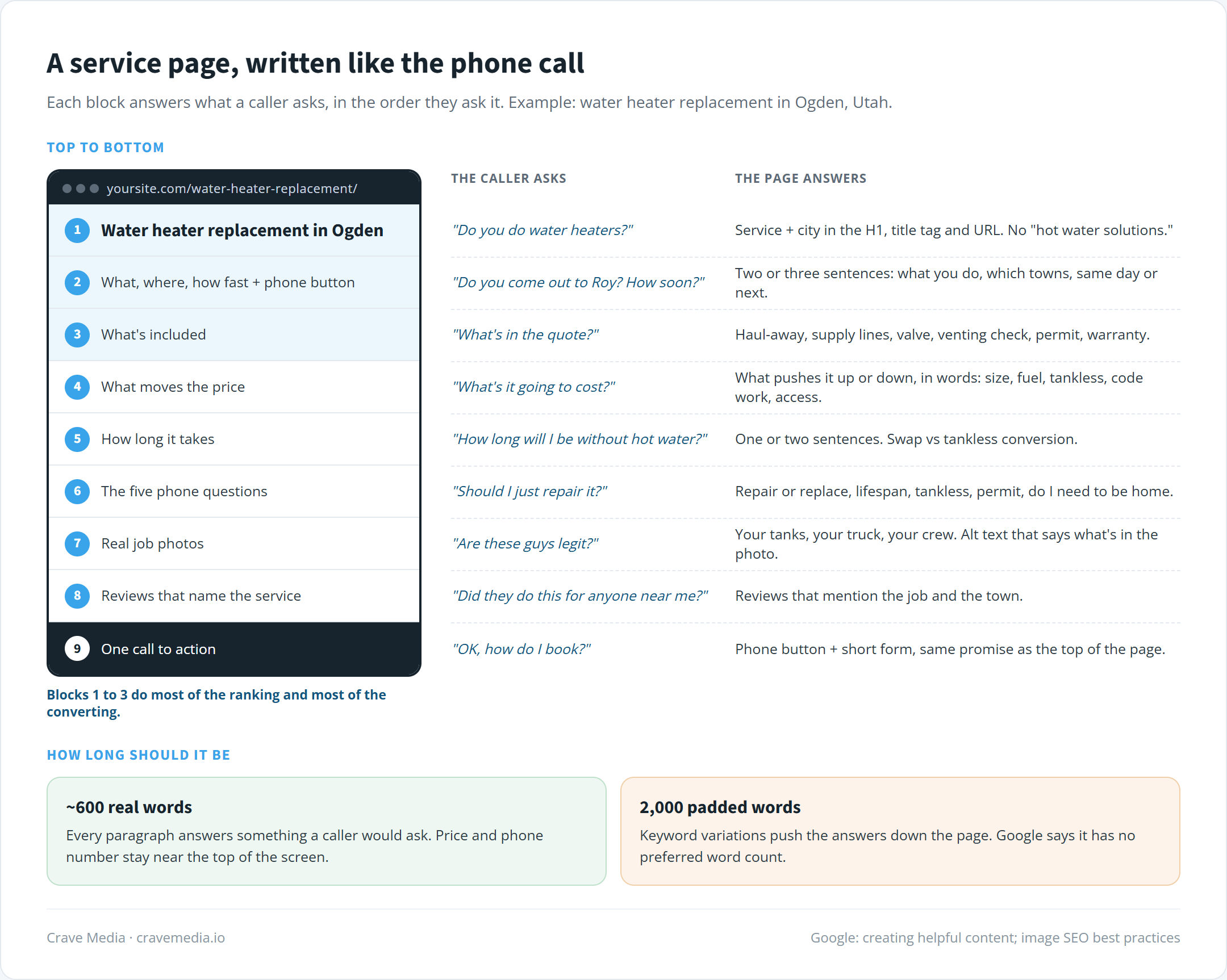
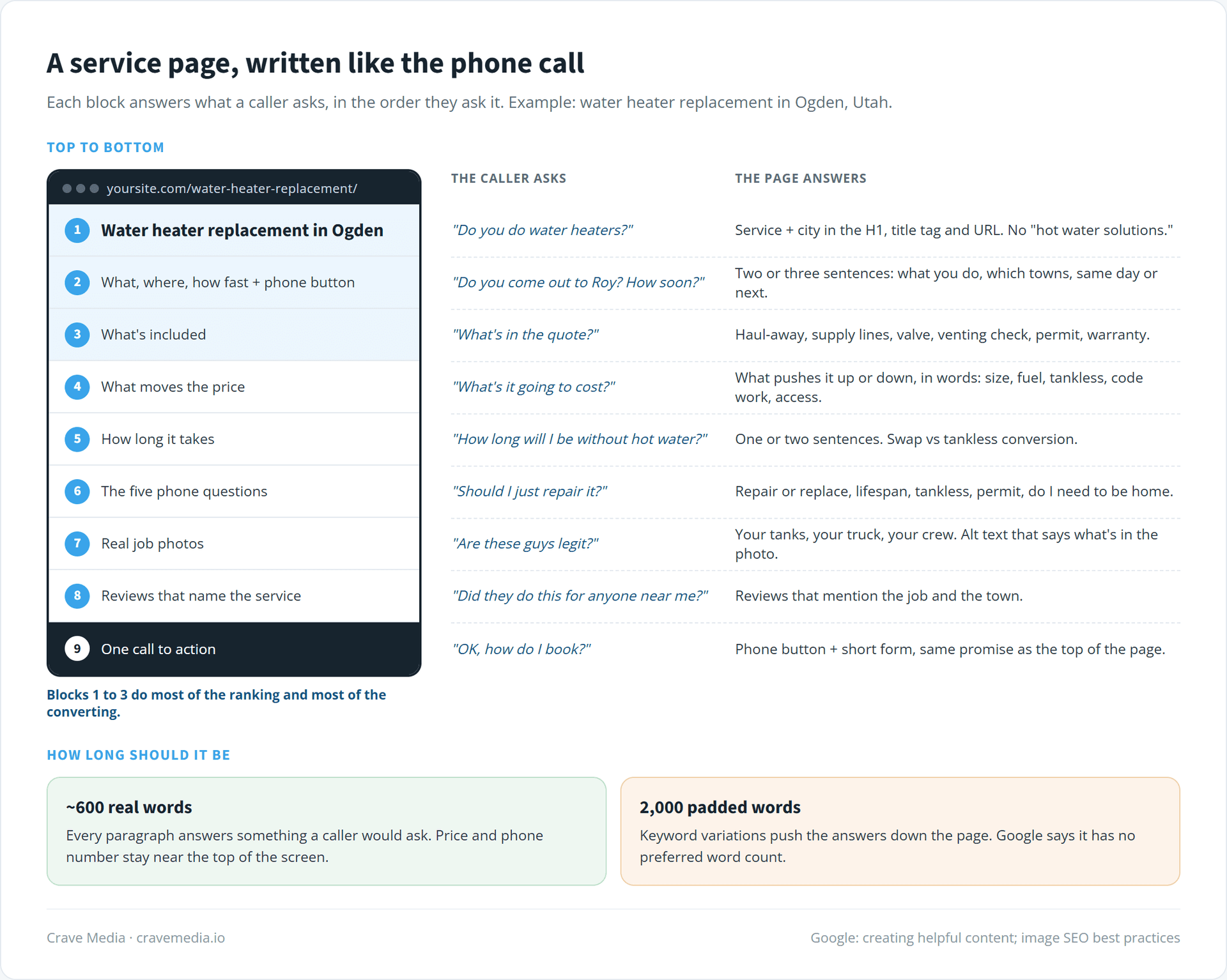
A service page template for a local business, in the order a customer asks on the phone. The top three blocks do most of the ranking and most of the converting.
Service page SEO starts with the H1
The H1 and the page title should say what the page is about and where. "Water heater replacement in Ogden" is a good H1. "Hot water solutions" isn't, and neither is "Our plumbing services," because nobody searches for either.
Keep the URL just as plain: /water-heater-replacement/ or /ogden/water-heater-replacement/ if you run pages per city. If you serve Ogden, Roy, Layton and Clearfield from one shop, one page with the main city in the H1 and the others named in the copy is usually enough to start. Separate city pages only earn their place when you have something different to say about each town.
Answer the question in the first paragraph
This is the part of the page we rewrite most often, and the part with the most riding on it.
The first two or three sentences under the H1 should tell someone what you do, where you do it, and how fast you can get there. For the Ogden page, that might read:
We replace gas and electric water heaters, tank and tankless, across Ogden, Roy, Layton and the rest of Weber and Davis counties. Most replacements are done the same day or the next morning, and if yours is leaking now, call and we'll tell you how to shut it off while the truck is on the way.
That's three facts and one useful instruction in about fifty words, and a homeowner knows within five seconds whether they've landed in the right place. It also gives Google and the AI answers something plain to quote, since those increasingly lift a sentence or two straight off the page. We made the same point in what AI search changes about local SEO: service pages that lead with what, where, cost and speed are easier for people and machines to read. Notice that the paragraph says nothing about family values or being "your trusted partner." Save the history for the about page.
Put the phone number and the main button right under that paragraph, too. Some people decide on the spot.
What's included
Next, say what the job covers. Homeowners shopping for a water heater are comparing quotes, and the cheapest one often leaves things out. Spell out what yours includes: hauling the old tank away, new supply lines and shutoff valve, checking the gas line and venting, the permit if the city requires one, and how long the parts and labor warranty runs.
A short bulleted list works pretty well here, because it's genuinely a list. Keep each line to what a customer would recognize. "Disposal of old unit" is clear. "Comprehensive end-to-end installation service" says nothing.
What moves the price
Every caller asks what it costs, and most service pages dodge the question. That's a mistake, both for rankings and for calls. People search "water heater replacement cost Ogden" constantly, and a page that never mentions cost gives Google nothing to match.
You don't have to publish a price list. Explain what makes the number go up or down, in words. For a water heater page, that's things like:
- Tank size and fuel type. A like-for-like 50-gallon gas swap is the simplest job you do.
- Switching from tank to tankless, which usually means new venting and sometimes a bigger gas line.
- Bringing the install up to current code, such as seismic straps, an expansion tank, or a drain pan, if the old one was installed without them.
- Location. A tank in an open garage is quicker than one in a finished basement closet behind a furnace.
- After-hours or weekend work, if you charge more for it.
Then, if you're comfortable, give a rough sense of scale: "a straight swap is usually the least expensive option, and going tankless usually costs a good deal more up front." If you do publish ranges, keep them honest and update them when prices change. Someone who calls because the page said one thing and hears another on the phone isn't going to book.
When we watch session recordings on client sites, a lot of visitors skip the top of a service page and scroll straight to the price section.
How long it takes
One or two sentences, set by what the customer cares about. "Most replacements take two to four hours once we're on site. Tankless conversions usually take most of a day." If the job means no hot water for a while, say so. If you can usually come same day, say that too, since it's often the reason someone calls you over the next result.
The five questions people ask on the phone
Ask whoever answers your phones what callers ask about this service. You'll get the same handful every time. For water heater replacement, they tend to be:
- Should I repair it or replace it?
- How long do water heaters last?
- Is tankless worth it here?
- Do you handle the permit?
- Do I have to be home?
Answer each one in two to four sentences on the page, in your own words. Short, direct answers to real questions are what a person reads before calling and what search engines tend to pull into answers.
Don't add these just for the search snippet. Google stopped showing FAQ rich results in May 2026, per its FAQ structured data documentation, so the little dropdowns under your listing are gone no matter what markup you add. The questions still belong on the page. They're what people want settled before they pick up the phone, and answering them is half of what your office staff does all day anyway.
Photos and reviews that prove it
Stock photos of a smiling plumber holding a wrench don't prove anything. Real job photos do: the new tank strapped in, the old corroded one on the dolly, your truck in front of a house a neighbor would recognize. Google's image SEO guidance says it uses alt text along with the page content to understand an image, and asks that images sit near the text they relate to. So put the water heater photos on the water heater page, next to the section they illustrate, with alt text that says what's in the picture ("new 50-gallon gas water heater with seismic straps in an Ogden garage").
Reviews work the same way. A five-star review that says "great service" helps a little. A review that says "they replaced our water heater in Roy the same afternoon it started leaking" helps a lot, because it names the service and the town and answers the speed question at once. Pull two or three of those onto the page. If you don't have any yet, start asking customers after each water heater job to mention what you did for them. Our post on getting more Google reviews covers how to ask without it feeling awkward.
One call to action
End the page with one clear next step. For a water heater page, that's usually a phone button and a short form, with the same wording and the same promise as the top of the page ("Call now, or tell us what's going on and we'll call you back within the hour").
What you don't want is five competing asks: call us, email us, download our guide, follow us on Facebook, sign up for the newsletter. Every extra option is a reason to leave without doing any of them. We go deeper on this in what a high-converting local business website looks like.
Why 600 real words beat 2,000 padded ones
We'd take a 600-word service page that answers the call over a 2,000-word page stuffed with keyword variations, on any client site, without much debate.
The long page usually exists because someone heard Google likes long content. Google says otherwise. Its guidance on helpful, people-first content asks, "Are you writing to a particular word count because you've heard or read that Google has a preferred word count?" and answers its own question: "No, we don't."
Padding has a real cost. Each extra paragraph about "quality water heater solutions in the greater Ogden area" pushes the price section and the phone number further down the screen. The customer with a leak won't dig through that. They'll hit the back button and call the next result.
Six hundred is a rough figure. If the questions customers ask about a service take 900 words to answer properly, write 900. The test is whether each paragraph answers something a real caller would ask. If you can't picture someone asking it, cut it.
Answer the call before it rings
Before anyone writes a word, sit down with your office manager for twenty minutes and get the questions they hear about your best-paying service, and how they answer them. Write those answers down in the order callers ask. That's most of the page already, and it's the version Google and the customer with a leaking tank both understand. Do that service first, then the next one.
If your current service pages read more like brochures than phone calls, a free audit will show which ones are holding you back and which searches you're missing. And if it's easier to have someone build them, our site building service writes service pages this way from the start.

About the author
Zac Spencer is an online marketing specialist and the owner of Crave Media, based in Salt Lake City, Utah. Since 2013 he has managed hundreds of Google Ads accounts across dozens of industries — with budgets from a few hundred dollars to $250K a month — and run SEO for local businesses, ecommerce shops, and international franchises.