
SEO · October 9, 2026
What AI search changes about local SEO, and what it doesn't

By Zac Spencer · Owner, Crave Media
The question we hear most from SEO clients this year is some version of "do I need to start doing AI SEO now?" It usually follows something specific. An AI Overview started answering the question their best blog post used to rank for, or a cold email showed up selling "generative engine optimization" as its own monthly package.
Short answer: the work you're paying for still counts. AI search changes local SEO in a handful of places and leaves the core alone, and the biggest change for most owners is in how the monthly report should read.
If you want the deeper look at how ChatGPT and Google's AI pick which businesses to name, our sister site covers that in AI search vs Google search for local businesses. This post stays on the SEO side.
Where AI answers show up in local search
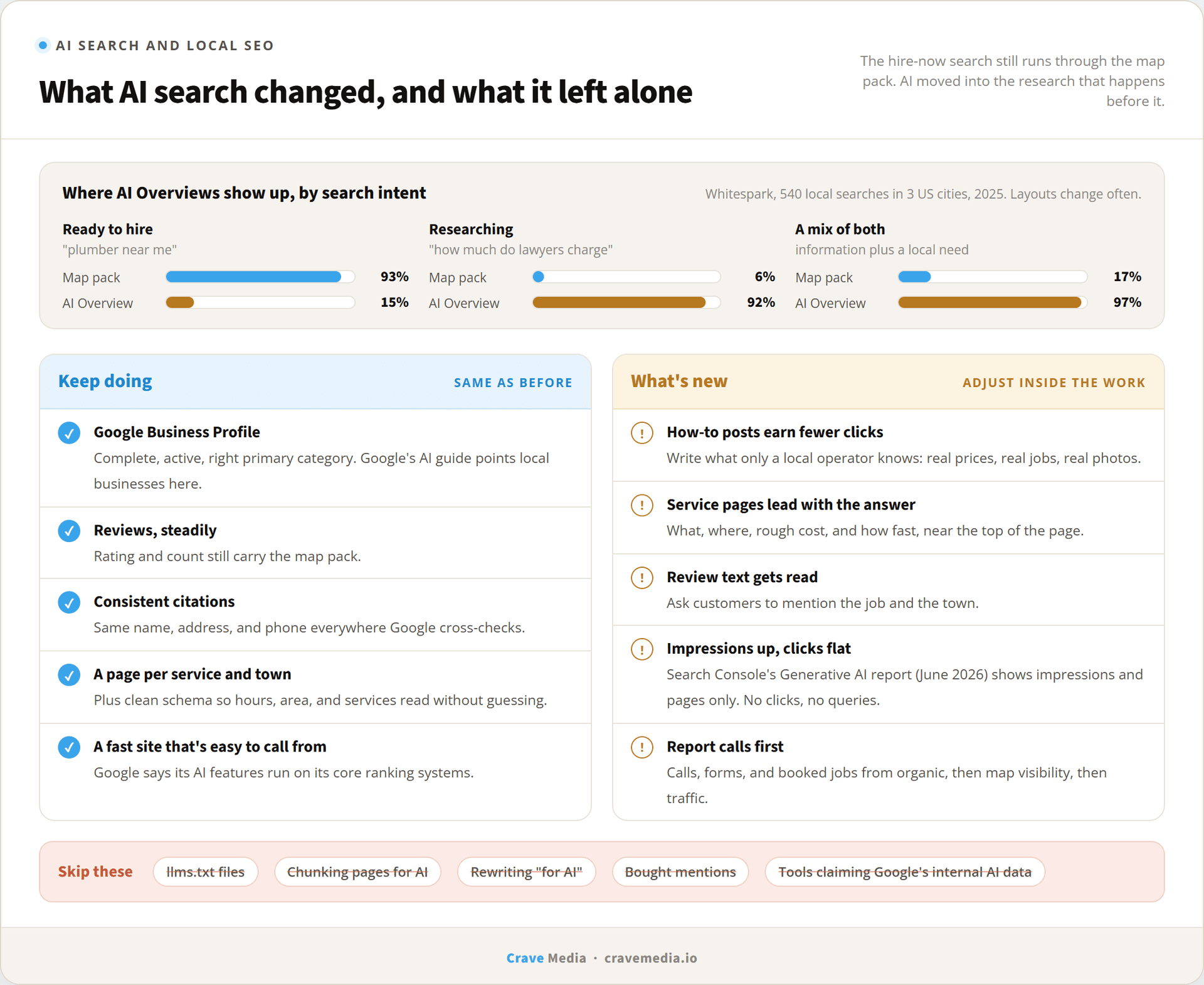
AI answers don't land evenly. Whitespark ran 540 local searches across Houston, Phoenix, and Denver in 2025 and found a sharp split by intent. On searches like "plumber near me," the map pack showed up 93 percent of the time and an AI Overview just 15. On informational searches like "how much do lawyers charge," it flipped: AI Overviews on 92 percent, the map pack on 6. Searches mixing the two got an AI Overview 97 percent of the time.
That study is more than a year old, and Google rearranges these layouts constantly, so hold the exact numbers loosely. The shape matches what we see. When someone is ready to hire, Google mostly hands them the map and your Business Profile. The research a week earlier, what's wrong and what it'll cost, is where the AI moved in.
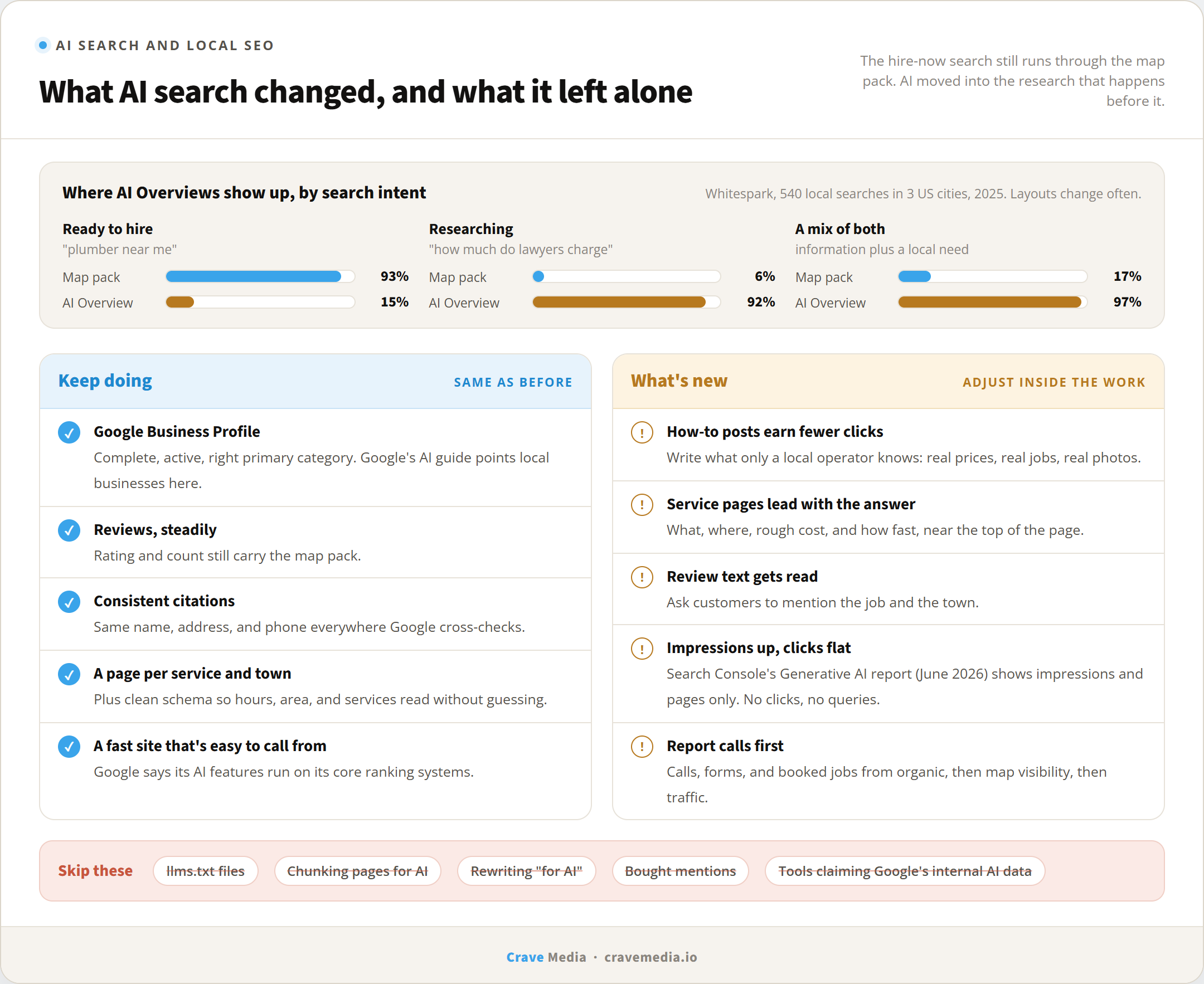
What AI search changes about local SEO: the map pack still owns hire-now searches, and the adjustments happen inside the same local SEO work.
What stays the same
Google has been unusually direct about this. Its guide to optimizing for generative AI features, updated in July 2026, says those features are "rooted in our core Search ranking and quality systems" and that SEO best practices still apply. It points local businesses to their Business Profile. It also says Google Search ignores llms.txt files, and that you don't need to chop pages into chunks or rewrite them "for AI."
So the local SEO list hasn't changed:
- A complete, active Google Business Profile with the right primary category
- A steady pace of reviews from real customers
- The same name, address, and phone across the directories and citations Google cross-checks
- One real page per service, and per town where it makes sense
- Clean schema markup so machines read your hours, area, and services without guessing
- A site that loads fast and is easy to call from
All of it still drives the map pack, and it's what Google's AI pulls from when it writes about a local business. One of our clients grew organic traffic 423 percent year over year on that list.
If your SEO is done right, you don't need a second vendor selling AI visibility as a separate product. When someone pitches an llms.txt file with a monthly retainer attached, Google's own documentation says the file does nothing for Google Search. Ask what else you'd be paying for.
What changes
None of this needs a new budget line. It changes where effort goes inside the work you already do.
Informational posts earn fewer clicks
The post that ranked for "why is my furnace short cycling" used to bring in visitors. Now an AI Overview often answers that on the results page, and fewer people click. The ones who do tend to be further along.
Keep writing, but write what an AI summary can't assemble from ten other sites. Google's guide calls it "non-commodity content." For a local business that means your real price ranges, the jobs you see most in your area, a photo of the corroded flue from last week's call in Sandy, and an honest call on when to replace instead of repair from someone who does it for a living. Generic how-to posts were already a weak bet. They're weaker now.
Service pages need the answer up top
A service page that opens with three paragraphs of family history and buries the service area in the footer is hard for anyone to quote. Put what you do, where, roughly what it costs, and how fast you can get there near the top. We've been reordering client service pages this way all year, and we'd do it even if AI didn't exist, because people skim too. Our list of the pages a local business website needs covers what belongs on each.
Reviews get read
Star rating and count still carry the map pack. AI answers sometimes go further and summarize what reviewers say, though Google doesn't publish how much weight review text gets. We now ask clients to request reviews that name the job and the town. "Fixed our AC in Bountiful the same afternoon" tells any reader more than "great service."
Your reports read differently
This is the change owners feel first, and the one we spend the most time explaining.
Appearances in Google's AI features have counted in your Search Console totals for a while, folded into the regular Web numbers. In June 2026 Google added a separate Generative AI performance report showing how often your pages appeared in AI Overviews and AI Mode, and which pages; it reached every site by the end of August. It shows impressions only. No clicks, and no list of the searches behind them.
A common pattern now is impressions climbing while clicks hold flat or dip on informational pages. That can look like SEO going backward. Often your page is showing up more, inside an answer people read without clicking, and the phone is ringing the same.
So we changed the order of our client reports. Calls, form fills, and booked jobs from organic search come first, counted by call tracking. Map pack visibility comes second. Clicks and impressions still appear, further down, with a note on which pages lost clicks to AI answers and whether that cost anything. If your SEO report still opens with traffic, ask for that order.
Search Console also added a setting to keep your content out of AI features. For a local service business, we'd leave that setting alone. Opting out won't bring the clicks back. It takes your name out of the answer.
What we check, and what we skip
Every month or so we search a few of each client's best questions in Google's AI Mode to see whether they're named and whether the details are right. When they're wrong, it's almost always a missing detail on the profile or the site, and that's a normal SEO fix.
We don't add llms.txt files, split pages into AI-sized chunks, buy "mentions," or pay for tools that claim to see inside Google's AI. Google's guide specifically warns about that last one and tells site owners to use the Search Console report instead. And none of it speeds up the clock. Local SEO still takes months to build.
Same work, new scoreboard
AI search moved the questions people ask before they call. It didn't move the hire. That still runs through the map pack, your profile, and a site that answers plainly, and the businesses AI names are mostly the ones already doing that well. What changed is how you keep score.
If you want help with that work, our local SEO service handles it and reports on calls first. Or request a free audit and we'll show you where your site appears in AI answers today, which pages are losing clicks to them, and whether it's costing you calls.

About the author
Zac Spencer is an online marketing specialist and the owner of Crave Media, based in Salt Lake City, Utah. Since 2013 he has managed hundreds of Google Ads accounts across dozens of industries — with budgets from a few hundred dollars to $250K a month — and run SEO for local businesses, ecommerce shops, and international franchises.